Leverage
A physical lever trades distance for force; it does not create energy. As a mental model, leverage means finding where a given effort or resource can have a larger effect. The useful comparison includes costs, alternatives, and risks—financial leverage, for example, magnifies losses as well as gains.
THE IDEA
GETTING MORE BANG FOR YOUR BUCK
The lever is a simple machine consisting of a bar that sits atop a fulcrum. Through the placement of the fulcrum, the lever amplifies a small force over a large distance to create a much larger force over a small distance. Think of how you might use a crowbar to open a locked door. Back in the third century B.C., Archimedes famously boasted of the powers of the lever, “Give me a place to stand and I shall move the Earth.”
Even before Archimedes, the followers of Aristotle—the Peripatetic school—described levers in their work Mechanica, noting how the greater the distance from the fulcrum, the more easily a weight will move. The word itself hints at this ease: its roots trace to the Proto-Indo-European legwh (light, agile, easy), the Latin levare (not heavy), and the Old French levier (to raise). In essence, leverage means making something light by raising it with a lever.
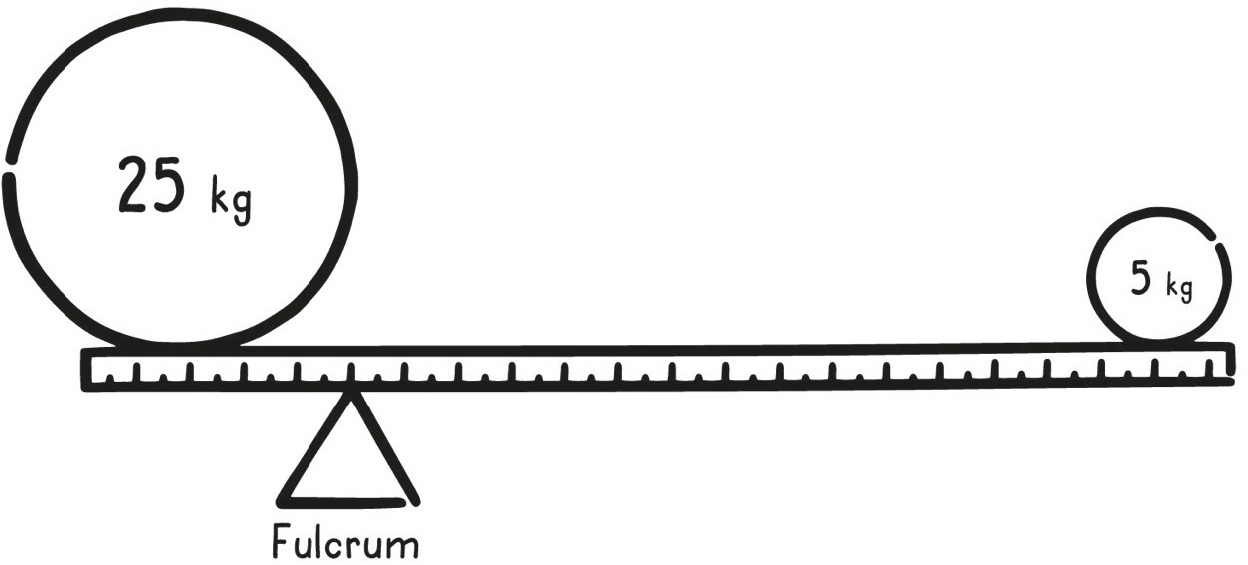
There are three basic physical arrangements of force, fulcrum, and weight:
- Force–Fulcrum–Weight, as with a crowbar.
- Fulcrum–Weight–Force, as with a wheelbarrow.
- Fulcrum–Force–Weight, as with a baseball bat—this arrangement requires greater applied force but moves the load through a greater distance and speed. It trades force for motion rather than creating or requiring extra work in an ideal lever.
Used to great effect for thousands of years, levers enable disproportionate strength. The ancient Egyptians leveraged them to lift stones weighing up to 100 tons to build pyramids and obelisks. Many everyday tools—scissors, pliers, door handles, wheelbarrows, fishing rods—are levers. They are among humanity’s simplest yet greatest inventions.
The mechanical advantage gained by a lever, also known as leverage, serves as the basis of a mental model applicable across a wide variety of situations. The concept can be useful in any situation where applying force or effort in a particular area can produce outsized results, relative to similar applications of force or effort elsewhere. Leverage is achieving results significantly greater than the force you put in.
In finance, leverage refers to borrowing money to purchase assets, which allows gains and losses to be multiplied. In this context, leveraging up means increasing debt, while deleveraging is the opposite. A leveraged buyout takes place when one company buys out another, partially using other people’s money. In all these financial situations, the small force is the amount of money you initially put up, allowing you to wield a much larger force through the greater sum of money you have available via the debt you take on. For example, individuals usually purchase homes with down payments much smaller than the total price. A down payment of 20 percent illustrates the arrangement; in the run-up to the 2007/2008 financial crisis, some buyers put as little as zero percent down! But by taking on debt, people get to live in the homes they want.
In negotiation, leverage refers to the power one side has over another. If you have the ability to give or take more things than the other party, you have more leverage. Even a modest source of bargaining power can matter, depending on the alternatives available to each side.
As applied to individuals, certain activities or actions have much greater leverage than others, and spending time or money on these high-leverage activities will produce the greatest effects. Therefore, you should take time to continually identify high-leverage activities. It’s getting more bang for your buck.
You can apply this model in all areas of your life. The highest-leverage choice might not be the best fit every time, but the option that provides the most impact at the lowest cost always warrants consideration.
- Which job will give you the best opportunity to advance your career?
- Which home renovations might most increase the value of your home in an upcoming sale or most increase its livability?
- Which activities will most help your kids in the future, or bring them the most joy?
- To which causes or charities would your cash contributions make the most difference (a mental model itself called effective altruism)?
- How much and what type of exercise do you need to do to get the most benefits in the least amount of time?
Thinking about leverage helps you factor opportunity cost into your decision making. An activity’s opportunity cost depends on the best alternative you forgo. A high-impact activity can still be costly in those terms if it prevents an even more valuable one.
People who think that simply working hard is the path to financial wealth are mistaken. You need to leverage your judgment as well—this requires both hard work and opportunity. Once you have judgment, you want to continue to leverage it to decrease the effort needed to achieve your goals. More broadly, many of humanity’s tools for progress are forms of leverage: written language, for example, leverages what people have learned in the past so that we don’t have to relearn everything from scratch with each new generation. Standardization of processes gives organizations leverage over people by making them easier to replace. Levers are everywhere, once you start looking for them.
The Pareto principle can help you find high-leverage activities. It states that in many situations, 80 percent of the results come from approximately 20 percent of the effort. Addressing this 20 percent is therefore a high-leverage activity. This principle originated from observations in the late 1800s by economist Vilfredo Pareto detailed in his book Manuel d’economie politique: that 80 percent of the peas harvested in his garden came from only 20 percent of the pods, 80 percent of the land in Italy at the time was owned by 20 percent of the people, and so on.
Modern-day examples of this principle are easy to find. The book’s U.S. healthcare example attributes about 80 percent of spending to 20 percent of patients (see the figure below). Similarly, in 2007, 85 percent of U.S. wealth was owned by 20 percent of the people. While every relationship is not always 80/20, there is a common pattern for outcomes to be far from evenly distributed.
An 80/20 split describes concentration; it does not uniquely identify a probability distribution. A power-law distribution can produce strongly concentrated outcomes, but establishing that form requires more than observing one uneven split. Its mathematical form involves exponentiation, which gives it its name.
U.S. Health Spending Concentration
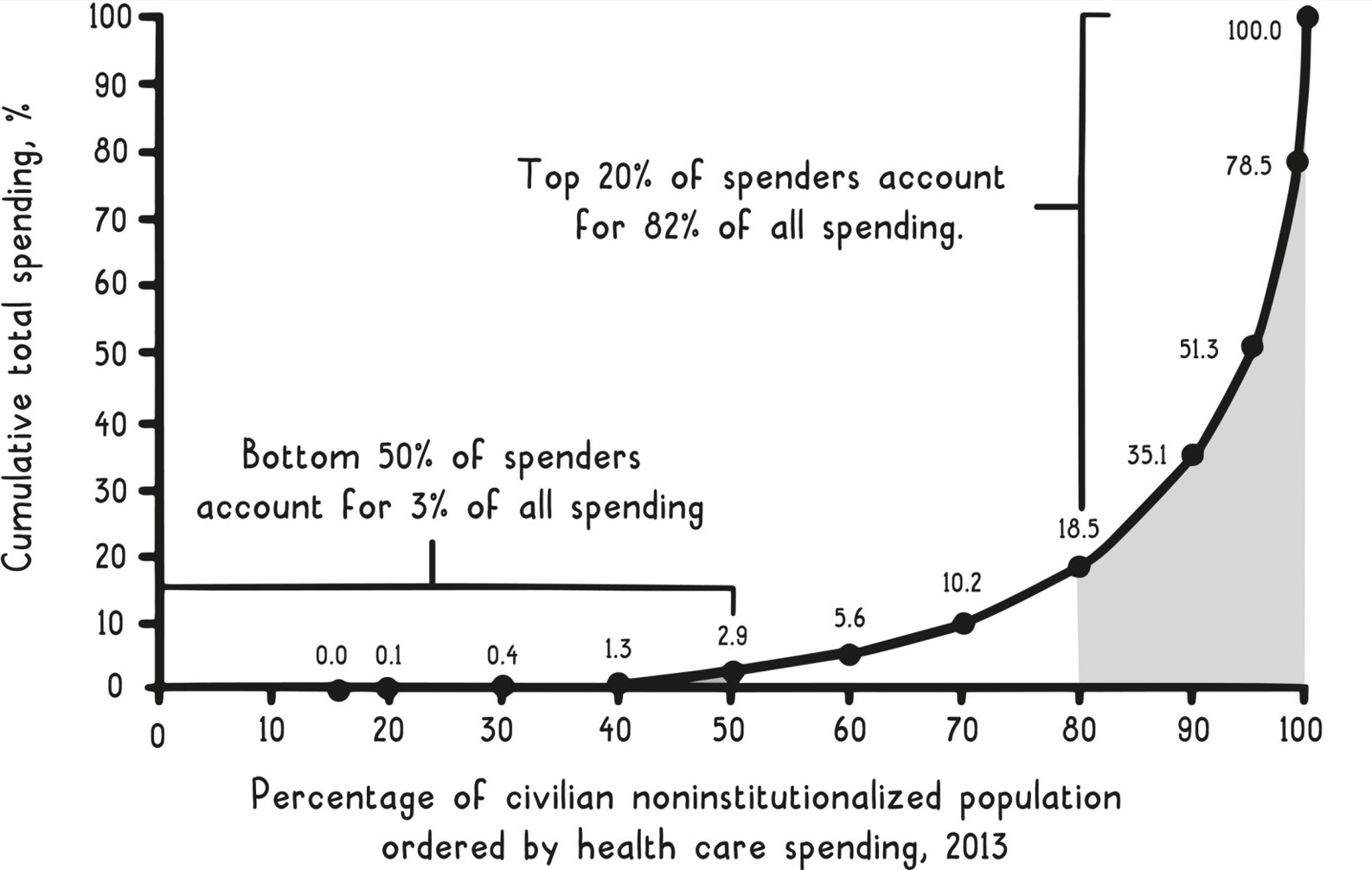
The figure above illustrates concentrated healthcare spending. The concentration alone does not establish that the data follow a power law. Other examples with similar patterns include the returns from venture capital, the strength of volcanic eruptions, and the size of power outages. When you’re working to influence such a distribution, you’re often looking toward those top outcomes, as they will have the most impact on the total.
Management consultant Joseph Juran popularized the Pareto principle in the 1940s, advising that the high-leverage plan is to find and focus on the smallest amount of the work that will bring about the best results. He called these high-leverage activities “the vital few.” For example, if you want to improve the effectiveness of a web page, focus on the headline and leading image, often referred to as the “hero section.” This is the first thing visitors will see, and the only thing many of them will read. The headline and image may also be what people encounter when the page is shared on social media. Small changes to this section—use of a catchier turn of phrase or a more engaging image—are simple, but have potential for a large effect.
The same principle applies to whole organizations. If you are trying to reduce costs and 80 percent of the budget is from 20 percent of the items, it makes sense to spend time seeing what you can do to make reductions in that 20 percent. Similarly, if 80 percent of your company’s sales come from 20 percent of its customers, you need to make sure these customers are satisfied, and find more like them. And if 80 percent of the usage of your website comes from 20 percent of the features, focus on those features. These heavily used features are candidates for an MVP, alongside the minimum features needed to make it useful (the book discusses MVPs in Chapter 1).
After you determine the 80/20 and address the easiest gains, additional work may produce progressively smaller benefits. In economics, this model is called the law of diminishing returns. It is the tendency for continued effort to diminish in effectiveness after a certain level of result has been achieved.
When Lauren was at GlaxoSmithKline, an external group was hired to evaluate the quality of clinical study reports and how efficiently they were written. The group evaluated report drafts to see how they evolved over time. For one report that had six drafts, the consultants found that the report’s quality did not substantially improve from draft two to draft six—quite clearly a case of diminishing returns! The later drafts added little measured improvement, while colleagues continued waiting for the final report.
There is a similar concept called the law of diminishing utility, which says that the value, or utility, of consuming an additional item is usually, after a certain point, less than the value of the previous one consumed. Consider the difference between the enjoyment you receive from eating one donut versus eating a second or third donut. By the time you get to a sixth donut, you may no longer get any enjoyment out of it, and you might even start getting sick.
When continuing beyond a point like this can actually make things worse, you move from diminishing returns to negative returns. This can happen when you are striving for perfection and it becomes counterproductive. There are lots of phrases related to this concept—overdoing it, trying too hard, etc. (discussed as Too Much of a Good Thing in Chapter 2 of the book).
Law of Diminishing Returns
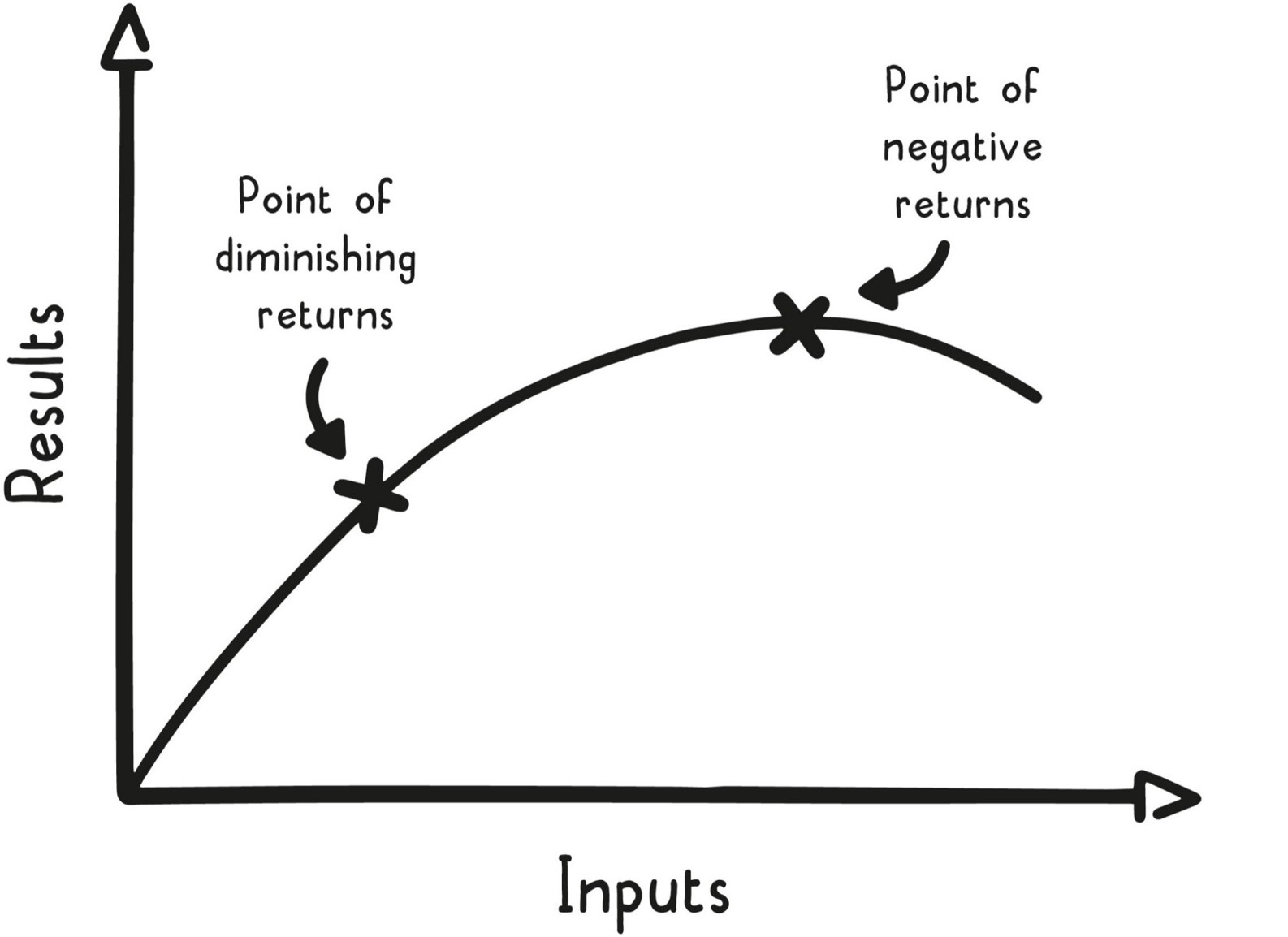
Overdoing it is also a quick path toward burnout, where high stress can take its toll and eventually extinguish your motivation, or worse. In the late 1970s in Japan the term karoshi was coined to describe the increasing number of people, some as young as their twenties and thirties, dying from strokes and heart attacks attributed to overwork.
Similar negative returns and burnout are prevalent in the high-stress environment of modern life throughout the world. In the quest for athletic success, for example, children all over the United States are suffering extreme injuries from overtraining—a clear sign of negative returns. Parents have started to sign their kids up for specialized coaching programs and commit them to playing one sport year-round at very young ages, which can easily result in overtaxing their young, growing bodies.
The account describes hundreds of young baseball pitchers a year having surgery on their elbows, colloquially named Tommy John surgery after the major league pitcher. The contrast is with an operation previously associated mainly with professional pitchers. Throwing more pitches in a year greatly increases your risk of injury, and so a heavy year-round schedule puts many teenagers in a dangerous situation. A lot of these kids are not even playing baseball two years later, whether it’s because they never fully recovered or they just got completely burned out.
Another familiar example of negative returns is pulling an all-nighter. It is proven that cramming is not an effective method to retain material long term. All-night cram sessions can additionally be counterproductive because no one is at their best in a sleep-deprived state. If the all-nighter is to complete a paper, can the writer accurately evaluate the quality of the writing in the middle of the night? Probably not. The extra hours may add errors or poor revisions rather than improve the paper.
So, once you’ve pushed through the highest-leverage pieces of a given project, when should you move on? Clearly, you ought to quit before you hit negative returns, but just because you’ve hit diminishing returns doesn’t always mean you must stop what you’re doing. It really comes down to opportunity cost. If you can identify another activity that can produce greater results for the same amount of effort, then you should jump to it.
Otherwise, you should keep at your current activity, since you’re still making progress (even if it is slower progress) and you don’t have anything better to do. However—and this is key—you should not assume there isn’t anything better to do. You must periodically brainstorm and seek alternatives, making sure there aren’t other high-leverage projects, with their own 80/20s, just out of view.
When to use it
Identifying the most valuable features for a minimum viable product (MVP).
Focusing on the top 20% of customers who generate 80% of sales.
Choosing which charitable causes to donate to for maximum impact.
Selecting exercise routines that give the best health benefits per unit of time.
In personal productivity, use checklists and habit stacking (like written procedures) to reduce cognitive load and avoid reinventing solutions.
In business, implement standard operating procedures and automation software to scale operations without proportionally increasing headcount.
In finance, use financial leverage (loans) to control larger assets with a small amount of capital, though with associated risk.
In career growth, build a professional network that amplifies your reach and opportunities far beyond what you could achieve alone.
FROM THEORY TO EVERYDAY LIFE
In practice
Clinical Study Report Revisions
In the GlaxoSmithKline example, consultants found little measured improvement in one clinical study report between its second and sixth drafts. That prompted a question about whether the later revision effort was worth the time it took.
Home Purchase with Low Down Payment
A homebuyer who puts down 20% controls an asset worth more than the initial cash contribution by taking on debt. During the housing bubble described here, some buyers put 0% down. Borrowing magnifies exposure to both gains and losses.
Written Language
A way to leverage what people have learned in the past so that we don’t have to relearn everything from scratch with each new generation.
Standardization of Processes
Repeatable procedures let a company transfer work among people more easily. That can also make an individual worker easier to replace.
Physical Lever Types
Force/Fulcrum/Weight: crowbar prying open a door. Fulcrum/Weight/Force: wheelbarrow lifting a load. Fulcrum/Force/Weight: baseball bat swinging, trading extra force for greater speed and distance.
Ancient Egyptian Construction
Used levers to lift stones weighing up to 100 tons to build pyramids and obelisks, amplifying human strength.
Everyday Tools
Scissors, pliers, door handles, wheelbarrows, and fishing rods all incorporate leverage to make tasks easier.
A MOMENT TO REFLECT
Put it to work.
What are the high-leverage activities in your current project that will produce the most impact with the least effort?
Where in your life are you experiencing diminishing returns? Should you shift focus to another area?
How can you apply the Pareto principle to identify the 20% of efforts that yield 80% of results?
Where in your life are you applying significant force but getting minimal results? Could a lever help?
What tools, systems, or knowledge could you use to amplify your efforts?
How can you better leverage your judgment to reduce the effort needed to achieve your goals?
References
- Manuel d’economie politique — Vilfredo Pareto (1896)
- Mechanica — Peripatetic school (followers of Aristotle)
CONTINUE THE CONVERSATION
Source texts
- The Great Mental Models Volume 2 Physics, Chemistry and Biology
- Super Thinking (Gabriel Weinberg, Lauren McCann)