Levels of Explanation: Event, Pattern, and Structure
Senge distinguishes three ways to explain a complex situation: events describe what happened, patterns show how behavior changes over time, and structure explains how rules, relationships, and delays produce those patterns. Structural explanations can reveal where a change in policy or system design could alter recurring behavior.
THE IDEA
THE LEARNING DISABILITIES AND OUR WAYS OF THINKING
The beer game simulates a supply chain in which players order and ship beer through different positions. It brings out the organizational learning disabilities described in the book’s Chapter 2:
- Because they “become their position,” people do not see how their actions affect the other positions.
- Consequently, when problems arise, they quickly blame each other—“the enemy” becomes the players at the other positions, or even the customers.
- When they get “proactive” and place more orders, they make matters worse.
- Because their overordering builds up gradually, they don’t realize the direness of their situation until it’s too late.
- By and large, they don’t learn from their experience because the most important consequences of their actions occur elsewhere in the system, eventually coming back to create the very problems they blame on others.17
- The “teams” running the different positions (usually there are two or three individuals at each position) become consumed with blaming the other players for their problems, precluding any opportunity to learn from one another’s experience.18
The deepest insights in the beer game come from seeing how these learning disabilities are related to alternative ways of thinking in complex situations. For most participants, the overall experience of playing the game is deeply dissatisfying because it is purely reactive. Yet, most eventually realize that the source of the reactiveness lies in their own focus on week-by-week events. Most of the players in the game get overwhelmed by the shortages of inventory, surges in incoming orders, disappointing arrivals of new beer. When asked to explain their decisions, they give classic “event explanations.” A player might explain an order of forty at Week 11 as a response to retailers ordering thirty-six and wiping out inventory. So long as they persist in focusing on events, they are doomed to reactiveness.
The systems perspective shows that there are multiple levels of explanation in any complex situation, as suggested by the diagram below. In some sense, all are equally “true.” But their usefulness is quite different. Event explanations—“who did what to whom”—doom their holders to a reactive stance. As discussed earlier, event explanations are the most common in contemporary culture, and that is exactly why reactive management prevails.
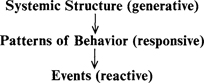
“Pattern of behavior” explanations focus on seeing longer-term trends and assessing their implications. For example, in the beer game, a pattern of behavior explanation would be: “Production/distribution systems are inherently prone to cycles and instability, which become more severe the further you move from the retailer. Therefore, sooner or later, severe crises are likely at the brewery.” Pattern of behavior explanations begin to break the grip of short-term reactiveness. At least they suggest how, over a longer term, we can respond to shifting trends.19
The third level of explanation, the “structural” explanation, is the least common and most powerful. It focuses on answering the question, “What causes the patterns of behavior?” In the beer game, a structural explanation must show how orders placed, shipments, and inventory interact to generate the observed patterns of instability and amplification, taking into account the effects of built-in delays in filling new orders, and the vicious cycle that arises when rising delivery delays lead to more orders placed. Though rare, structural explanations, when they are clear and widely understood, have considerable impact.
An exceptional example of a leader providing such insight was Franklin Roosevelt, when he went on the radio on March 12, 1933, to explain the four-day “banking holiday.” In a time of panic, Roosevelt calmly explained how the banking system worked, structurally. “Let me state the simple fact that when you deposit money in a bank the bank does not put the money into a safe-deposit vault,” he said. “It invests your money in many different forms of credit—bonds, mortgages. In other words, the bank puts your money to work to keep the wheels turning around …” He explained how banks were required to maintain reserves, but how those reserves were inadequate if there were widespread withdrawals; and why closing the banks for four days was necessary to restore order. In so doing, he generated public support for a radical but necessary action, and his reputation as a master of public communication.20
The reason that structural explanations are so important is that only they address the underlying causes of behavior at a level at which patterns of behavior can be changed. Structure produces behavior, and changing underlying structures can produce different patterns of behavior. In this sense, structural explanations are inherently generative. Moreover, since structure in human systems includes the “operating policies” of the decision makers in the system, redesigning our own decision making redesigns the system structure.21
For most players of the game, the deepest insight usually comes when they realize that their problems, and their hopes for improvement, are inextricably tied to how they think. Generative learning cannot be sustained in an organization where event thinking predominates. It requires a conceptual framework of “structural” or systemic thinking, the ability to discover structural causes of behavior. Enthusiasm for “creating our future” is not enough.
As the players in the beer game come to understand the structures that cause its behavior, they see more clearly their power to change that behavior, to adopt ordering policies that work in the larger system. They also discover a bit of timeless wisdom delivered years ago by Walt Kelly in his famous line from “Pogo”: “We have met the enemy and he is us.”
The excerpt ends at the start of Part II, The Fifth Discipline: The Cornerstone of the Learning Organization, and chapter 4, The Laws of the Fifth Discipline.1
When to use it
Business: Analyze supply chain fluctuations beyond immediate events to identify structural causes like ordering policies and delays.
Public policy: Design interventions that address systemic issues (e.g., poverty, traffic) by understanding patterns and underlying structures, not just events.
Personal development: Identify recurring behavioral patterns (e.g., procrastination) and change underlying habits or environments.
Organizational culture: Examine the policies and feedback that produce recurring problems, so teams can change them and learn from the results.
FROM THEORY TO EVERYDAY LIFE
In practice
Beer Game: Event vs. Structural Explanation
In the beer game simulation, players often give event explanations (e.g., 'I ordered forty because my retailers ordered thirty-six and wiped out my inventory'), leading to reactive blame. A structural explanation reveals how ordering policies, delays, and feedback loops cause systemic instability and amplification, enabling players to redesign their ordering decisions.
Franklin Roosevelt's Banking Holiday Speech (1933)
During the bank panic, Roosevelt explained how banks invest deposits, maintain reserves, and become vulnerable to widespread withdrawals. He used that explanation to tell listeners why a temporary bank closure had been necessary to restore order.
A MOMENT TO REFLECT
Put it to work.
Think of a problem you are currently facing. Are you viewing it at the event, pattern, or structural level? How might a structural explanation change your approach?
Why does event thinking lead to reactive management? Can you recall a situation where focusing on events made matters worse?
In what ways can you redesign the underlying structure of your decision-making to create more desirable patterns of behavior?
Often confused with
References
- The Fifth Discipline — Peter Senge (1990)
CONTINUE THE CONVERSATION
Source texts
- The Fifth Discipline The Art Practice of the Learning Organization (Peter M. Senge)