Intuition Pumps on Determinism and Free Will
This chunk presents a series of thought experiments—Conway's Game of Life, rock-paper-scissors, two lotteries, inert historical facts, computer chess, ultimate responsibility, sphexishness, and the Boys from Brazil—that challenge and clarify concepts of determinism, free will, moral responsibility, unpredictability, and the distinction between practical and absolute freedom.
THE IDEA
Category: mental_model Secondary: ['heuristic', 'decision_framework', 'scientific_principle'] Difficulty: intermediate Domains: philosophy, psychology, science, technology
The fix is in! We’re all hardwired! That, and: Don’t blame me! I’m wired wrong!
Wired wrong? What would it be, then, to be wired right—or have scientists “discovered” that nobody is, or could be, wired right for moral responsibility?
1 If you doubt that instilling such a belief could have such consequences, see Vohs and Schooler (2008) and the subsequent literature for experimental evidence.
66. A DETERMINISTIC TOY: CONWAY’S GAME OF LIFE
When physicist Richard Feynman found himself listening to a scientific talk in a field he didn’t know well, he had a favorite question to ask the speaker: Can you give me a really simple example of what you’re talking about? If the speaker couldn’t oblige, Feynman got suspicious, and rightly so. Did this person really have something to say, or was this just fancy technical talk parading as scientific wisdom? If you can’t make a hard problem relatively simple, you are probably not going about it the right way. Simplification is not just for beginners.
Biology has its “model organisms”—species that have been carefully chosen to ease the path of the experimenter; they reproduce swiftly in the lab, are relatively safe and easy to handle, and—once they have been studied by many teams—are well mapped and understood: the fruit fly, the laboratory rat, the zebra fish, the squid (for its giant nerve axon), the nematode worm Caenorhabditis elegans, and Arabidopsis thaliana, a hardy, fast-growing plant related to mustard, the first plant to have its entire genome sequenced. Artificial intelligence (AI) has its own simple cases, known as “toy problems,” which, as the name suggests, are deliberately oversimplified versions of “serious” real-world problems. Many of the most interesting programs devised in AI are solutions to toy problems—such as getting a computer program to build simple structures in the blocks world, a virtual world consisting of a tabletop with a bunch of movable children’s blocks on it. Playing chess is a toy problem; it is certainly much more tractable than driving a car from Maine to California, or solving the Arab–Israeli conflict, or even making a sandwich of appropriate ingredients found in a kitchen. Ethicists have their trolley problems: In the simplest version, a runaway trolley is heading down a track where if it is not diverted it will hit and kill five people who cannot get off the track; there is a switch that you can throw that will divert the trolley to a side track—where it will hit and kill a single person. Do you throw the switch?
Here is a toy world for helping people think about determinism, the idea that the facts at one moment in time—the location, mass, direction, and velocity of every particle—determine what happens in the next moment, and so on, forever . Physicists and philosophers and others have argued for several millennia about whether our universe is deterministic, or whether there are some genuinely undetermined events: utterly unpredictable “random” events that just happen without anything causing them to happen. Even experienced thinkers may find new insights by playing around with Life, the breathtakingly simple model of a deterministic world created by the mathematician John Horton Conway and his graduate students in 1970.
Life is played on a two-dimensional grid, such as a checkerboard, using simple counters, such as pebbles or pennies—or one could also go high-tech and play it on a computer screen. It is not a game one plays to win; if it is a game at all, it is solitaire. The grid divides the plane into square cells, and each cell is either ON or OFF at each moment. (If it is ON, place a penny on the square; if it is OFF, leave the square empty.) Notice that each cell has eight neighbors: the four adjacent cells—north, south, east, and west—and the four diagonals—northeast, southeast, southwest, and northwest.
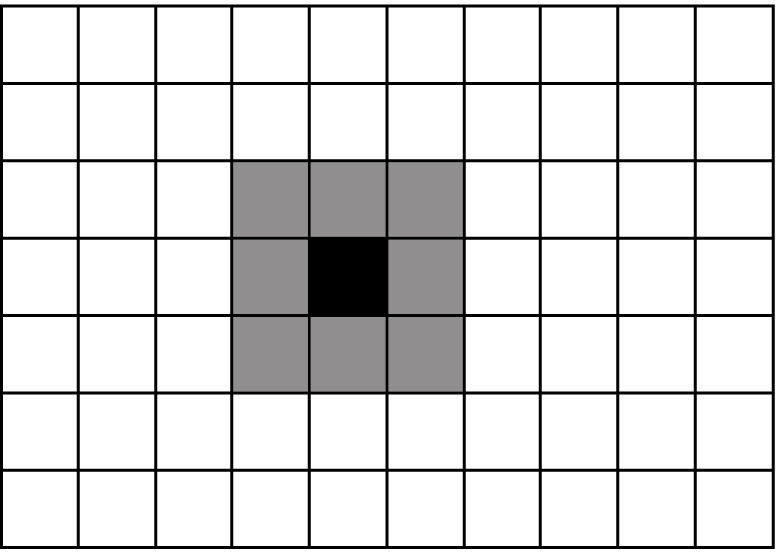
Figure 1
Time in the Life world is discrete, not continuous; it advances in ticks, and the state of the world changes between each tick according to the following rule:
Life Physics: For each cell in the grid, count how many of its eight neighbors are ON at the present instant. If the answer is exactly two, the cell stays in its present state (ON or OFF) in the next instant. If the answer is exactly three, the cell is ON in the next instant whatever its current state. Under all other conditions the cell is OFF.
That’s the only rule of the game. You now know all there is to know about how to play Life. The entire physics of the Life world is captured in that single, unexceptioned law. While this is the fundamental law of the “physics” of the Life world, it helps at first to conceive this curious physics in biological terms: think of cells going ON as births, cells going OFF as deaths, and succeeding instants as generations. Either overcrowding (more than three inhabited neighbors) or isolation (less than two inhabited neighbors) leads to death. Consider a few simple cases.
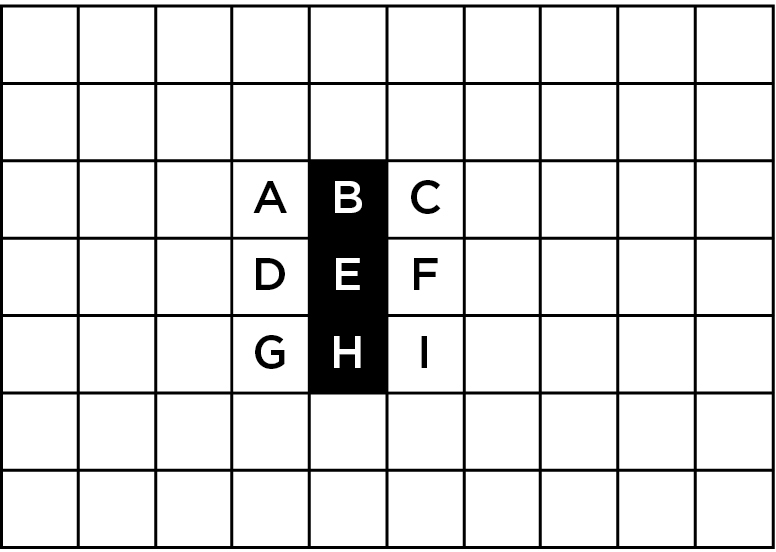
Figure 2
In the configuration in figure 2, only cells D and F have exactly three neighbors ON, so they will be the only birth cells in the next generation. Cells B and H each have only one neighbor ON, so they die in the next generation. Cell E has two neighbors ON, so it stays on. So the next “instant” will look like figure 3.
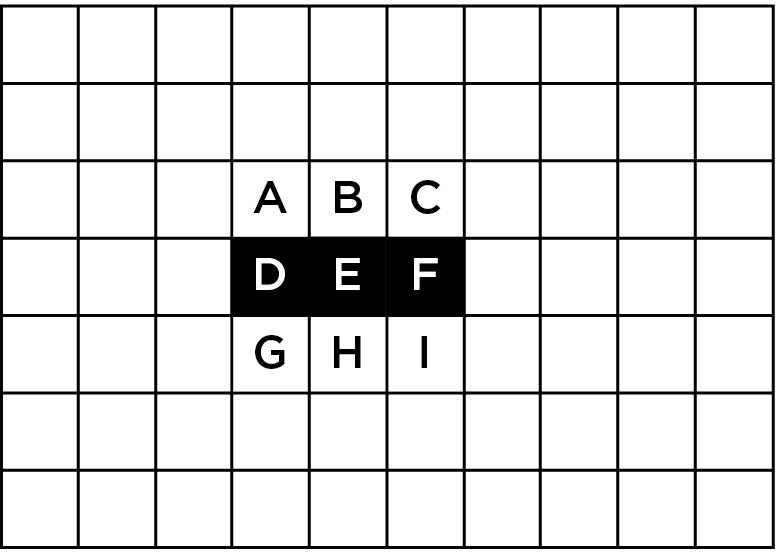
Figure 3
Obviously, the configuration will revert back in the next instant, and this little pattern will flip-flop back and forth indefinitely, unless some new ON cells are brought onto the scene somehow. It is called a flasher or traffic light. What will happen to the configuration in figure 4?
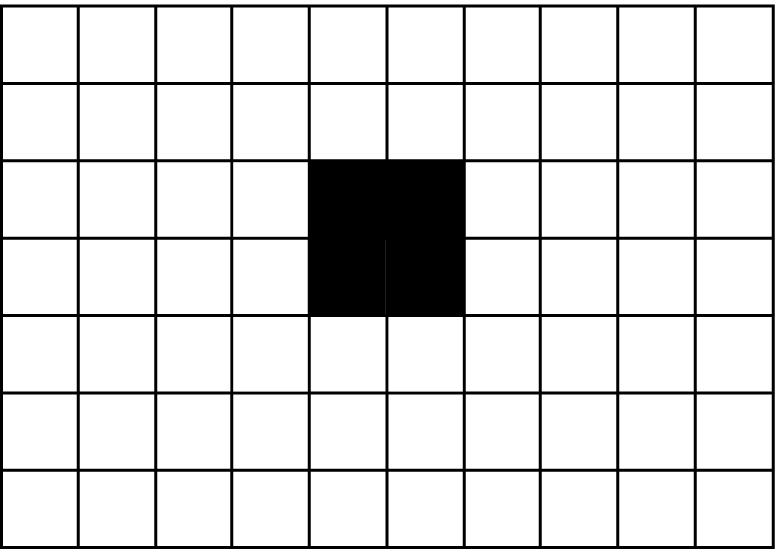
Figure 4
Nothing. Each ON cell has three neighbors ON, so it is reborn just as it is. No OFF cell has three neighbors ON, so no other births happen. This configuration is called a still life.
By the scrupulous application of our single law, one can predict with perfect accuracy the next instant of any configuration of ON and OFF cells, and the instant after that, and so forth. In other words, the Life world is a toy world that perfectly instantiates the determinism made famous by the early-nineteenth-century French scientist Pierre Laplace: given the state description of this world at an instant, we observers can perfectly predict the future instants by the simple application of our one law of physics. Or we could put it this way: when we adopt the physical stance toward a configuration in the Life world, our powers of prediction are perfect: there is no noise, no uncertainty, no probability less than one. Moreover, it follows from the two-dimensionality of the Life world that nothing is hidden from view. There is no backstage; there are no hidden variables; the unfolding of the physics of objects in the Life world is directly and completely visible.
If you find following the simple rule a tedious exercise, there are computer simulations of the Life world in which you can set up configurations on the screen and let the computer execute the algorithm for you, changing the configuration again and again according to the single rule. In the best simulations, the scale of both time and space can be changed, alternating between close-up and bird’s-eye views.
One soon discovers that some simple configurations are more interesting than others. Consider a diagonal line segment, such as the one shown in figure 5.
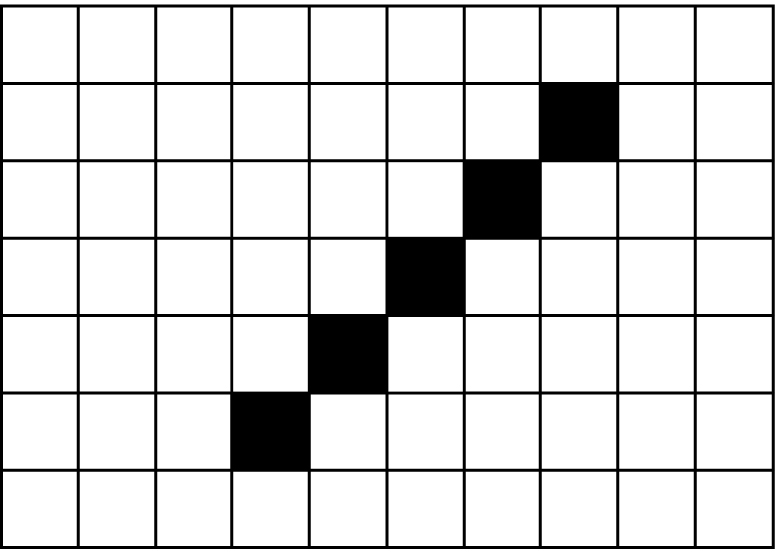
Figure 5
This pattern is not a flasher; each generation, the two ON cells at either end of the row die of isolation and there are no birth cells. The whole segment soon evaporates. In addition to the configurations that never change—the still lifes—and those that evaporate entirely, such as the diagonal line segment, there are configurations with all kinds of periodicity. The flasher, we saw, has a two-generation period that continues ad infinitum, unless some other configuration encroaches. Encroachment is what makes Life interesting: among the periodic configurations are some that swim, amoeba-like, across the plane. The simplest is the glider, the five-pixel configuration shown taking a single stroke to the southeast in figure 6.
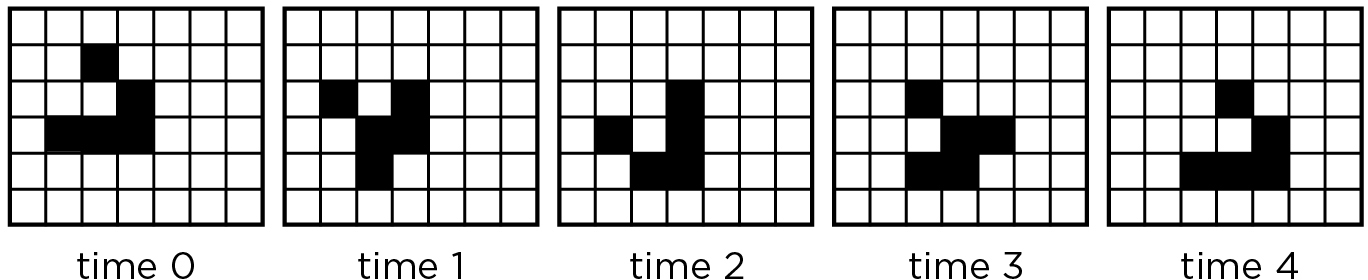
Figure 6
Then there are the eaters, the puffer trains and space rakes, and a host of other aptly named denizens of the Life world that emerge as recognizable objects at a new level (analogous to the design level). This level has its own language, a transparent foreshortening of the tedious descriptions one could give at the physical level. For instance:
An eater can eat a glider in four generations. Whatever is being consumed, the basic process is the same. A bridge forms between the eater and its prey. In the next generation, the bridge region dies from overpopulation, taking a bite out of both eater and prey. The eater then repairs itself. The prey usually cannot. If the remainder of the prey dies out as with the glider, the prey is consumed. [Poundstone, 1985, p. 38]
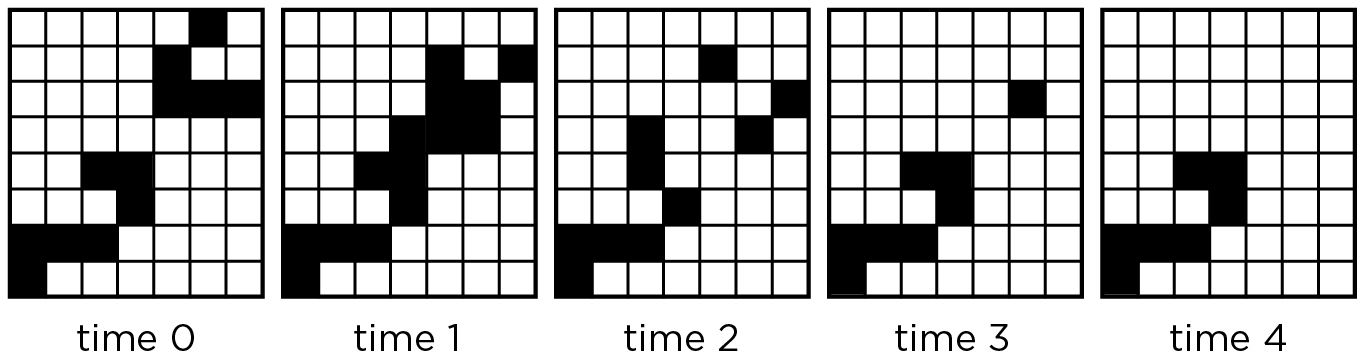
Figure 7
Notice that something curious happens to our “ontology”—our catalogue of what exists—as we move between levels. At the physical level there is no motion, only ON and OFF, and the only individual things that exist, cells, are defined by their fixed spatial location. At the design level we suddenly have the motion of persisting objects; it is one and the same glider (though each generation is composed of different cells) that has moved southeast in figure 6, changing shape as it moves; and there is one less glider in the world after the eater has eaten it in figure 7.
Notice too that whereas at the physical level, there are absolutely no exceptions to the general law, at this level our generalizations have to be hedged: they require “usually” or “provided nothing encroaches” clauses. Stray bits of debris from earlier events can “break” or “kill” one of the objects in the ontology at this level. Their salience as real things is considerable, but not guaranteed. To say that their salience is considerable is to say that one can, with some small risk, ascend to this design level, adopt its ontology, and proceed to predict—sketchily and riskily—the behavior of larger configurations or systems of configurations, without bothering to compute the physical level. For instance, one can set oneself the task of designing some interesting super-system out of the “parts” that the design level makes available.
This is just what Conway and his students set out to do, and they succeeded majestically. They designed, and proved the viability of the design of, a self-reproducing entity composed entirely of Life cells. Grinding away deterministically on its infinite plane, it would copy itself perfectly, and then its copy would copy itself, and so forth. It was also (for good measure) a Universal Turing machine: a two-dimensional computer that in principle can compute any computable function! What on earth inspired Conway and his students to create first this world and then this amazing denizen of that world? They were trying to answer at a very abstract level one of the central questions of biology: What is the minimal complexity required for a self-reproducing thing? They were following up the brilliant early speculations of John von Neumann, who had been working on the question at the time of his death in 1957. Francis Crick and James Watson had discovered the structure of DNA in 1953, but how it worked was a mystery for many years. Von Neumann had imagined in some detail a sort of floating robot that picked up pieces of flotsam and jetsam that could be used to build a duplicate of itself, and that would then be able to repeat the process. His description (posthumously published, 1966) of how an automaton would read its own blueprint and then copy it into its new creation anticipated in impressive detail many of the later discoveries about the mechanisms of DNA expression and replication, but in order to make his proof of the possibility of a self-reproducing automaton mathematically rigorous and tractable, von Neumann had switched to simple, two-dimensional abstractions, now known as cellular automata. Conway’s Life world cells are a particularly agreeable example of cellular automata.
Conway and his students wanted to confirm von Neumann’s proof in detail by actually creating a two-dimensional world with a simple physics in which such a self-replicating construction would be a stable, working structure. Like von Neumann, they wanted their answer to be as general as possible, and hence as independent as possible of actual (earthly? local?) physics and chemistry. They wanted something dead simple, easy to visualize and easy to calculate, so they not only dropped from three dimensions to two but also “digitized” both space and time: all times and distances, as we saw, are in whole numbers of “instants” and “cells.” It was von Neumann who had taken Alan Turing’s abstract conception of a mechanical computer (now called a Turing machine) and engineered it into the specification for a general-purpose stored-program serial-processing computer (now called a von Neumann machine), and in his brilliant explorations of the spatial and structural requirements for such a computer, he had realized—and proved—that a Universal Turing machine (see part IV) could in principle be “built” in a two-dimensional world.1 Conway and his students also set out to confirm this with their own exercise in two-dimensional engineering.2
It was far from easy, but they showed how they could “build” a working computer out of simpler Life forms. Glider streams can provide the input-output “tape,” for instance, and the tape-reader can be some huge assembly of eaters, gliders, and other bits and pieces. What does this machine look like? Poundstone (1985) calculated that the whole construction would be on the order of 1013 cells or pixels.
Displaying a 1013-pixel pattern would require a video screen about 3 million pixels across at least. . . . [Imagine a screen with the high resolution of your laptop or iPad, a half a mile wide.] Perspective would shrink the pixels of a self-reproducing pattern to invisibility. If you got far enough away from the screen so that the entire pattern was comfortably in view, the pixels (and even the gliders, eaters and guns) would be too tiny to make out. A self-reproducing pattern would be a hazy glow, like a galaxy. [pp. 227–288]
In other words, by the time you have built up enough pieces into something that can reproduce itself (in a two-dimensional world), it is roughly as much larger than its smallest bits as an organism is larger than its atoms. You probably can’t do it with anything much less complicated, though this has not been strictly proved.
The game of Life illustrates many important principles and can be used to construct many different arguments or thought experiments, but I will use it to illustrate just three points, leaving you to discover others for yourself: First, notice how the distinction between the physical stance and the design stance gets blurred here. Do gliders, for instance, count as designed things, or as natural objects—like atoms and molecules? The tape-reader that Conway and his students cobbled out of gliders and eaters and the like must count as designed if anything does, but its ingredients are quite raw materials—the simplest “things” in the Life world. Nobody had to design or invent the glider; it was discovered to be implied by the physics of the Life world. But that, of course, is actually true of everything in the Life world. Nothing happens in the Life world that isn’t strictly implied—logically deducible by straightforward theorem-proving—by the physics and the initial configuration of cells. Some of the things in the Life world are just more marvelous and unanticipated (by us, with our puny intellects) than others. There is a sense in which the Conway self-reproducing computer pixel-galaxy is “just” one more Life macromolecule with a very long and complicated periodicity in its behavior. This nicely illustrates a parallel point about biology and the origin of life: amino acids, one might say, just are; they didn’t have to be designed. But proteins, composed of nothing but amino acids, are too fancy; they are at least sorta designed. Darwin’s gradualism makes yet another appearance.
Second, the Life world, being deterministic, has a perfectly predictable future for every possible configuration, but, somewhat surprisingly, its past is often perfectly inscrutable! Consider the still life consisting of four ON pixels in a square. You can’t tell from looking at it, or even looking at it and its neighborhood, what its past was. To see this, note that any three of the four pixels ON would lead, in the next generation, to this still life of four pixels ON. Whether any of those cells were OFF in the past is an inert historical fact.
Third, recall how important “noise” and collisions were in creating the mutations that evolution—like other creative processes—feeds on. Conway’s huge construction reproduced itself, but it couldn’t mutate. It would always make a perfect copy of itself, and in order to introduce mutations into the picture, the whole construction would have to be enlarged many fold. Why? Because the Life world is deterministic, so the only way a “random” mutation can occur is if some stray bit of stuff wanders (pseudo-randomly) onto the scene and breaks something. But the smallest moving thing is a glider, so think of it as like a single photon, or cosmic ray, moving at the speed of (Life physics) light. A single glider can do a lot of damage; if it must barely “tweak” something in the genome of the self-reproducing thing without destroying the genome, that genome is going to have to be very large, relative to the glider, and quite robust. It might well be provable that evolution could not occur in the Life world, no matter how large we made the entities, if it turned out that these galaxy-sized assemblages were just too fragile to survive an occasional rain of gliders.
1 See Dennett, 1987, chapter 9, for more on the theoretical implications of this trade-off in space and time.
2 For a completely different perspective on two-dimensional physics and engineering, see A. K. Dewdney’s Planiverse (1984), a vast improvement over Edwin A. Abbott’s Flatland (1884), and a magnificent thinking tool in its own right.
Probably every one of you knows the game of rock, paper, and scissors. Two people face each other, and count, “One, two, three, shoot!” and each, simultaneously, extends a hand either clenched in a fist (rock), with a pair of fingers extended (scissors), or with the palm flat open facing down (paper). Rock breaks (beats) scissors, scissors cut (beat) paper, and paper covers (beats) rock. Unless both players display the same hand symbol—a tie—one player wins and the other loses. It’s a tantalizing game because if you can outguess your opponent, you can seem to read her mind and come up with the right hand shape to win consistently. It’s unnerving when that happens. Can some people play the game better than others? Apparently, since there have been tournaments with large cash prizes in which national and international winners have emerged, and—this is important since every tournament has to be won by somebody even if there is no skill involved—the better players have a history of winning.
How do they do it? Perhaps by picking up subtle hints from the faces and postures of their opponents. Poker players speak of reading the “tell” of another player, sensing when they are bluffing and when they aren’t, while maintaining a “poker face” of their own. Perhaps most people who play rock, paper, and scissors have a tell that they can’t control and that the best players pick up at the last instant. So what is the best strategy to use to prevent your opponent from picking up a pattern from your outer demeanor? Playing absolutely randomly is the best, since if you play a random sequence of moves, there is simply no pattern for your opponent to detect. (While you are playing randomly, and breaking even, you can try to find a pattern in your opponent’s moves, and use that pattern to craft a nonrandom strategy, and then strike.)
People are notoriously bad at creating actually random series. They tend to switch too often, avoiding choosing the same move two or three times in a row, for instance (which ought to occur fairly often in a genuinely random series). Knowing that your casual effort to create a genuinely patternless series is apt to fail, you should consider a better strategy: get a table of random numbers from the library (or online). Put your finger “at random” somewhere on the table, and copy down the next hundred digits. Throw out all the 0s (say), and then replace each 1, 2, or 3 with “R” (for rock), each 4, 5, and 6, with “P” (for paper), and each 7, 8, and 9 with “S” (for scissors). This will give you a sequence of approximately ninety moves (since you threw out approximately ten 0s), which should be enough for a match.
Now you’re ready to play, and the cardinal rule is: keep your list secret. If your opponent gets to peek at it, you will be completely at her mercy. As the saying goes, she will turn you into a money pump. If she has no way of getting at your list, on the other hand, she will have to start trying to second-guess you, anticipating your line of thinking as best she can. (In short, she will have to treat you from the intentional stance and reason about your reasoning, instead of treating you as a simple mechanism whose behavior she can reliably read off your list.)
This simple principle of keeping your intended choices secret from your opponent turns out to be one of the central pivots in the long-standing controversies over free will. In fact, the invention of game theory by von Neumann and Morgenstern (1944) began with the recognition that while a solitary agent (or intentional system) trying to predict the future from the information it gathers can get by with a calculation of expected utility using probability theory (of one sort or another), as soon as there are two agents, two intentional systems in the environment, the circumstance is changed radically. Now each agent has to take into account the attempts at prediction by the other agent, and include the other agent’s observation of, and attempts to anticipate and exploit, its own behavior, creating feedback loops of indefinite complexity.1
This fundamental fog of inscrutability or unpredictability of agents by each other creates the conditions in which game theory flourishes. Evolution has discovered this, and many species can be seen to apply the principles of game theory (competence without comprehension!) in their interactions. Gazelle stotting is just one simple example. Another is the erratic flight of butterflies, whose trajectories are hard for insectivorous birds to predict, though evolution has helped the birds by giving them a faster “flicker fusion rate” than we have, for instance (they see more “frames per second” than we do—a movie would look like a slide show to them).
Be unpredictable, and look out for others following this advice! “Appreciation” of this principle can be seen in the widespread instinct found in animals who, when confronted with any complicated moving entity, try to treat it as an agent—“Who goes there, and what do you want?” not just “What’s that?”—in order to be safe, because maybe it is an agent and it wants to eat the animal, or to mate with it, or to fight over some prize. This instinctual response is the source in evolution of the invention of all the invisible elves, goblins, leprechauns, fairies, ogres, and gods that eventually evolve into God, the ultimate invisible intentional system (Dennett, 2006a).
Like animals who adopt this strategy without having to know why, we human beings appreciate the tactic of preserving our unpredictability without having to understand why this is such a good idea. But it’s pretty obvious, most of the time. When you are shopping and spot an antique that you have to have, you know better than to gush over it before you’ve learned the selling price. You’ll get scalped by the seller if you don’t. When you advertise something for sale, you put a reasonable asking price on it—one you would be content to receive—because you can’t tell when a buyer would actually pay more, and you hope that the buyer can’t tell how much less you would accept than your asking price. (You can refuse to bargain, of course.) Auctions are ways of exploring this terra incognita, and if you trust the auctioneer with an advance bid, you are counting on his integrity not to reveal your maximum to the other bidders.
Similarly, when you fall head over heels in love at first sight of somebody, you do your best not to swoon and pant, keeping as reserved and casual as possible; you don’t want to scare this paragon off or, alternatively, let this delight have too much of the upper hand, wrapping you around her little finger. A poker face is not just for poker. In general, you improve your chances of getting what you want by keeping the competition—the other agents in the neighborhood—off balance, so they don’t have good enough hunches about which way you’re going to leap to prepare for your landing. (It’s costly to prepare another agent’s environment, so your opponents won’t try to anticipate you unless they have very good evidence of what you will do.)
Magicians know how to do a “psychological force” to get you to pick from the deck (“of your own free will”) the card they want you to take. There are many methods, all subtle and hard to detect, and a really good magician can do it most of the time. This is a genuine abridgement of your agency, a manipulation that turns you into a tool, a pawn, an extension of the magician’s will, not a free agent.
Contrary to ancient ideology, we don’t want our free choices to be utterly uncaused. What we all want, and should want, is that when we act, we act based on good information about the best options available to us. If only the environment will cause us to have lots of relevant true beliefs about what’s out there, and also cause us to act on the most judicious assessment of that evidence we could achieve! That would give us almost everything we want as agents—except this: we wouldn’t want the environment to include a manipulative agent that usurps control from us, so we wouldn’t want the environment to make our best moves too obvious to all the other agents out there, for then they can exploit us, knowing too much about what we want and how much we want it. So add to our wish list the capacity to keep our thought processes and our decisions to ourselves, even if it means on occasion choosing our second-best option, just to keep the others off balance. (Clegg, 2012, provides a pioneering formal analysis of this.)
Some people, dimly appreciating the importance of this unpredictability, think that “just to be safe” they should hold out for absolute unpredictability, which can be achieved only if, down in the basement of our brains, matters are physically indeterministic. Here is how the philosopher Jerry Fodor (2003) once put it with characteristic vividness:
One wants to be what tradition has it that Eve was when she bit the apple. Perfectly free to do otherwise. So perfectly free, in fact, that even God couldn’t tell which way she’d jump. [p. 18]
But why does “one want” this? Is this absolute unpredictability any better, really, than practical unpredictability? Many philosophers, over several thousand years, have insisted on absolute unpredictability as a condition of genuine free will. Do they know something that we don’t know? If so, they are keeping it secret. To almost all of them, the idea that free will is incompatible with determinism has seemed too obvious to need an argument. I say that the burden of proof is on them. Show us why we ought to despair if we can’t have absolute unpredictability. I’ve shown why we—like evolution itself—are wise to arrange for as much practical unpredictability as we can. Tell us, please, why that is not enough.
I will give you one good reason: if you plan to play rock, paper, and scissors with God, for high stakes (salvation, maybe), then you have reason, just as Fodor says, to want “perfect” freedom. I, for one, don’t anticipate that contest, so I am content with the practical freedom I have by just keeping my counsel and staying away from sleight-of-hand artists and other manipulators when the stakes are high.
1 A delicious example of runaway higher-order second-guessing appears in the film The Princess Bride, in the scene in which Wallace Shawn as Vizzini tries to outwit Cary Elwes as Westley in the “Which cup has the poison?” encounter, and ends up outwitting himself. See http://www .dailymotion.com/video/xhr71a_never-go-in-against-a-sicilian-when-death-is-on-the-line_shortfilms.
Compare the following two lotteries for fairness. In Lottery A—for “After”— all the tickets are sold, their stubs are placed in a suitable mixer and mixed, as randomly as you like, and then the winning ticket is blindly drawn. (Most lotteries we encounter are like this.) In Lottery B—for “Before”—the mixing of stubs and the blind drawing of the winner take place before the tickets are sold (and the winning stub is put in a safe), but otherwise the lotteries are conducted the same way. Someone might think the second lottery is unfair because the winning ticket is determined before people even buy their tickets. One of those tickets is already the winner (even if nobody knows which one); the other tickets are worthless paper, and selling them to unsuspecting people is some sort of fraud. But in fact both lotteries are equally fair. Everyone who buys a ticket has an equal chance of winning; the timing of the selection of the winner is an utterly inessential feature.
The drawing in most lotteries is postponed until after the sale of the tickets in order to provide the public with firsthand eyewitness evidence that there have been no shenanigans. No sneaky person with inside knowledge has manipulated the distribution of tickets, because the knowledge of the winning ticket did not (and could not) exist in any agent until after the tickets were sold. It is interesting that not all lotteries follow this practice. Publisher’s Clearing House used to mail out millions of envelopes each year that had written on them in bold letters “YOU MAY ALREADY HAVE WON”—a million dollars, or some other prize. (The organization now runs its lottery largely online.) These expensive campaigns are based on market research showing that in general people do think lotteries with preselected winners are fair so long as they are honestly conducted. But perhaps people go along with these lotteries uncomplainingly because they get their tickets for free. Would many people buy a ticket in a lottery in which the winning stub, sealed in a special envelope, was known to have been deposited in a bank vault from the outset? People buy scratch tickets by the millions, and whether or not any ticket is a winner is already determined when it is bought. Apparently these people consider themselves to have a real opportunity to win. I think they are right, but whether they are right or wrong, their calm conviction that such lotteries are fair, and that they have a real opportunity to win, should undo the confidence of the philosophers (going back two millennia to Democritus and Lucretius) who have somehow convinced themselves that no opportunity is a real opportunity unless the outcome is undetermined up to the last instant. These philosophers have maintained that without a continuing supply of truly random, undetermined branch points to break up the fabric of causation, there is no possibility of free choices, no real chances to do the right thing.
The two lotteries give us a new perspective on the problem of determinism. If the world is determined, then we have pseudo-random number generators in us, not truly (quantum-mechanical) random randomizers. If our world is determined, all our lottery tickets were drawn at once, in effect, about fourteen billion years ago at the moment of the Big Bang, put in an envelope for us, and doled out as we needed them through life. Whenever you need to “flip a coin” or in some less ostentatious way make a chancy decision, your brain opens the envelope and takes out the next “random” number, letting its value determine what you do, just like the list of moves in “rock, paper, and scissors.” “But that is unfair,” someone may say, “for some people will have been dealt more winners than others.” Indeed, on any particular deal, some people have more high cards than others, but one should remember that in the long run the luck averages out. “But if all the drawings take place before we are born, some people are determined to get more luck than others!” That will be true, however, even if the drawings are not held before we are born, but periodically, on demand, throughout our lives. Even in a perfectly random and unbiased drawing, a genuinely undetermined drawing, it is still determined that some people will get more winners than others. Even in a perfectly fair, perfectly random, coin-tossing tournament, it is determined that someone—or other—will win, and everybody else in the tournament will lose. The winner cannot properly claim it was his “destiny” to win, but whatever advantages accrue to winning are his, destiny or not, and what could be fairer than that? Fairness does not consist in everybody winning.
Probably the most frequently cited reason for hoping for indeterminism is that without it, when we choose an act, “we could not have done otherwise,” and surely (ding!) that is something that should be important to us. This, too, is not as obvious as it has often seemed, and in order to get a glimpse at how this familiar idea might be misleading us, consider the curious category of inert historical facts.
An inert historical fact is any fact about a perfectly ordinary arrangement of matter in the world at some point in the past that is no longer discernible, a fact that has left no footprints at all in the world today. My favorite example of an inert historical fact is this:
A. Some of the gold in my teeth once belonged to Julius Caesar.
Or maybe this:
B. It is false that some of the gold in my teeth once belonged to Julius Caesar.
Now (logic tells us) one of these two must be a fact. (Hang on: Wasn’t the moral of the sorta operator chapter that we should distrust these “obvious” disjunctions? Let’s check this one out. How could it be the case that neither A nor B had a clear claim on truth? Well, what if ownership in Caesar’s day was either vague or ill defined so that Caesar only sorta owned some of his gold—perhaps the way the Queen of England to this day is the owner of all the swans in the land?1) Assuming that the relevant concept of ownership is nicely demarcated, the way the concept of gold is, one of the two sentences must express a fact, but which of the two is true is almost certainly not discoverable by any physical investigation, no matter how sophisticated it is and no matter how long it takes to conduct it.
Really? We can imagine cases where we could be almost certain that either A or B is the true alternative. If it turned out that, because of various well-recorded historical processes, the “provenance” of some of the gold in my teeth was scrupulously controlled and recorded through the millennia (like the “chain of custody” for exhibits of evidence in murder trials), we could be quite sure that A is true. Let’s say that my dentist purchased an ancient gold ring from a museum, the famous “Caesar’s pinky ring,” which a host of documents attest had been handed down over the centuries from monarch to monarch until it arrived in the museum, and there is a videotape showing the dentist melting the ring and pouring the molten gold into the plaster cast for my filling. Outlandish, sure, but clearly within the bounds of physical possibility. Or alternatively, suppose that I am a gold-panning hobbyist and made a trip to the base of a receding glacier in Alaska that had covered the land for ten thousand years, where I carefully collected all the gold that subsequently went into my teeth. Then B would be even more certainly the truth. But if nothing like these extreme tales is well evidenced, then it is as good as certain that we could never know which of A or B is true. The true one, whichever it is, is an inert historical fact.
Quantum physics raises an interesting difficulty: even if the trajectory of each atom of gold in my teeth could be traced back through the centuries, if there were occasions when two or more gold atoms—one from the Caesar legacy and one from outside sources—collided (or just got very close to each other), it would be impossible in principle to tell which atom was which after the “collision.” Atoms and smaller particles don’t have anything like fingerprints or other distinguishing characteristics, and cannot be continuously tracked, so the continuing identity of particles does not always make sense, adding another barrier to knowing the facts about the gold.
Now whether or not the whole universe is deterministic, computers are designed to be deterministic in the face of submicroscopic noise and even quantum randomness, absorbing these fluctuations by being digital, not analog. (We saw a vivid example of that with Conway’s game of Life in chapter 66, but digital determinism is everywhere.) The fundamental idea behind digitizing in order to produce determinism is that we can create inert historical facts by design. Forcibly sorting all the pivotal events into two categories—high vs. low; ON vs. OFF; 0 vs. 1—guarantees that the micro-differences (between different high voltages, different flavors of being ON, different shades of 0) are ruthlessly discarded. Nothing is allowed to hinge on them, and they vanish without a trace, facts about actual historical variations that make no difference at all to the subsequent series of states through which the computer passes. For instance, your friend downloads a song from a website and burns it onto two CDs. These two unlabeled CDs—we’ll call them A and B, but we won’t write their names on them—will be digital duplicates, of course. Ask him to “copy” one of them onto your laptop in a pitch-black room. Don’t tell him which CD to use, and have him handle both CDs after completing the action (wiping out the possibility of using fingerprint evidence, or DNA traces) before depositing them in a bag full of other CDs and shaking it vigorously. Now we have two candidate inert historical facts:
(a) Your laptop has a copy made from the A disc.
(b) Your laptop has a copy made from the B disc.
Any actual physical encoding of the bit stream of the song will have a microscopically fine structure that differs from the fine structure of any other encoding. And when you “copy” one of the CDs to RAM (random-access memory), the voltage patterns in RAM will also have a unique fine structure, and if we then “copy” the file from RAM to a hard disk or a flash drive, these too will contain microscopic differences that distinguish them. What is conveniently called copying is always the creation of yet another continuous or analog physical signal that has its own unique fine structure because that’s the way the world is way down among the electrons and protons. But the genius of digitization is that all this fine structure is “ignored,” wiped out in the “correction to the norm.” When you have norms, like an alphabet, it doesn’t make any difference wH at f LAv Or the individual symbols have; they all read the same. In a computer it’s all 0s and 1s.
So unless one of the CDs happens to have an “error” discernible at the level of the digital idealization (has a flipped bit, that is—a 0 instead of a 1, or vice versa), there will be no way of telling. The digitization prevents the propagation of the individuality of the two CDs to later versions, and ultimately to the digital-to-analog conversion that drives the speakers or ear buds. Some music lovers are reputed to be “golden eared,” able to tell vinyl records from the best digital CDs, and compressed (e.g., MPEG) from uncompressed digital files, but no music lover could do better than chance if asked whether two successive playings of some music were from the same, or different, CDs. That is an inert historical fact, undetectable not just by human ears but by electron microscopy of the fine structure of their “copies” in RAM. Any human being who could do this would be a strong candidate for having supernatural ESP, since digitization creates a physical barrier to the information transmission that would enable a guesser to do better than chance.
Because a computer is a digital device, it is trivial to get it to execute a few trillion steps, and then place it back in exactly the same (digital) state it was in before, and watch it execute exactly the same few trillion (digital) steps again, and again, and again.
Wait a minute, comes an objection: You say computers are deterministic? You can get them to replay exactly the same trillion steps over and over? Gimme a break! Then why does my laptop crash every so often? Why does my word processor freeze on Tuesday when I was doing the very same thing that worked just fine on Monday?
You weren’t doing the very same thing. It froze not because it is indeterministic, but because it was not in exactly the same state on Tuesday that it was in on Monday. Your laptop must have done something in the interval that raised a hidden “flag” or called up some part of the word processor that had never before been activated by you, which flipped a bit somewhere that got saved in its new position when you shut down, and now the word processor has stubbed its toe on that tiny change and crashed. And if you somehow manage to put it back in exactly the same Tuesday-morning state a second time, it will crash again.
What about the “random-number generator”? I thought my computer had a built-in device for creating randomness on demand.
Every computer these days comes equipped with a built-in “random number” generator that can be consulted whenever needed by any program running on it. (Before there were computers you could buy a book that was nothing but a table of random numbers to use in your research, page after page of digits that had been scrupulously generated in such a way as to pass all the tests of randomness that mathematicians had devised. Of course each copy of a particular edition of such a book had exactly the same sequence of random numbers in it. RAND Corporation published one of the best books in 1955; it consisted of a million random digits.) The sequence of numbers generated by a so-called random-number generator isn’t really random, but just pseudo-random: it is “mathematically compressible” in the sense that this infinitely long sequence can be captured in a finitely specified mechanism that will crank it out. Suppose, for instance, your random-number generator is a program that can be specified in, say, a megabyte—eight million bits—but it generates a sequence (the same sequence every time) that is actually infinite. If you wanted to send somebody this infinite series, you wouldn’t have to do so in an infinitely long e-mail message recording the series verbatim. You could just send them your megabyte-long algorithm and they’d have access to the entire infinite series. That is the fundamental idea of a pseudo-random-number generator. Whenever you start the random-number generator from a cold start—whenever you reboot your computer, for instance—it will always yield exactly the same sequence of digits, but a sequence that is as apparently patternless as if it were generated by genuinely random quantum fluctuations. It is a built-in “table of random numbers,” you might say, rather like what you would get on a very long loop of videotape, recording the history of a fair roulette wheel over millions of spins. The loop always returns to “the beginning” when you start up your computer. Sometimes this matters. Computer programs that avail themselves of randomness at various “choice” points will nevertheless spin out exactly the same sequence of states if run over and over again from a cold start, and sometimes, if you want to test a program for bugs, you will always test the same “random sample” of states, unless you take steps (easy enough) to jog the program to dip elsewhere, now and then, into the stream of digits for its next “random” number.
1 According to the official royal website, “Today, the Crown retains the right to ownership of all unmarked mute swans in open water, but The Queen only exercises her ownership on certain stretches of the Thames and its surrounding tributaries. This ownership is shared with the Worshipful Company of Vintners and the Worshipful Company of Dyers, who were granted rights of ownership by the Crown in the fifteenth century. Nowadays, of course, the swans are no longer eaten.”
It is fiendishly difficult to think clearly about determinism and choice. If determinism is true, are there ever any real choices? If an agent that apparently has free will is actually deterministic, living in a deterministic world, does this remove all choice, all opportunity? Here is an intuition pump that explores the question by looking at a simplified world—chess playing—in an artificially constructed deterministic world: the world of activity performed by a computer.
Suppose you install two different chess-playing programs on your computer and yoke them together with a little supervisory program that pits them against each other, game after game, in a potentially endless series. Will they play the same game, over and over, until you turn off the computer? You could set it up like that, but then you wouldn’t learn anything interesting about the two programs, A and B. Suppose A beats B in this oft-repeated game. You couldn’t infer from this that A is a better program in general than B, or that A would beat B in a different game, and you wouldn’t be able to learn anything from the exact repetition about the strengths and weaknesses of the two different programs. Much more informative would be to set up the tournament so that A and B play a succession of different games. This can be readily arranged. If either chess program consults the random-number generator during its calculations (if, for instance, it periodically “flips a coin” to escape from situations where it has no handy reason for doing one thing versus another in the course of its searching for a good move), then in the following game the state of the random-number generator will have changed (unless you arrange to have it re-initialized), and hence different alternatives will be explored, in a different order, leading on occasion to different moves being “chosen.” A variant game will blossom, and the third game will be different in different ways, resulting in a series in which no two games, like no two snowflakes, are alike. Nevertheless, if you turned off the computer and then restarted it running the same program, exactly the same variegated series of games would spin out, because the same pseudo-random series of numbers would determine all the “coin flips” used by both programs.
Suppose, then, we set up such a chess universe involving two programs, A and B, and study the results of a run of, say, a thousand games. We will find lots of highly reliable patterns. Suppose we find that A always beats B, in a thousand different games. That is a pattern that we will want to explain, and saying, “Since the program is deterministic, A was caused always to beat B,” would utterly fail to address our very reasonable curiosity. We will want to know what it is about the structure, the methods, the dispositions, of A that accounts for its superiority at chess. A has a competence or power that B lacks, and we need to isolate this interesting factor. It might be that the explanation lies at a low level; it might turn out, for instance, that program A and program B are actually the same program, identical chess-move evaluators at the source code level, but program A is more efficiently compiled than B so that it can explore the game further than program B can in the same number of machine cycles. In effect A “thinks exactly the same thoughts” about chess as B, and B “knows” everything about chess that A does, but A just thinks faster. (Serious chess, tournament chess, is always played with a time clock; if you run out of time before you’ve made all your moves, you lose.) More likely the superiority of A to B would require explanation at a higher-level perspective at which the everyday topics of chess decision-making appear: representations of board positions, evaluations of possible continuations, decisions about which continuations to pursue further, and so forth. Thus program A may adjust the relative value of its pieces as the game progresses, or have better evaluation functions of board positions, or decide to terminate certain sorts of explorations earlier or later. It doesn’t “think the same thoughts” as B; it “thinks better, more sophisticated thoughts.” (It sorta thinks these thoughts, of course. It isn’t a conscious person.)
It might actually be more telling if one program didn’t always win. Suppose A almost always beats B, and suppose A evaluates moves using a different set of principles. Then we would have something even more interesting to explain. To investigate this causal question, we would need to study the history of the thousand different games, looking for further patterns. We would be sure to find plenty of them. Some of them would be endemic to chess wherever it is played (e.g., the near certainty of B’s loss in any game where B falls a rook behind), and some of them would be peculiar to A and B as particular chess players (e.g., B’s penchant for getting its queen out too early). We would find the standard patterns of chess strategy, such as the fact that when B’s time is running out, B searches less deeply in the remaining nodes of the game tree than it does when it has more time remaining and is in the same local position. In short, we would find a cornucopia of explanatory regularities, some exceptionless (in our run of a thousand games) and others statistical.
These recognizable chess-move patterns are salient moments in the unfolding of a deterministic pageant that, observed from the perspective of micro-causation, is pretty much all the same. What from one vantage point appear to us to be two chess programs in suspenseful combat can be seen through the “microscope” (as we watch instructions and data streaming through the computer’s CPU) to be a single deterministic automaton unfolding in the only way it can, its jumps already predictable by examining the precise state of the pseudo-random-number generator and the rest of the program and data. There are no “real” forks or branches in its future; all the “choices” made by A and B are already determined by the total state of the computer and its memory. Nothing, it seems, is really possible in this world other than what actually happens. Suppose, for instance, that an ominous mating net (a guaranteed win that might be hard to discern) looms over A at time t, but it collapses when B runs out of time and terminates its search for the key move one pulse too soon. That mating net was never going to happen. (This is something we could prove, if we doubted it, by running exactly the same tournament another day. At the same moment in the series, B would run out of time again and terminate its search at exactly the same point.)
So what are we to say? Is this toy world really a world without prevention or avoidance, without offense and defense, without lost opportunities, without the thrust and parry of genuine agency, without genuine possibilities? Admittedly, our chess programs, like insects and fish, are much too simple agents to be plausible candidates for morally significant free will, but the determinism of their world does not rob them of their different powers , their different abilities to avail themselves of the opportunities presented. If we want to understand what is happening in that world, we may, indeed must, talk about how their informed choices cause their circumstances to change, and about what they can and cannot do. If we want to uncover the causal regularities that account for the patterns we discover in those thousand games, we have to take seriously the perspective that describes the world as containing two agents, A and B, trying to beat each other in chess.
Suppose we rig the tournament program so that whenever A wins, a bell rings, and whenever B wins, a buzzer sounds. We start the marathon and an observer who knows nothing about the program notes that the bell rings quite frequently, the buzzer hardly ever. What explains this regularity, she wants to know. The regularity with which A beats B can be discerned and described independently of adopting the intentional stance, but it stands in need of explanation. The only explanation—the right explanation—may be that A generates better “beliefs” about what B will do if . . . than B generates about what A will do if . . . In such a case, adopting the intentional stance is required for finding the explanation (see chapters 33 and 42 for other examples of causal links that are utterly inexplicable until you adopt the intentional stance).
So far so good, but these “decisions” and “choices” seem to be only sorta decisions and choices. They lack something, it seems, that genuine choices have: “could have done otherwise.” But let’s look more closely at a specific example, since appearances can be deceiving. It will help to add a third chess-playing program, C, to our tournament program, and let’s suppose that C is better than A and B, beating them both almost all the time, and let’s suppose that the first twelve moves in a pair of these games are exactly the same, and that C wins both games, beating both A and B, though by somewhat different routes after those first twelve moves. The experts huddle in retrospect and figure out that at move 12, the last common move, if either A or B had castled, C would likely have lost. Castling at move 12 was the key to victory, missed by both A and B.
The designer of program A shrugs and says, “Well, A could have castled,” and the designer of B adds, “My program too; B could have castled.” But the designer of A was right and the designer of B was wrong! How could this be? The tournament program T is deterministic, and if we run through the games again, in exactly the same state, neither A nor B castles. Isn’t the designer of A kidding herself? Not necessarily. What are we trying to find out when we ask if A could have done otherwise? Looking at precisely the same case, again and again, is utterly uninformative, but looking at similar cases is in fact diagnostic. If we find that in many similar circumstances in other games, A does pursue the evaluation slightly farther, discovering the virtues of such moves and making them, then we support the designer’s conviction that A could have castled then.
We might find, in the minimal case, that flipping a single bit in the (pseudo-)random-number generator would have resulted in A’s castling. Suppose A’s designer digs deep down into the actual execution of the program and shows that on this occasion A stopped “thinking” one pulse too early. (Every chess program, no matter how brilliant, has to truncate its searches arbitrarily at some point.) A considered castling, and had begun its analysis of that outcome, but since time was running out, it consulted its random-number generator, flipping a coin, in effect, and settled on the move it had so far identified as the best—and it wasn’t castling. But if the pseudo-random number had been a 1 instead of a 0, A would have gone on considering for a little while longer, and castled instead. “Just flip one bit in the random number and A wins!” says the designer. We would say that in this case A’s failure to castle was a fluke, bad luck with the random-number generator.
When we turn to the designer of B, no such story in support of the claim that B could have castled under the circumstances is forthcoming. It is true that B “knows” that castling is legal under these conditions, and perhaps actually briefly “considered” castling, but B was nowhere near choosing castling on this occasion. Castling was a deep move, the sort of move that is followed by “(!)” in the newspaper chess columns, and far beyond program B’s limited analytical powers. So here we have an entirely deterministic world—program T—in which A could have castled but B could not have castled. The difference between A and B is real and explanatory, a difference in competence or ability. One way we could put it is apparently paradoxical:
A could have castled at time t but the universe couldn’t have had a castling event at time t.
What could possibly license this way of describing the situation? Simply this: if we consider A divorced from its immediate environment—which includes the random-number generator— then whether A castles or not is undetermined. It depends on something that is strictly speaking outside A. Given the way the rest of the universe was arranged at t, castling was not possible for A, but that is “not A’s fault.” B, in contrast, could not have castled; it was not in B’s nature to castle. To imagine B castling would require too many alterations of reality.
This is a useful discovery: a distinction between what A and B “could do” that does not depend on indeterminism. Even in a deterministic world we can see that A can do kinds of things that B cannot do, and this difference is part of the explanation of why A beats B. The fact that, because determinism is true in this world, A and B can only do what they actually do on the specific occasion (and would do it again and again if exactly the same circumstances were repeated) is simply not interesting, not relevant to the explanation we get of the perfectly objective and visible regularity: A beats B.
A chess-playing program is not a moral agent, and it is not morally responsible for the choices it makes—its world is entirely amoral, and violating one of the rules of chess is simply unthinkable for a chess program, and hence requires no penalties for violations. But as we have just seen, even in the simple deterministic world of computer chess we can make a real and important distinction between A and B. Sometimes when A does something stupid or clever we can say, “A could have done otherwise, but B could not have done otherwise.” If you think that this must be a mistake “because neither A nor B could ever have done otherwise since the world is deterministic,” it is you making the mistake.
A and B differ in chess competence, and “could have done otherwise” nicely captures an aspect of that difference, as we have just seen. What about moral competence? When people say of some human beings who act badly that “they could have done otherwise,” and use this as their justification for not excusing them, while agreeing that other human beings in similar circumstances could not have done otherwise, they are not making a mistake either—and this is independent of whether or not determinism is true. They are pointing to a real difference in moral competence that does not depend on either indeterminism or determinism, and that can ground a difference in our response.
To see this more clearly, take the perspective of the programmer who designed program B. She wants to know if she has uncovered a weakness in B. Here is a game in which not castling cost B the victory; could B have castled then? If all it would take for that to happen was the flip of a single bit in the random-number generator, then perhaps no design improvements are called for. As often as not, in similar circumstances, B will castle, and perhaps that’s as good as anyone could hope for. A program must always use random numbers now and then (as coin flips) to terminate search and get on with the game, and hence there will always be cases where thanks to the flip, the search stops just this side of discovery. And notice that the situation is not improved if we give program B (or program A) a quantum random-number generator, say, a Geiger counter that spews out bits based on the undetermined trajectories of subatomic particles. Then consider what we would say about B in the case where B doesn’t castle because of a single 1 where a 0 might have been. If the quantum number generator yields a 0, B castles; if it yields a 1, B doesn’t castle. “B could have castled,” says an observer when the 1 comes up. Yes, but B is no freer for all that. In a series of games in which this sort of opportunity comes up, half the time B will castle and half the time B won’t, whether B’s random-number generator is “genuine” or “pseudo.” The philosopher David Wiggins (1973, p. 54) once wrote of the “cosmic unfairness” of determinism, but what our intuition pump about the computer chess tournament shows is the equal “cosmic unfairness” of indeterminism. B is “at the mercy of” its random-number generator or its pseudo-random-number generator. (So, of course, is A; so are we all.) There is no reason to prefer the genuinely random-number generator—unless of course you plan to play chess against an omniscient God who can see into your pseudo-random-number generator and plan accordingly!
So we’re still looking for a reason to want indeterminism to be true. Perhaps we can have all the free will worth wanting without indeterminism playing any role. Here’s another candidate reason:
I can’t change the past, but if indeterminism is true, I can change the future!
Nope. Change the future from what to what? From what it was going to be to what it is going to be? You can no more change the future than you can change the past. The concept is incoherent. So:
If determinism is true, I can’t change the future, and if determinism is false, I can’t change the future. So it follows that I can’t change the future.
Why does it seem that we want to change the future? Because we want to be able to foresee disasters and do something so those disasters don’t happen. And we can do this, independently of indeterminism. If somebody throws a brick at you, and you see it and duck, you can avoid being hit by the brick. Good for you. Was the collision going to happen? In one sense yes, since the brick was clearly on a trajectory right for your head, but since you saw it (since you were caused to see it by the light bouncing off of it into your eyes, where your brain calculated the risk and was caused to take action), you avoided it. Of course, if you had wanted to avoid avoiding it (if some reason had occurred to you for why you might actually do better by letting it hit you), you could do just that. Some observer might not be able to tell, right up to the last moment, whether you were going to take the hit or not. And if he was betting on you to duck, he’d lose. We’re back at our reason for wanting to be unpredictable, which does not require indeterminism.
What does this intuition pump accomplish? It takes the familiar phrase “could have done otherwise” and shows that contrary to widespread but ill-examined opinion, a valuable version of it does not depend on indeterminism. If there is a sense of “could have done otherwise” that is both incompatible with determinism and morally important—not merely a metaphysical curiosity, you might say—this has yet to be established, and the burden of proof lies with those who think so. One more “obvious” point exposed as not so obvious after all.
So far, we’ve been looking at trivial choices, not involving moral responsibility at all: rock, paper, scissors; chess moves; and brick-ducking. Perhaps it is when we are specifically looking at our attempts to be moral agents, not just intentional systems like chess-playing computers and stotting gazelles, that indeterminism is truly desirable. Many thinkers have thought so. For them, these exercises are just so much distraction. Here is a nice clear version of what some thinkers take to be the decisive argument. It is due in this form to the philosopher Galen Strawson (2010):
-
You do what you do, in any given situation, because of the way you are.
-
So in order to be ultimately responsible for what you do, you have to be ultimately responsible for the way you are—at least in certain crucial mental respects.
-
But you cannot be ultimately responsible for the way you are in any respect at all.
-
So you cannot be ultimately responsible for what you do.
The first premise is undeniable: “the way you are” is meant to include your total state at the time, however you got into it. Whatever state it is, your action flows from it non-miraculously. The second premise observes that you couldn’t be “ultimately” responsible for what you do unless you were “ultimately” responsible for getting yourself into that state—at least in some regards. But according to step (3) this is impossible.
So step (4), the conclusion, does seem to follow logically. Several thinkers have found this argument decisive and important. But is it really? Let’s look more closely at step (3). Why can’t you be ultimately responsible for some respects, at least, of the way you are? In everyday life we make exactly this distinction, and it matters morally. Suppose you design and build a robot and send it out into the world unattended and unsupervised and knowing full well the sorts of activities it might engage in, and suppose it seriously injures somebody. Aren’t you responsible for this, at least in some respects? Most people would say so. You made it; you should have foreseen the dangers—indeed you did foresee some of the dangers—and now you are to blame, at least in part, for the damage done. Few would have any sympathy for you if you insisted that you weren’t responsible at all for the harm done by your robot.
Now consider a slightly different case: you design and build a person (yourself at a later time) and send yourself out into the risky world knowing full well the possible dangers you would encounter. You get yourself drunk in a bar and then get in your car and drive off. Aren’t you responsible, at least in part, for the “way you were” when you crashed into a school bus? Common sense says of course. (The bartender, or your compliant host, may share the responsibility.) But how could this be, in the face of Strawson’s knockdown argument? Well, remember that Strawson says you can’t be absolutely responsible for the way you are. Okay, but so what? Who would think it was important to be absolutely responsible? That is indeed a state that is utterly impossible, even if indeterminism is true! (So much for the idea that this argument gives us a reason for hoping for indeterminism.) Here is what Strawson (2010) says:
To be absolutely responsible for what one does, one would have to be causa sui, the cause of oneself, and this is impossible (it certainly wouldn’t be more possible if we had immaterial souls rather than being wholly material).
Absolute responsibility is a red herring, a blessing nobody should hanker for. Strawson (2003) thinks otherwise, and criticizes me for neglecting it:
He doesn’t establish the kind of absolute free will and moral responsibility that most people want to believe in and do believe in. That can’t be done, and he knows it.
He’s exactly right: I don’t establish the kind of free will most people want to believe in, and I know it. But I think they are wrong to want to believe in it, and wrong to believe in it if they do. The burden falls on Strawson and others to show why we ought to care about ultimate responsibility—or the determinism/indeterminism issue—in our lives. They can define a variety of free will that is incompatible with determinism, and show that lots of folks think that’s important, but they also need to show that those folks aren’t deceiving themselves. Why should anybody care? (Note my rhetorical question. I’m leading with my chin. I would be happy for Strawson or somebody else to step up to the plate and try to answer it, but so far there are no volunteers.)
Before leaving Strawson’s argument, let me ask if you have noticed its uncanny resemblance to an earlier argument. I will revise the earlier argument into a form a little closer to Strawson’s to bring out the similarities.
-
A mammal is a mammal, in any given context, because of the way it is.
-
In order to be a mammal, you have to become the way you are by having a mammal for a mother.
-
But this must be true of your mother, and her mother, and so forth ad infinitum, which is impossible.
-
So you cannot be a mammal because mammals are utterly impossible.
You should always be leery of any such “ancestral” argument. It is almost certain to be a disguised instance of the ancient fallacy known as the sorites (or “heap”) argument:
-
A single grain of wheat is not a heap.
-
Adding a grain to a single grain does not make a heap.
-
You can’t make a non-heap into a heap by adding a single grain.
-
Therefore there are no such things as heaps!
Philosophers have written about the sorites paradox and the problems of the vague boundaries of terms (which is what the paradox obviously depends on) for thousands of years, and there is still no resolution of just how to diagnose and avoid the fallacy. (See the Stanford Encyclopedia of Philosophy online for an excellent and up-to-the-minute survey.) There are even a few brave philosophers who declare the sorites to be valid, and they try to live with the “fact” that there are no bald men and no non-bald men either. Tough position to defend! But as chapter 43 showed, Darwin taught us how to turn our backs on the sorites; we don’t need to find “principled” dividing lines between categories ranked in ancestral order.
To my knowledge I am the first to point out the resemblance of Strawson’s argument—and the other arguments of this ilk in the free-will literature—to a sorites paradox, but there it is. I think it is just as obvious that people can gradually become morally responsible during their passage from infancy to adulthood as it is that lineages of reptiles and then therapsids can gradually become a lineage of mammals over the eons. You don’t have to be an absolute mammal to be a mammal, and you don’t have to be absolutely responsible to be responsible, or have absolute free will to have a kind of free will worth wanting. In fact, since absolute free will would be miraculous, there really needs to be a powerful argument to show why anybody would covet such a thing. Do they want to be God? Too bad, they’re out of luck, but the next best thing is quite a good thing to be.
Doug Hofstadter (1982) coined the term “sphexishness” for a familiar sort of rigid, robotic mindlessness that is often mistaken for great cleverness. The defining example of sphexishness, and the source of the term, is a wasp with a curious behavior. Doug and I had independently been struck by a passage in a popular science book, The Machinery of the Brain, written by Dean Wooldridge (1963), who described the Sphex wasp thus:
When the time comes for egg-laying, the wasp Sphex builds a burrow for the purpose and seeks out a cricket which she stings in such a way as to paralyze but not kill it. She drags the cricket into the burrow, lays her eggs alongside, closes the burrow, then flies away, never to return. In due course, the eggs hatch and the wasp grubs feed off the paralyzed cricket, which has not decayed, having been kept in the wasp equivalent of deep freeze. To the human mind, such an elaborately organized and seemingly purposeful routine conveys a convincing flavor of logic and thoughtfulness—until more details are examined. For example, the wasp’s routine is to bring the paralyzed cricket to the burrow, leave it on the threshold, go inside to see that all is well, emerge, and then drag the cricket in. If the cricket is moved a few inches away while the wasp is inside making her preliminary inspection, the wasp, on emerging from the burrow, will bring the cricket back to the threshold, but not inside, and will then repeat the preparatory procedure of entering the burrow to see that everything is all right. If again the cricket is removed a few inches while the wasp is inside, once again she will move the cricket up to the threshold and re-enter the burrow for a final check. The wasp never thinks of pulling the cricket straight in. On one occasion this procedure was repeated forty times, always with the same result. [p. 82]
A perfect example, it seems, of the imperfect, uncomprehending competence that we unmask when we expose the superficial, pseudo-understanding of a second-rate computer program. We have recently learned, however, that Wooldridge gave us—as popular science writers so often do—an oversimplified sketch of the phenomenon. The psychologist Lars Chittka, in a note to me, quoted from the work of Jean-Henri Fabre (in 1879), which had apparently been the source for Wooldridge, who, if he had read on in Fabre, would have found that in fact only some Sphex wasps are sphexish. In fact, Fabre was eager to make the point. If at first blush you thought Sphex was clever, and at second blush you thought Sphex was stupid, try third blush, and find that some Sphex wasps are not so sphexish after all. Chittka sent me the German translation of Fabre (I still haven’t located the French), which includes the following sentence: “Nach zwei oder drei Malen, . . . packt ihre Fuehler mit den Kieferzangen und schleift sie in die Hoehle. Wer war nun der Dummkopf?” (After two or three times, . . . she grabbed her [the prey’s] antennae with her pincers and slid it into the hole. Now who’s the dummy?)
So the adjective sphexish is a bit of a misnomer, but since it has caught on, the Sphex wasps will just have to endure the insult. They are lucky, in a way, to be in the limelight of nonspecialist attention, which probably has a nonnegligible fitness enhancement. (Which habitat would you vote to protect, Sphex habitat or Humdrumbeetle habitat?) Sphex wasps may not be “charismatic” like elephants and tigers and wolves, but they are rather well known—for their problematic sphexishness.
Sphexishness is an important property not so much because so many whole, simple animals—insects, worms, fish—exhibit it (though they do, in varying degrees), but because it gives us a term for the limited, robotic, myopic, competences out of which we can build fancier, more versatile, comprehending minds. The building blocks in any mind model had better be sphexish! Or, as I noted earlier, the building blocks should be sorta minds, pale shadows of our minds. Sphexishness is also useful to distinguish morally competent minds from morally incompetent minds. To the extent that a human being is sphexish, because of a brain tumor or brain injury or serious imbalance of neuromodulators or mental illness or sheer ignorance or immaturity, that human being could not have done otherwise in the relevant sense.
The persistent biologist interfering with the Sphex wasp in order to expose its sphexishness is the very model of the manipulative agent we rightly dread. Many philosophers’ thought experiments about free will depend on invoking just such a puppeteer, or a nefarious neurosurgeon who has secretly wired someone up to do his bidding. Presumably the moral of these scary tales is that even if there is no actual puppeteer, the fact that our behavior is caused by various features of our environments, as processed through our perceptual systems and brains, shows that there might as well be a puppeteer. (The cover illustration of Sam Harris’s little book Free Will (2012) is a set of puppeteer control strings.) But this invited conclusion is a clear non sequitur. When the “control” by the environment runs through our well-working perceptual systems and our undeluded brains, it is nothing to dread; in fact, nothing is more desirable than our being caused by the things and events around us to generate true beliefs about them that we can then use in modulating our behavior to our advantage. Photons bouncing off air holes in the tidal flats into my eyes are apt to cause me to grab my clam rake and basket and start digging. If this is a case of being controlled by my environment, I’m all for it. And, like most people, I do not feel threatened or manipulated when my friends offer me sumptuous meals, knowing full well that I will be unable to resist the temptation to eat them.
Another thing you will notice about the puppeteer and neurosurgeon examples in the literature on free will is that the intervention is always—always—secret. Why should this be? Because it is only when we are unwittingly being caused to act or choose by some other, secret agent that the intuitions flood in to the effect that our will is not free. The reason for this is not far to seek, and harks back to the insight that inaugurated game theory: when an agent knows about the attempt at manipulation by another agent, it thereupon seeks countermeasures, and at the very least adjusts its behavior to better cope with this discovery. The competitive interactions between the two agents involve multiple levels of feedback, and hence diminishing “control” by the would-be manipulator. And if the intervention is not only not secret, but requested by the “puppet,” the tables are turned completely.
This we can demonstrate by simply altering the standard cases slightly, turning the knobs on the intuition pumps. The philosopher Harry Frankfurt (1969) invented an intuition pump in which a person is being monitored by secretly implanted neurostimulation gadgetry that is controlled by a neurosurgeon who makes sure that that person decides the way he wants that person to decide. If you, as that person, are faced with a dilemma and choose option A rather than B, then if this is what the neurosurgeon wanted you to choose, he does nothing; if instead his gauges show that you are about to choose option B, he hits the button and prevents you from choosing option B, and you choose A after all. You don’t feel a thing. Did you choose freely in either case? Over the years philosophers have written hundreds of pages about “Frankfurt cases” with many variations, but one turning of the knobs that makes a huge difference has never to my knowledge been explored. Here it is:
Wanting to tame your profligate love of rich desserts, you have contracted with the good doctor to implant this device, and you are paying him a handsome fee to monitor your every meal, providing a safety net that keeps you from ordering the hot fudge sundaes and slices of cheese cake. Both of you hope he never has to deploy his button, and soon you almost forget that he or his assistant is electronically at your elbow; you are cured and the gadget has recorded an unbroken string of hundreds of A choices (“No thanks, just a cup of black coffee”). If those aren’t examples of you choosing responsibly and freely, why not? Wasn’t it wise of you to get help with your somewhat fragile willpower?
73. THE BOYS FROM BRAZIL: ANOTHER BOOM CRUTCH
In 2004, the psychologists Joshua Greene and Jonathan Cohen co-authored “For the Law, Neuroscience Changes Everything and Nothing,” which was published in the prestigious journal Philosophical Transactions of the Royal Society. This influential article conjures up a revolution in the law, triggered by scientific discoveries.
[T]he law says that it presupposes nothing more than a metaphysically modest notion of free will that is perfectly compatible with determinism. However, we argue that the law’s intuitive support is ultimately grounded in a metaphysically overambitious, libertarian [indeterministic] notion of free will that is threatened by determinism and, more pointedly, by forthcoming cognitive neuroscience. [p. 1776]
The case they make is subtle; it has to be, because they grant that there are a wealth of arguments in support of compatibilism (the view defended by me here), but they want to show that actually “we are all of two minds” about free will. They offer a thought experiment designed to reveal the dependence of everyday commonsense thinking on indeterminism. Note that this is pretty much what I’ve just been calling for: show us, please, both that and why we should care about indeterminism. Their thought experiment was inspired by the film The Boys from Brazil, about Nazi scientists who raise Hitler clones (thanks to some salvaged DNA). Here it is:
Let us suppose, then, that a group of scientists has managed to create an individual—call him Mr Puppet—who, by design, engages in some criminal behavior: say, a murder done during a drug deal gone bad. [p. 1780]
Here is what they say about their thought experiment:
Yes, he is as rational as other criminals, and, yes, it was his desires and beliefs that produced his actions. But those beliefs and desires were rigged by external forces, and that is why, intuitively, he deserves our pity more than our moral condemnation. . . . what is the real difference between us and Mr Puppet? One obvious difference is that Mr Puppet is the victim of a diabolical plot whereas most people, we presume, are not. But does this matter? The thought that Mr Puppet is not fully responsible depends on the idea that his actions were externally determined. . . . But the fact that these forces are connected to the desires and intentions of evil scientists is irrelevant, is it not? What matters is only that these forces are beyond Mr Puppet’s control, that they’re not really his. [p. 1780]
What do you think? Is this a good intuition pump for its purpose, or not? Amusingly, the authors note that this is a question worth considering: “Daniel Dennett might object that the story of Mr Puppet is just a misleading ‘intuition pump.’ ” Indeed I do. I say it’s a boom crutch. But they shrug off this hunch and carry on: “It seems to us that the more one knows about Mr Puppet and his life the less inclined one is to see him as truly responsible for his actions and consider our punishing him as a worthy end in itself.”
So let’s take a closer look, turning the knobs on this intuition pump to see what is actually doing the work. I propose to adjust four knobs. First, let’s get rid of the diabolical plot—which the authors themselves insist does not matter. I am surprised that they are so blithe about introducing a “nefarious neurosurgeon” and supposing that this is obviously innocent, since doubts have been expressed for years about such a move, but we can test their conviction by replacing “a group of scientists” with “an indifferent environment”:
BEFORE: Let us suppose, then, that a group of scientists has managed to create an individual—call him Mr Puppet—who, by design, engages in some criminal behavior: say, a murder done during a drug deal gone bad.
AFTER: Let us suppose, then, that an indifferent environment has managed to create an individual—call him Mr Puppet—who, by design, engages in some criminal behavior: say, a murder done during a drug deal gone bad.
Second knob: With the plotters gone, we have to replace “by design” with “with high probability”:
BEFORE: Let us suppose, then, that an indifferent environment has managed to create an individual—call him Mr Puppet—who, by design, engages in some criminal behavior: say, a murder done during a drug deal gone bad.
AFTER: Let us suppose, then, that an indifferent environment has managed to create an individual—call him Mr Puppet—who, with high probability, engages in some criminal behavior: say, a murder done during a drug deal gone bad.
Third knob: I want to change the motivation of the crime—still a murder, but in a rather different setting. (That shouldn’t matter, should it?)
BEFORE: Let us suppose, then, that an indifferent environment has managed to create an individual—call him Mr Puppet—who, with high probability, engages in some criminal behavior: say, a murder done during a drug deal gone bad.
AFTER: Let us suppose, then, that an indifferent environment has managed to create an individual—call him Mr Puppet—who, with high probability, engages in some criminal behavior: say, a murder done to cover up an embezzlement.
Fourth knob: Let’s change the culprit’s name. After all, it’s just a name.
BEFORE: Let us suppose, then, that an indifferent environment has managed to create an individual—call him Mr Puppet—who, with high probability, engages in some criminal behavior: say, a murder done to cover up an embezzlement.
AFTER: Let us suppose, then, that an indifferent environment has managed to create an individual—call him Captain Autonomy—who, with high probability, engages in some criminal behavior: say, a murder done to cover up an embezzlement.
What intuitions does this pump for you now? The same intuitions? Are you more inclined to pity than condemnation? Maybe it would help if we fleshed out the details a little further. Here is my friendly amendment to Greene and Cohen’s intuition pump:
Captain Autonomy majored in economics at Harvard, and after graduation he went to work at Lehman Brothers, where all around him people were cheating and making fortunes in the process. He fell in love with a gold-digging heartbreaker, who threatened to leave him if he didn’t get rich quick. He saw his chance, a virtually undetectable embezzlement, almost surely an invisible crime, and he knowingly took the risk, but, alas, against all the odds a witness arose, who made the mistake of standing too close to the railing on the penthouse garden, . . . a quick “stumble”—Oops!—and the witness was sent to his death on the avenue below. Suspicions were aroused, and soon enough Captain Autonomy was under arrest.
Are you still inclined to think that because his actions were externally determined he is “not truly responsible”? Even if you are still tempted to see Captain Autonomy as a victim of his (posh) environment, I think you have to agree that the temptation is much diminished, and might even be a hangover of sorts from the earlier telling. (Or maybe I’ve just exploited your emotions in the opposite direction, counting on your bloodthirsty desire to punish the greedy Wall Street types for their role in our economic malaise.) I’m not claiming that my variations prove that people are or can be responsible in spite of being determined; I am just claiming that this particular intuition pump is not at all to be trusted, since the (available, permissible) knob settings are interfering so much with our judgments. It may not have been designed to blow smoke, but it certainly manages to hinder clear thinking.
When to use it
Debating free will and moral responsibility in philosophy or neuroscience discussions.
Designing AI systems that balance predictability and adaptability in multi-agent environments.
Analyzing legal concepts of responsibility in cases involving manipulation or determinism.
Understanding evolutionary strategies like sphexishness to build robust cognitive architectures.
FROM THEORY TO EVERYDAY LIFE
In practice
Conway's Game of Life: A Glider and Eater
A glider is a five-cell pattern that moves diagonally across the grid. An eater is a stable pattern that can consume a glider in four generations, showing how complex behavior emerges from simple deterministic rules.
The Two Lotteries
Lottery A (draw after selling tickets) and Lottery B (draw before selling) are equally fair; the timing of the draw is irrelevant to fairness. This undermines the idea that real opportunity requires indeterminism.
Inert Historical Facts: Gold in Teeth
Whether some gold in my teeth once belonged to Julius Caesar is an inert historical fact—undetectable in principle, yet one of the two alternatives must be true. Determinism creates facts that are inaccessible.
A MOMENT TO REFLECT
Put it to work.
How does the Game of Life challenge the idea that determinism eliminates genuine agency?
In what ways does the concept of inert historical facts undermine claims about the importance of indeterminism for free will?
If you could not be unpredictable without absolute indeterminism, would you still value practical unpredictability? Why?
Often confused with
References
- The Machinery of the Brain — Dean Wooldridge (1963)
- Intuition Pumps and Other Tools for Thinking — Daniel Dennett (2013)
- Free Will — Sam Harris (2012)
- For the Law, Neuroscience Changes Everything and Nothing — Joshua Greene and Jonathan Cohen (2004)
- The Impossibility of Ultimate Responsibility — Galen Strawson (2010)
- Alternate Possibilities and Moral Responsibility — Harry Frankfurt (1969)
- The Selfish Gene — Richard Dawkins (1976)
- Gödel, Escher, Bach — Douglas Hofstadter (1979)
- The Game of Life — John Horton Conway (1970)
- A Million Random Digits — RAND Corporation (1955)
- The Planiverse — A.K. Dewdney (1984)
- Flatland — Edwin A. Abbott (1884)
CONTINUE THE CONVERSATION
Source texts
- Intuition Pumps and Other Tools for Thinking