Interconnectedness
Logical connectives make relationships between claims explicit. And joins conditions that both hold; inclusive or allows either condition or both. Cheng uses joint contributions to an outcome and everyday ambiguities to show why those distinctions matter.
THE IDEA
Consider a student who fails a course. The student’s effort and the quality of the teaching can both contribute to the outcome:
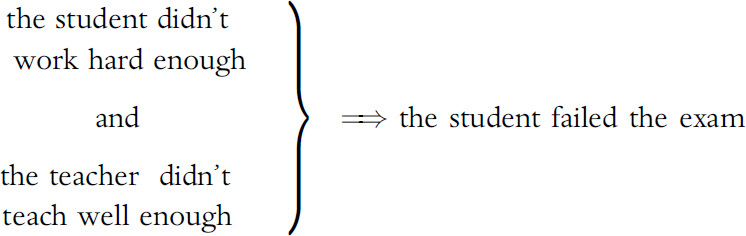
Someone might argue “Well, if the student had worked harder, they’d have passed, so it’s the student’s fault.” Someone else might argue “Well, the student did the best they could but they were so badly taught they didn’t have a chance, so it’s the teacher’s fault”. A former Oxford student sued Oxford University for lost income on the grounds that he was taught so badly it was Oxford’s fault he didn’t get a first-class degree, and that this caused him to lose income in his years since graduation. It’s unadvisable to comment on such cases without all the information, but I would hope that there are better remedies for poor teaching than a lawsuit years later.
The crucial point is that when two factors combine to cause a result, either one of them being different could cause the result to be different. But that doesn’t mean that one of them is individually to blame for the result: it is the combination of the two that caused the result. The logic of this situation is the logic of connectives.
Logical connectives are the way that logical statements are connected to form bigger, more complex statements. It is a general principle in mathematics that a good way to understand something complex is to break it down into simple constituent parts. Then you just have to understand simple building blocks together with the ways of sticking them together. Logical connectives are the way of sticking together simple logical statements into complex wholes.
For example, “The student didn’t work hard enough and the teacher didn’t teach well enough.” The connecting word here is “and”. How could the student have passed? Perhaps if “The student worked harder or the teacher taught better.” The connecting word here is “or”. These two words are the two basic connectives in logic.
“And” and “or” can cause confusion when combined with implication and negation. Breaking a complex claim into smaller statements helps us inspect both the parts and their connections.
The general situation is that given two statements A and B, we get two new statements by using “and” and “or”:
-
A and B are both true.
-
A or B is true.
Everyday usage can make these connections less clear.
In real life it might be that the word “and” doesn’t explicitly appear in a sentence, but we can turn the sentence into an equivalent one where the connective has been made explicit. For example, if someone is a white man, they are white and also a man. Similarly “This is a racial slur” means “This is a statement about race and it is a slur”. The long version sounds pedantic in normal language but clarifies the logic, so in the context of logic could count as precision rather than pedantry. Occasionally clarification is needed in normal language as well. I once said “He’s a black cab driver” in the US and got some very funny looks because people thought I was saying “He’s black and a cab driver”, when really I meant “He’s a driver of black cabs”. (Black cabs are not really a concept in the US and so the interpretation with “and” was more obvious.) The first time I bought a packet of Yorkshire “Chardonnay wine vinegar crisps” I was amused to read the ingredients and discover it was Chardonnay wine and vinegar, not vinegar made from Chardonnay wine.
The mathematical concept of “or” is a bit more tricky than “and” because it’s not quite the same as the way we use it in everyday life. If you ask someone “Would you like tea or coffee?” you might expect the answers tea, coffee or neither. If you ask a pedantic mathematician they are liable to answer yes or no. This is because in mathematics “or” is a logical connective that joins two statements A and B together to make a new statement “A or B”. The new statement is true if either A or B is true, or both. This is different from normal usage in English where “or” often excludes the possibility of both – if I see “tea or coffee” on a fixed-price menu I expect to choose one, and expect that I won’t be allowed to ask for both. This difference makes “or” logically ambiguous, and we humans tend to have to infer the correct meaning from the context. For example, you have to pay excess baggage fees on a plane if your luggage is too big or too heavy. It should be clear from the context that if it is both too heavy and too big you still have to pay extra. This makes it different from the “tea or coffee” type of situation.
Similarly you have higher social status if you are rich or male (or both). You are an LGBTQI person if you identify as lesbian, gay, bisexual, transgender, queer or intersex, or more than one (for example, transgender and lesbian).
Logic and mathematics require things to be unambiguous without us having to understand things according to context. So we have to make a difference between these two uses of the word “or”. The one that excludes the possibility of both is called “exclusive or”. When you’re offered tea or coffee (but not both) that’s an exclusive or. The one that includes the possibility of both is called “inclusive or”, so when you have to pay more if your luggage is too heavy or too big (or both), it’s an inclusive or. This distinction is usually clear from context in normal language, so it becomes pedantry rather than precision. However, in logic we have to make the distinction clear without guessing about context, so the distinction becomes precision rather than pedantry. So when a mathematician answers “yes” to the tea or coffee question, it means that yes, they want tea or coffee or both, and I would say they are being pedantic because not only are they not clarifying the situation, they are actively obfuscating it.
Mathematicians usually use inclusive or unless they specify otherwise. Everyday usage depends on context; “either” can help signal an exclusive choice. Venn diagrams can help picture statements connected by “and” and “or”.
When to use it
In a project review, write competing explanations with explicit conditions, then ask what evidence supports each condition and their proposed connection.
When evaluating a controversial statement, rephrase it using explicit connectives to clarify meaning and avoid ambiguity.
In negotiations, use 'inclusive or' to propose options that allow for combined solutions rather than forcing a binary choice.
During a legal or ethical debate, use logical connectives to precisely describe the combination of conditions that lead to a ruling.
FROM THEORY TO EVERYDAY LIFE
In practice
Failing Student
Suppose a student fails in circumstances where both their preparation and the teaching contributed. Improving either might have changed the result. That possibility does not establish that one factor alone explains the failure or settle how responsibility should be assigned.
Tea or Coffee
In everyday language, 'or' often excludes both options (exclusive or). A pedantic mathematician asked 'Tea or coffee?' might answer 'yes' meaning they want tea or coffee or both, but this ignores the context where only one is expected.
Excess Baggage Fee
Airlines charge extra if luggage is too heavy OR too big. This is an inclusive or: if both conditions apply, the fee is still charged. It demonstrates how context clarifies the logical connective.
A MOMENT TO REFLECT
Put it to work.
Think of a recent outcome you attributed to a single cause. How might a combination of factors (using 'and' and 'or') provide a more accurate analysis?
Consider a situation where you assumed an 'exclusive or' (one or the other, not both). Could an 'inclusive or' interpretation have changed your decision or reasoning?
How could you use logical connectives to avoid oversimplified blame in a team project or personal conflict?
Often confused with
CONTINUE THE CONVERSATION
Source texts
- The Art of Logic How to Make Sense in a World that Doesn’t (Eugenia Cheng)