Information Overload in Cockpit Design
The evolution of cockpit design from minimal controls to complex instrument panels reveals that too much information can overwhelm pilots, emphasizing the need for optimal information presentation. This lesson from aviation applies broadly to high-reliability organizations.
THE IDEA
Lessons Learned in Cockpit Design
The Wright brothers' flyer had no seat, cockpit or control stick. Some years after, pilots flew in open‐air cockpits where they could fly an aircraft with a control stick and a few levers. They could ‘feel’ how fast they travelled and how the plane responded to their course corrections. Aiming to fly in good weather as much as possible, they would navigate and land by eye. The relationship between the pilot and the aircraft was direct and visceral.
Sadly, unforeseen design weaknesses, poor construction, poor‐quality materials, adverse weather conditions, etc., resulted in aircraft crashes. So, over the years, there were improvements in airframe design, cockpit design, construction techniques, available materials, etc., to allow pilots to fly aircraft in increasingly demanding situations (e.g. in poor weather and at night).
As time progressed, aviation electronics became a recognised specialist field (known as ‘avionics’). With improved radio and navigation equipment, radar, and air traffic control centres, flying became increasingly safer, enabling long distance flights and allowing pilots to land safely in challenging situations. Cockpits were fitted with more instruments and controls. Inevitably, the crew of an aircraft was increasingly removed from the ‘no filter’ experience of the early days.
A turning point was reached during the 1960s and 1970s when it became clear that sometimes flight crews were becoming overwhelmed and confused with too much information in the cockpit. Wiener and Nagel, authors of ‘Human Factors in Aviation’,2 summed up the essential problem:
‘Crew system designs and flight station layouts … frequently ignored the limitations and capabilities of the human operator’.
Henceforth, cockpits were built following Aerospace Recommended Practices (ARPs)3 so that flight crew could:
- reach controls without effort,
- clearly see flight instruments and
- communicate easily with one another and air traffic control.
Insights concerning instrumentation and control design from the world of aviation have been distilled and adapted by organisations such as the Institute for Ergonomics and Human Factors,4 which transmits its knowledge of appropriate instrumentation and control panel design to many High‐Reliability Organisations (e.g. chemical plant and railway control rooms).
The critical learning about appropriate control panel design is captured in Illustration 5.1; not enough information is bad, but having lots of information is not always better. As I will explain shortly, the importance of this lesson may have yet to be appropriately recognised and applied in a range of other contexts.
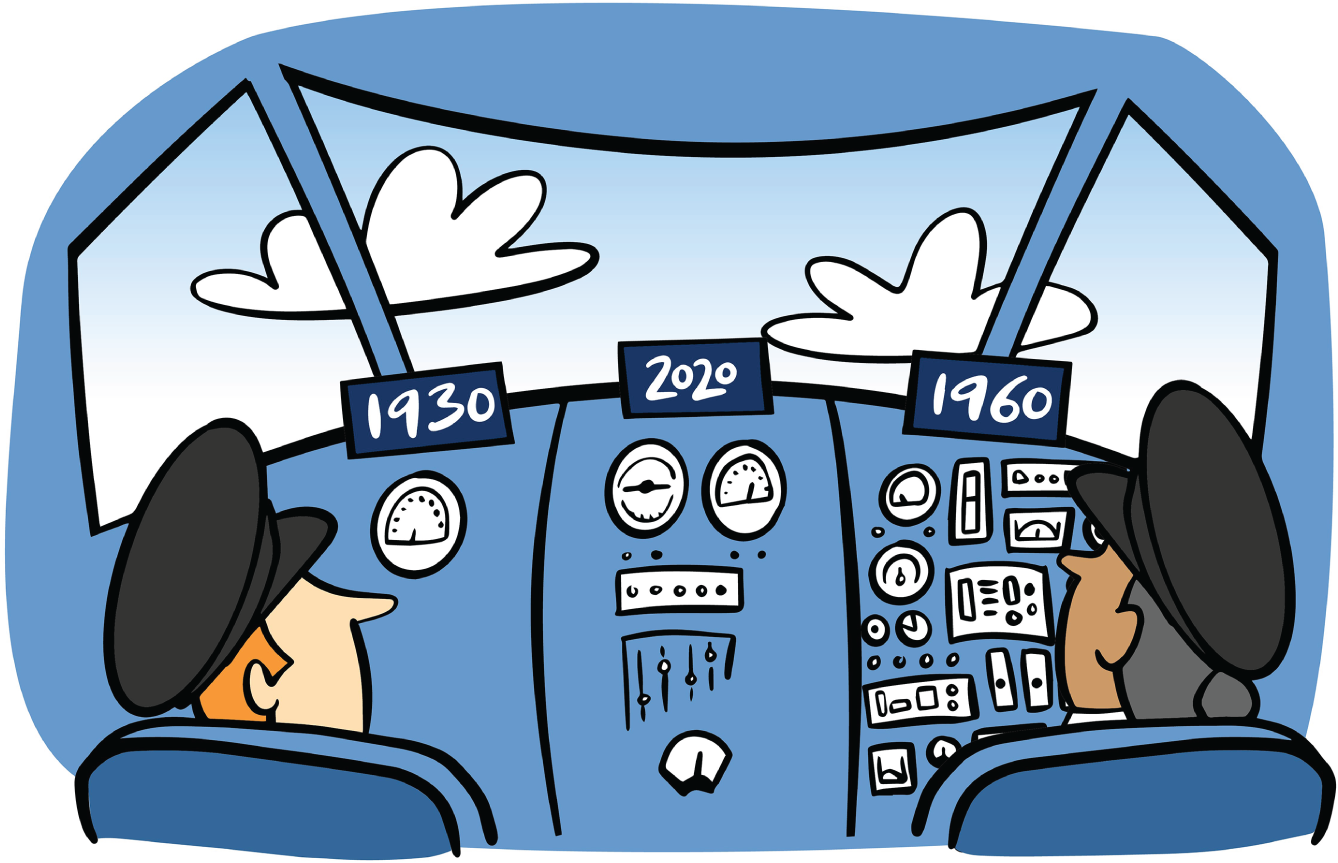
Illustration 5.1 Communication and information
A former airline captain explains:
‘For my flying career, I have been impressed by how cockpit design has evolved, with more augmented displays, touchscreen controls and a clear hierarchy of cockpit messages and warnings.
Regular flight simulator training also ensures that rarely seen messages are understood and – even more importantly – you can recognise when instruments are not working correctly and then “piece together” what is happening.
No matter how much you are used to relying on instruments, you must always be “on the lookout for trouble”. You need to have situational awareness of where you are in relation to the topography of land and sea, etc.
Instrumentation is vitally important, but you must think about what it is and is not telling you, and above all, remember to fly the aircraft in the air.’
So, despite developments in instrumentation panels, there can still be shortcomings and difficulties in interpreting instruments and warnings, especially in high‐stress environments.
When to use it
Designing a user interface for a nuclear power plant control room to ensure operators are not overwhelmed.
Creating a sales dashboard for executives that highlights key metrics without extraneous data.
Developing training simulations for emergency responders to practice interpreting critical information under stress.
Organizing a command center for disaster response with clear communication hierarchies and instrument panels.
FROM THEORY TO EVERYDAY LIFE
In practice
Historical Cockpit Evolution
Early aircraft had minimal controls, providing direct feedback. Over time, cockpits became filled with instruments, causing pilot overwhelm in the 1960s-70s. This led to redesigns following human factors principles.
Pilot Testimony on Modern Cockpits
A former airline captain describes how augmented displays and regular simulator training help manage information, but stresses the importance of maintaining situational awareness and not relying solely on instruments.
A MOMENT TO REFLECT
Put it to work.
Consider a dashboard or interface you use frequently. What information is essential, and what could be removed or simplified to reduce overload?
In a high-stress situation, how do you distinguish between critical information and noise? What strategies can help maintain situational awareness?
How might the lesson of cockpit design apply to your own presentations, reports, or data visualizations? Are you providing the right amount of information?
References
- Human Factors in Aviation — Wiener and Nagel (1988)
CONTINUE THE CONVERSATION
Source texts
- Beyond the Five Whys Root Cause Analysis and Systems Thinking (James C. Paterson)