Implicit Levels
The concept of Implicit Levels explains how analogies in everyday life are ambiguous because the abstract principle is not explicitly stated, leading to different interpretations. Disagreements arise when people infer different levels of abstraction from the same analogy, either seeing a more specific or more general principle at work.
THE IDEA
Analogies in everyday life can be ambiguous because we leave their abstract principles unstated. But the people who hear the analogy can infer the abstract principle in different ways, and are especially likely to do so if they disagree with us.
A reasonable starting point is the narrowest principle that connects the cases. For example, someone arguing that marriage should include gay couples might invoke commitment between “2 unrelated adults”. That analogy alone does not commit the speaker to extending marriage to every conceivable combination of people.
One of the reasons analogies are ambiguous in normal life is that we rarely make explicit what abstract principle we are invoking. After all, one of the main points of the exercise is to appeal to people intuitively and not have to exert their abstraction abilities. However, everyone then has to guess what principle is being invoked. Whereas in maths, making the abstract principle explicit is practically the entire point. We look at analogous situations A and B, and make a precise statement of what principle X we are going to study that causes them. There can therefore be no ambiguity: if A and B are both examples of X, and X is true, then A and B must both be true.
Disagreements over analogies basically take two forms, as in the argument about gay marriage. It starts by someone invoking an analogy of this form:
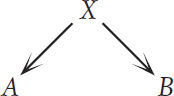
However, typically X is not explicitly stated. Now someone objects, either because they see a more specific principle W at work that is really the reason behind A, so they do not consider A and B to be analogous:
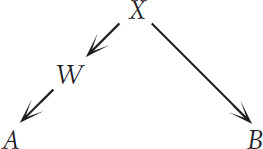
Or, they see a more general principle Y that they think the first person is invoking. This makes some other thing C analogous, and they object to that:
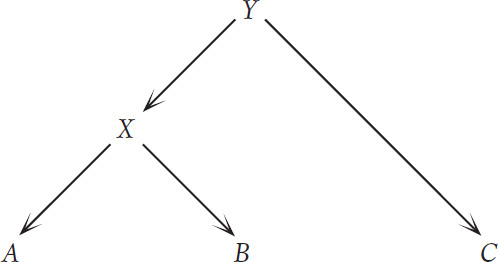
In both cases it would be more helpful to be clearer about what the principles at work really are, to explore the sense in which the different cases are and aren’t analogous, rather than just declaring that something is or is not analogous.
For example, is racism by white people against black people the same as racism by black people against white people? Here is a diagram that shows the sense in which it is and isn’t the same:
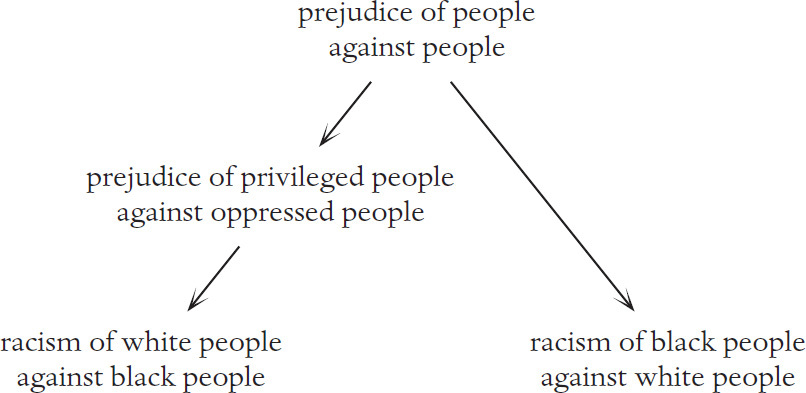
The argument is really about which level of principle we should go up to.
There is no right answer to what a good level of abstraction is for understanding a situation. All analogies break down somewhere. That is the whole point of an analogy: it is not the same as the original thing; it is similar in some way but therefore it is also different in some way. Pointing out that an analogy breaks down does not mean the analogy is bad. But if the analogy breaks down in some way that is relevant to what we’re discussing, that could be more important.
I think the best we can do is explore different levels and find out what levels cause analogies to appear and to break. This shows us what abstract principle is at work. In the end the whole aim is to reach greater understanding of in what way situations are equivalent and in what way they are not.
One way in which addition and multiplication are not analogous is if we consider inverses. Adding a number can always be inverted (undone) by subtraction. But multiplication by a number can’t always be undone – we can’t undo multiplication by 0, because we “can’t divide by 0”. What that really comes down to is that multiplication by 0 results in 0 wherever we start, so if we try to reverse that process we have no way of knowing where to go back to, whereas with addition we always know.
When to use it
Debating social issues: understanding that analogies can be interpreted at different levels helps clarify discussions and avoid false equivalence.
Teaching: explaining abstract concepts using analogies, but being explicit about the principle being conveyed to prevent misinterpretation.
Critical thinking: analyzing an opponent's analogy by identifying the level of abstraction they assume and where the analogy breaks down.
Problem-solving: using analogies to model solutions in new domains, but being aware of where the analogy fails to apply.
FROM THEORY TO EVERYDAY LIFE
In practice
Gay Marriage Analogy
Someone argues that if marriage is about commitment between two adults, then it should apply to gay couples. The objector might see a more specific principle (e.g., traditional union of man and woman) or a more general principle (e.g., any combination of people) that leads to different conclusions about what the analogy implies.
Racism Analogy
Comparing racism by white people against black people with racism by black people against white people. The disagreement is about what level of principle (e.g., racial power dynamics vs. individual discrimination) should be applied to determine whether they are equivalent.
A MOMENT TO REFLECT
Put it to work.
Think of a recent argument you had where an analogy was used. What level of abstraction was each person assuming?
How can you make the abstract principle explicit in your next discussion to avoid misunderstanding?
In what ways do analogies break down when taken too far, and how can that help refine your understanding?
CONTINUE THE CONVERSATION
Source texts
- The Art of Logic How to Make Sense in a World that Doesn’t (Eugenia Cheng)