Implicit and Explicit Subadditivity in Probability Judgments
Mutually exclusive and exhaustive events should have probabilities that sum to 1. This entry compares judgments for whole events and their subcategories using political affiliations and trial verdicts.
THE IDEA
Table 26.1. Median Probability Judgments Used to Test Implicit and Explicit Subadditivity in Study 1
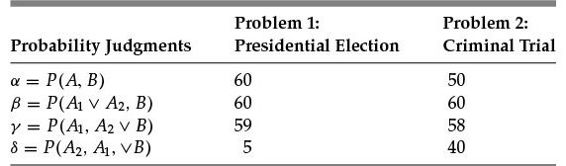
Note: In Problem 1, A1 = Republican, A2 = Independent, A = not Democrat, and B = Democrat. In Problem 2, A1 = not guilty, A2 = hung jury, A= result other than guilty, and B = guilty.
When to use it
Evaluating political polling data to adjust for subadditive probability estimates.
Assessing legal judgments where jurors must combine probabilities of different verdicts.
Training professionals in forecasting to recognize and correct for subadditive assessments.
Designing survey questions that minimize subadditivity in respondent judgments.
FROM THEORY TO EVERYDAY LIFE
In practice
Political Affiliation Judgment
In Problem 1, participants might judge the probability that a person is a Democrat (B) as 0.45 and the probability they are not a Democrat (A) as 0.60. These sum to 1.05, an inconsistent total for complementary events. Comparing A with the sum of A1 and A2 is a separate comparison.
Verdict Probability
In Problem 2, a juror might assign a 0.70 probability to a guilty verdict (B) and a 0.40 probability to a not guilty verdict (A1). A1 denotes not guilty, A2 a hung jury, and A either non-guilty outcome. These figures alone do not establish how the judgment for A compares with the sum of A1 and A2.
A MOMENT TO REFLECT
Put it to work.
How could judgments differ when a category is described as a whole rather than as separate subcategories?
How does the distinction between implicit and explicit judgments affect the magnitude of subadditivity?
In what real-world scenarios could subadditivity lead to flawed decision-making?
CONTINUE THE CONVERSATION
Source texts
- Heuristics and Biases The Psychology of Intuitive Judgment (Thomas Gilovich, Dale Griffin, Daniel Kahneman)