Human Factors
Human Factors is a discipline that applies knowledge of human abilities, characteristics, and limitations to the design of equipment, environments, and jobs, especially in high-stakes settings like aviation. It emphasises that organisations must proactively accommodate human variability and error rather than expecting perfect performance.
THE IDEA
Human Factors
The discipline of Human Factors, developed in earnest after World War II, incorporates human error and human variability thinking. It asks that airlines and other organisations where the stakes are high (e.g. High‐Reliability Organisations) should proactively think about the ways they can recognise and optimise human behaviour in the following spirit, spelled out by the Institute of Human Factors and Ergonomics:
‘The application of what we know about people, their abilities, characteristics and limitations to the design of equipment they use, environments in which they function and jobs they perform.’9
Human Factors thinking recognises, among other things, that people only have a certain ‘bandwidth’, which is one of the reasons cockpit instrumentation was ‘decluttered’. Likewise, Human Factors thinking is central to appreciating why flight simulators are so important; you can hire good people, and you can train them and test them on the theory, but unless you put them in highly realistic simulations of what might happen, you can't be sure what they will do.10
There are many valuable resources concerning Human Factors, but some people find the following analogy to be useful. If an organisation was staffed with personnel such as ‘Sully’, Mr Spock from Star Trek11 or Superman, you might be confident colleagues would make the right decisions, remember every policy and procedure by heart, not get distracted from the task at hand, share information and cooperate for the organisation's good.
But most people (including those with plenty of qualifications and experience) get tired, forget, don't always think logically and may not always share or interpret information the same way. This may be because they don't appreciate the significance of something or they are tired or demotivated or even because of resentments and rivalries between colleagues.12
So, the argument goes, no matter what Human Resource processes you put in place or what work you do on organisational culture and values, you can't guarantee what everyone in your organisation will think and how everyone will behave.
Illustration 10.1 tries to highlight the difference between robots, Vulcans, superheroes and human beings. We must recognise the enormous diversity of experiences, capabilities and mindsets that people have, which can have both positive and negative consequences for organisations, and which often cannot be eliminated. So, with a Human Factors mindset, you need to organise roles, tasks, etc., so that, even if you get human variation, things will still work within acceptable limits.
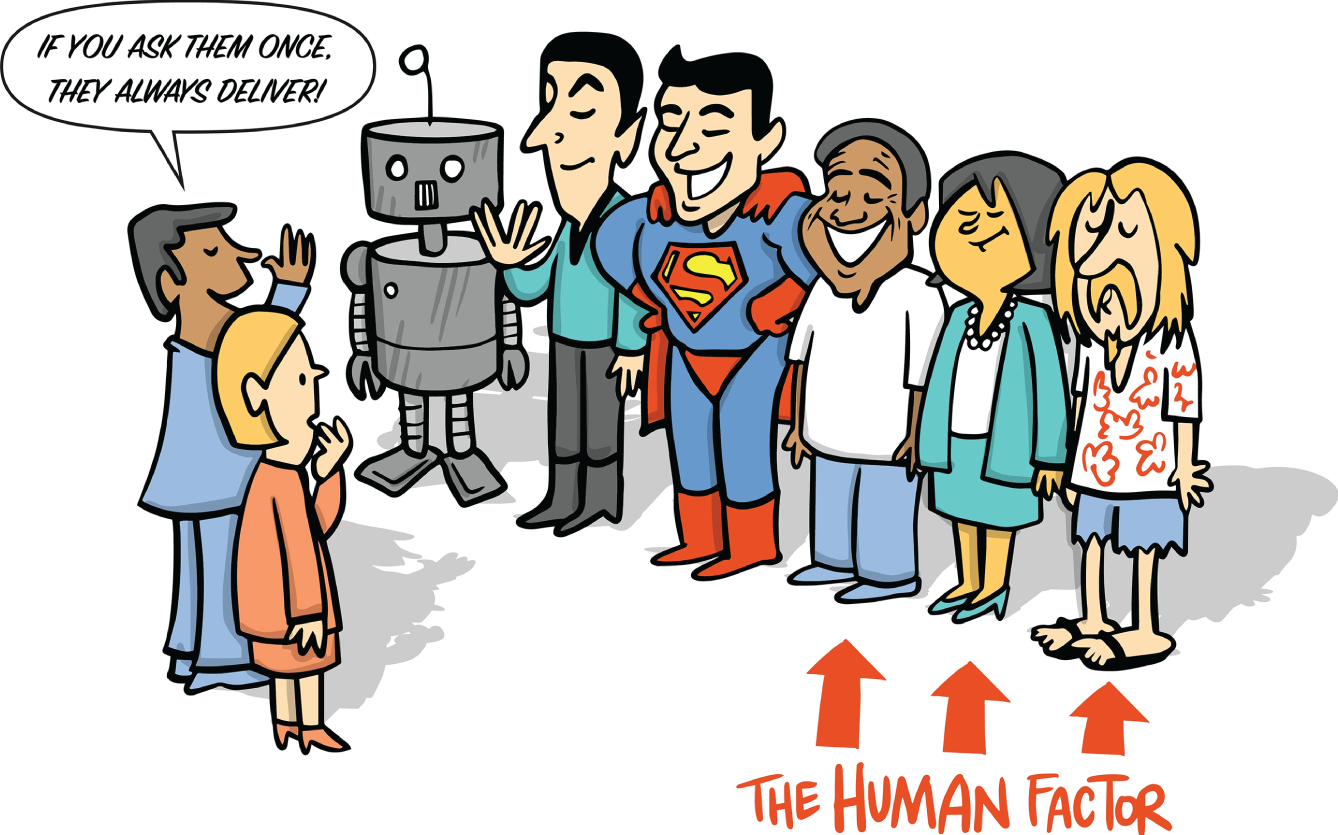
Illustration 10.1 The Human Factor
When to use it
Aviation: Designing cockpit layouts and emergency checklists that minimize cognitive load.
Healthcare: Structuring surgical teams and operating room checklists to reduce errors from fatigue or miscommunication.
Software: Developing user interfaces that prevent common mistakes, such as confirmation dialogs before irreversible actions.
Manufacturing: Arranging assembly line tasks to allow for natural human variation, using tools like jigs and clear labeling.
FROM THEORY TO EVERYDAY LIFE
In practice
Cockpit Decluttering
Human Factors thinking led to the decluttering of cockpit instrumentation because pilots have limited 'bandwidth' to process information. By reducing visual noise and prioritizing critical data, designers enable pilots to focus on essential tasks during flight.
Flight Simulators for Training
Flight simulators test how pilots will react in realistic, high-pressure scenarios. This approach recognizes that theoretical knowledge alone is insufficient; human performance must be observed and refined through simulated emergencies.
A MOMENT TO REFLECT
Put it to work.
Think of a system you use daily (e.g., software, workplace procedures). How could it be redesigned to accommodate human limitations like fatigue or distraction?
Recall a time when human error led to a problem in your organization. Was the error attributed to the individual, or was the system design considered? How might a Human Factors perspective change the response?
Imagine you are designing training for a demanding task. How would you use simulation to assess performance under realistic conditions and identify where more practice or better system design is needed?
CONTINUE THE CONVERSATION
Source texts
- Beyond the Five Whys Root Cause Analysis and Systems Thinking (James C. Paterson)