How the Right Kind of Listening Motivates People to Change
Generic warnings and lectures can leave a vaccine-hesitant parent feeling attacked. Grant introduces Marie-Hélène’s experience and a doctor who starts by interviewing parents about their concerns. The excerpt sets up this approach but ends before their conversation.
THE IDEA
How the Right Kind of Listening Motivates People to Change

It’s a rare person who wants to hear what he doesn’t want to hear.
—Attributed to Dick Cavett
When Marie-Hélène Étienne-Rousseau went into labor, she broke down in tears. It was September 2018, and her baby wasn’t due until December. Just before midnight, Tobie arrived, weighing just two pounds. His body was so tiny that his head could fit in the palm of her hand, and Marie-Hélène was terrified that he wouldn’t survive. Tobie spent only a few seconds in her arms before he was rushed to the neonatal intensive care unit. He needed a mask to breathe and was soon taken to surgery for internal bleeding. It would be months before he was allowed to go home.
While Tobie was still in the hospital, Marie-Hélène was shopping for diapers when she saw a headline about measles spreading in her province of Quebec. She hadn’t had Tobie vaccinated. It wasn’t even a question—he seemed too fragile. She hadn’t vaccinated her three other children, either; it wasn’t the norm in her community. Her friends and neighbors took it for granted that vaccines were dangerous and passed around horror stories about their side effects. Still, the fact remained: Quebec had already had two serious measles outbreaks that decade.
Writing about the period covered by his book, Grant reports rising measles cases and mortality estimates of about one in a thousand in developed countries and one in a hundred in developing countries. He cites estimates that deaths rose worldwide from 2016 to 2018 by 58 percent, exceeding a hundred thousand. He also reports roughly 20 million lives saved by vaccination over the preceding two decades, a recommended immunisation rate of 95 percent, and global coverage figures of 85 percent for a first dose and 67 percent for a second. These are figures from that account, rather than current surveillance data.
Government officials have tried to prosecute the problem, some warning that the unvaccinated could be fined up to a thousand dollars and sentenced to jail for up to six months. Many schools shut their doors to unvaccinated children, and one county even banned them from enclosed public places. When such measures failed to solve the problem, public officials turned to preaching. Since people held unfounded fears about vaccines, it was time to educate them with a dose of the truth.
The results were often disappointing. In a pair of experiments in Germany, introducing people to the research on vaccine safety backfired: they ended up seeing vaccines as riskier. Similarly, when Americans read accounts of the dangers of measles, saw pictures of children suffering from it, or learned of an infant who nearly died from it, their interest in vaccination didn’t rise at all. And when they were informed that there was no evidence that the measles vaccine causes autism, those who already had concerns actually became less interested in vaccinating. In those experimental conditions, the messages did not produce the intended change. That does not establish that evidence-based explanations always fail.
Resistance can sometimes strengthen a belief. Grant compares it to inoculation: rehearsing objections gives us ready answers to later attempts at persuasion. The comparison describes one possible response, rather than an inevitable effect of disagreement.
Marie-Hélène Étienne-Rousseau had been through that journey. Visits to the doctor with her older kids followed a familiar script. The doctor extolled the benefits of vaccines, warned her about the risks of refusing them, and stuck to generic messaging instead of engaging with her particular questions. The whole experience reeked of condescension. Marie-Hélène felt as if she were being attacked, “as if she were accusing me of wanting my kids to get sick. As if I were a bad mother.”
When tiny Tobie was finally cleared to leave after five months in the hospital, he was still extremely vulnerable. The nurses knew it was their last chance to have him vaccinated, so they called in a vaccine whisperer—a local doctor with a radical approach for helping young parents rethink their resistance to immunizations. He didn’t preach to parents or prosecute them. He didn’t get political. He put on his scientist hat and interviewed them.
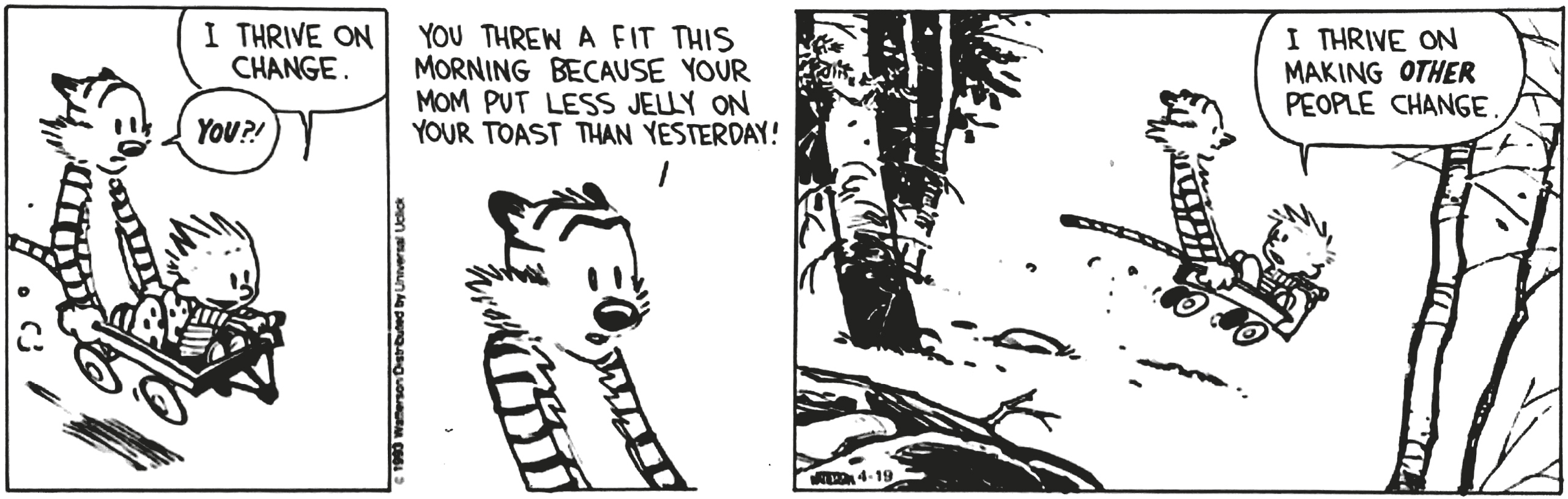
Calvin & Hobbes © 1993 Watterson. Reprinted with permission of ANDREWS MCMEEL SYNDICATION. All rights reserved.
When to use it
A doctor trying to convince a vaccine-hesitant parent about immunization.
A manager encouraging employees to adopt new safety protocols despite initial resistance.
A teacher addressing students' misconceptions about a scientific topic.
A friend trying to persuade someone to change a harmful habit like smoking.
FROM THEORY TO EVERYDAY LIFE
In practice
Marie-Hélène’s Concerns About Vaccination
Marie-Hélène had not vaccinated her children and felt accused by earlier doctors’ generic warnings. Before her premature baby left hospital, nurses called a doctor known for interviewing parents about their concerns. The excerpt ends at that introduction.
Backfiring of Fact-Based Persuasion in Germany
Grant describes experiments in Germany in which vaccine-safety messages increased perceived risk. They illustrate a possible backfire under the tested conditions, rather than showing that presenting facts generally makes resistance stronger.
A MOMENT TO REFLECT
Put it to work.
How can you engage with someone's specific concerns rather than giving generic facts when trying to persuade them?
Why do counterarguments sometimes strengthen beliefs instead of changing them?
What is the role of empathy and listening in changing minds, and how can you practice it in your own interactions?
Often confused with
CONTINUE THE CONVERSATION
Source texts
- Think Again The Power of Knowing What You Dont Know (Adam Grant)