How Much Is That in Dead Americans?
This bias involves scaling deaths or impacts from small populations to larger ones (like the US) using proportional equivalency, but this reasoning often breaks down because different scaling methods yield different results and context is lost.
THE IDEA
HOW MUCH IS THAT IN DEAD AMERICANS?
How bad is the conflict in the Middle East? Counterterrorism specialist Daniel Byman of Georgetown University lays down some cold, hard numbers in Foreign Affairs: “ The Israeli military reports that from the start of the second intifada [in 2000] through the end of October 2005, Palestinians killed 1,074 Israelis and wounded 7,520—astounding figures for such a small country, the proportional equivalent of more than 50,000 dead and 300,000 wounded for the United States.” This kind of computation has become commonplace in discussions of the region. In December 2001 the U.S. House of Representatives declared that the 26 people killed by a series of attacks in Israel were “ the equivalent, on a proportional basis, of 1,200 American deaths.” Newt Gingrich in 2006: “ Remember that when Israel loses eight people, because of the difference in population, it’s the equivalent of losing almost 500 Americans.” Not to be outdone, Ahmed Moor wrote in the Los Angeles Times: “ When Israel killed 1,400 Palestinians in Gaza—proportionally equivalent to 300,000 Americans—in Operation Cast Lead, incoming President Obama stayed mum.”
The rhetoric of proportion isn’t reserved for the Holy Land. In 1988, Gerald Caplan wrote in the Toronto Star, “ Some 45,000 Nicaraguans on both sides of the struggle have been killed, wounded or kidnapped in the past eight years; in perspective, that’s the equivalent of 300,000 Canadians or 3 million Americans.” Robert McNamara, the Vietnam-era secretary of defense, said in 1997 that the nearly 4 million Vietnamese deaths during the war were “ equivalent to 27 million Americans.” Anytime a lot of people in a small country come to a bad end, editorialists get out their slide rules and start figuring: how much is that in dead Americans?
Here’s how you generate these numbers. The 1,074 Israelis killed by terrorists amount to about 0.015% of the Israeli population (which between 2000 and 2005 ranged from about 6 to 7 million). So the pundits are reckoning that the death of 0.015% of the much larger United States population, which indeed comes to about 50,000, would have roughly the same impact here.
This is lineocentrism in its purest form. According to the argument by proportion, you can find the equivalent of 1,074 Israelis anywhere around the globe via the graph below:
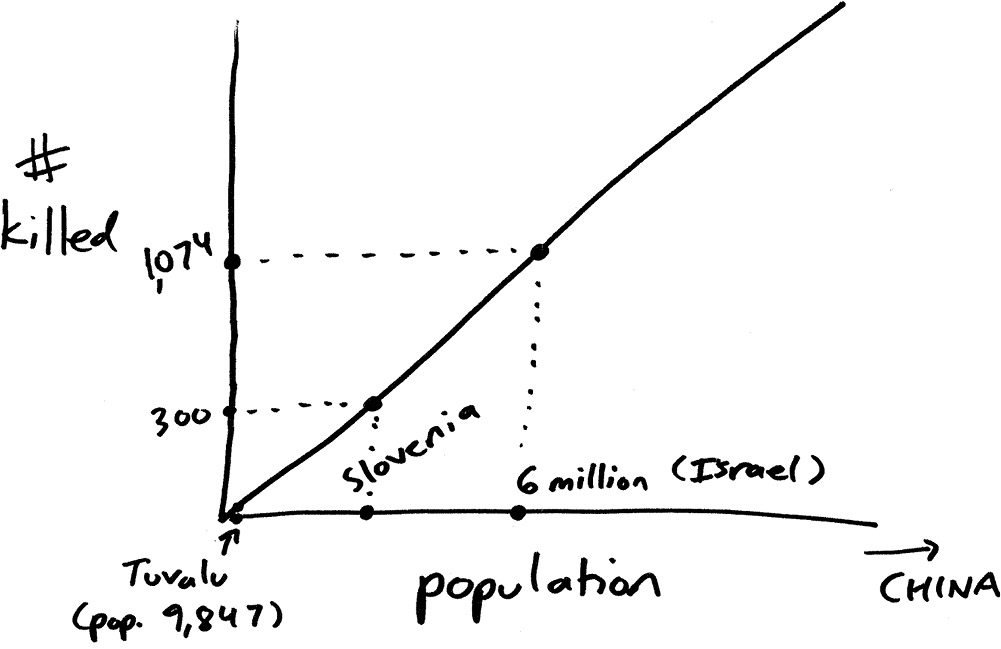
The 1,074 Israeli victims are equivalent to 7,700 Spaniards or 223,000 Chinese, but only 300 Slovenes and either one or two Tuvaluans.
Eventually (or perhaps immediately?) this reasoning starts to break down. When there are two men left in the bar at closing time, and one of them coldcocks the other, it is not equivalent in context to 150 million Americans getting simultaneously punched in the face.
Or: when 11% of the population of Rwanda was wiped out in 1994, all agree that it was among the worst crimes of the century. But we don’t describe the bloodshed there by saying, “In the context of 1940s Europe, it was nine times as bad as the Holocaust.” And to do so would set teeth rightly on edge.
An important rule of mathematical hygiene: when you’re field-testing a mathematical method, try computing the same thing several different ways. If calculations that claim to measure the same thing give different answers, check their assumptions. Different reference populations may answer different questions.
For example: the 2004 bombings at the Atocha train station in Madrid killed almost 200 people. What would be an equivalently deadly bombing at Grand Central Station?
The United States has almost seven times the population of Spain. So if you think of 200 people as 0.0004% of the Spanish population, you find that an equivalent attack would kill 1,300 people in the United States. On the other hand, 200 people is 0.006% of the population of Madrid; scaling up to New York City, which is two and a half times as large, gives you 463 victims. Or should we compare the province of Madrid with the state of New York? That gives you something closer to 600. The different results expose a choice the calculation cannot make for us: which population is relevant to the comparison?
One can’t, of course, reject proportions entirely. Proportions matter! If you want to know which parts of America have the biggest brain cancer problem, it doesn’t make much sense to look at the states with the most deaths from brain cancer: those are California, Texas, New York, and Florida, which have the most brain cancer because they have the most people. Steven Pinker makes a similar point in The Better Angels of Our Nature. The useful comparison depends on the question: raw totals and population rates convey different information.
When to use it
Evaluating news reports that compare death tolls from different countries by scaling to a familiar population.
Critiquing political speeches that use proportional equivalency to evoke sympathy or outrage.
Analyzing historical comparisons (e.g., Holocaust vs. Rwanda) to avoid trivializing unique events.
Teaching critical thinking about statistical methods and the importance of context in data interpretation.
FROM THEORY TO EVERYDAY LIFE
In practice
Israeli Deaths Scaled to US
Pundits often scale Israeli fatalities to the US population to convey impact. For example, 1,074 Israeli deaths (0.015% of population) are said to be equivalent to 50,000 US deaths. But this ignores differences in context, scale, and emotional resonance.
Madrid Bombing Scaling
The 2004 Madrid train bombings killed nearly 200 people. Ellenberg’s examples produce equivalents ranging from 463 to 1,300 US deaths depending on whether the comparison uses cities or countries. The arithmetic does not decide which reference population is appropriate.
A MOMENT TO REFLECT
Put it to work.
When you see a statistic scaled to a different population, ask yourself: What is the base population used, and could different scaling methods lead to different conclusions?
Why might using proportional equivalency for emotional impact be misleading in contexts like war or terrorism?
Can you think of a real-world example where proportional scaling was used in a way that you now suspect is flawed?
How would you explain the breakdown of proportional reasoning when comparing very small groups (like two men in a bar) to very large populations?
References
- Foreign Affairs article on Israeli-Palestinian conflict — Daniel Byman
- U.S. House of Representatives declaration on Israeli attacks — U.S. House of Representatives (2001)
- Comment on Israeli losses — Newt Gingrich (2006)
- Los Angeles Times article on Gaza casualties — Ahmed Moor
- Toronto Star article on Nicaraguan casualties — Gerald Caplan (1988)
- Statement on Vietnamese war deaths — Robert McNamara (1997)
- The Better Angels of Our Nature — Steven Pinker (2011)
CONTINUE THE CONVERSATION
Source texts
- How Not to Be Wrong The Power of Mathematical Thinking (Ellenberg, Jordan)