How Fat Tails (Extremistan) Come from Nonlinear Responses to Model Parameters
Taleb argues that uncertainty about model parameters can raise estimated tail probabilities through nonlinear effects. He uses uncertainty about Gaussian standard deviation to illustrate the sensitivity of rare-event estimates and the danger of treating parameters as known.
THE IDEA
How Fat Tails (Extremistan) Come from Nonlinear Responses to Model Parameters
Rare events have a certain property—missed so far at the time of this writing. We deal with them using a model, a mathematical contraption that takes input parameters and outputs the probability. The more parameter uncertainty there is in a model designed to compute probabilities, the more small probabilities tend to be underestimated. Simply, small probabilities are convex to errors of computation, as an airplane ride is concave to errors and disturbances (remember, it gets longer, not shorter). The more sources of disturbance one forgets to take into account, the longer the airplane ride compared to the naive estimation.
We all know that to compute probability using a standard Normal statistical distribution, one needs a parameter called standard deviation—or something similar that characterizes the scale or dispersion of outcomes. But uncertainty about such standard deviation has the effect of making the small probabilities rise. For instance, for a deviation that is called “three sigma,” events that should take place no more than one in 740 observations, the probability rises by 60% if one moves the standard deviation up by 5%, and drops by 40% if we move the standard deviation down by 5%. So if your error is on average a tiny 5%, the underestimation from a naive model is about 20%. Great asymmetry, but nothing yet. It gets worse as one looks for more deviations, the “six sigma” ones (alas, chronically frequent in economics): a rise of five times more. The rarer the event (i.e., the higher the “sigma”), the worse the effect from small uncertainty about what to put in the equation. With events such as ten sigma, the difference is more than a billion times. We can use the argument to show how smaller and smaller probabilities require more precision in computation. The smaller the probability, the more a small, very small rounding in the computation makes the asymmetry massively significant. For tiny, very small probabilities, you need near-infinite precision in the parameters; the slightest uncertainty there causes mayhem. They are very convex to perturbations. This in a way is the argument I’ve used to show that small probabilities are incomputable, even if one has the right model—which we of course don’t.
The same argument relates to deriving probabilities nonparametrically, from past frequencies. If the probability gets close to 1/ sample size, the error explodes.
This of course explains the error of Fukushima. Similar to Fannie Mae. To summarize, small probabilities increase in an accelerated manner as one changes the parameter that enters their computation.
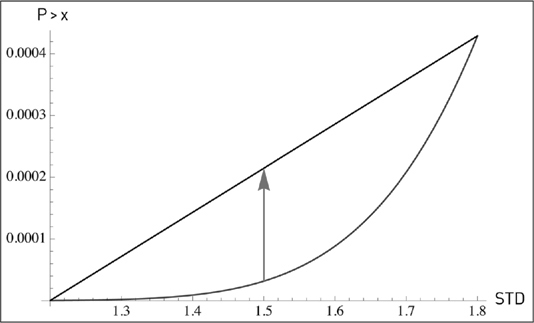
FIGURE 38. The probability is convex to standard deviation in a Gaussian model. The plot shows the STD effect on P>x, and compares P>6 with an STD of 1.5 compared to P>6 assuming a linear combination of 1.2 and 1.8 (here a(1)=1/5).
The worrisome fact is that a perturbation in σ extends well into the tail of the distribution in a convex way; the risks of a portfolio that is sensitive to the tails would explode. That is, we are still here in the Gaussian world! Such explosive uncertainty isn’t the result of natural fat tails in the distribution, merely small imprecision about a future parameter. It is just epistemic! So those who use these models while admitting parameters uncertainty are necessarily committing a severe inconsistency.2
Of course, uncertainty explodes even more when we replicate conditions of the non-Gaussian real world upon perturbating tail exponents. Even with a powerlaw distribution, the results are severe, particularly under variations of the tail exponent as these have massive consequences. Really, fat tails mean incomputability of tail events, little else.
When to use it
Evaluating rare event risks in financial portfolios (e.g., tail risk hedging).
Designing safety margins for critical infrastructure (nuclear plants, dams).
Interpreting pandemic probability models given uncertainty in disease spread parameters.
Assessing the reliability of extreme weather forecasts under climate model parameter uncertainty.
FROM THEORY TO EVERYDAY LIFE
In practice
Three Sigma Underestimation
Taleb’s three-sigma illustration starts with an expected 1 in 740 occurrences. He reports that a 5% upward change in standard deviation raises the probability by 60%, while a 5% downward change lowers it by 40%, and describes naive underestimation as about 20%. The example illustrates asymmetric sensitivity to parameter changes.
Fukushima Disaster
Taleb invokes Fukushima as an example of underestimated rare-event risk. The parameter-sensitivity argument identifies a possible modeling problem; the passage does not provide a reconstruction establishing its role in the disaster.
A MOMENT TO REFLECT
Put it to work.
Why does small parameter uncertainty lead to massive underestimation of tail probabilities?
How can this principle be applied to improve risk assessment in fields like finance or engineering?
What real-world disasters might be explained by the incomputability of tail events due to parameter sensitivity?
Often confused with
CONTINUE THE CONVERSATION
Source texts
- Antifragile (Nassim Nicholas Taleb)