Hot-Hand Fallacy
The hot-hand fallacy is inferring a higher chance of success from a recent streak without adequate evidence. This passage discusses historical basketball data in which shooting percentages were lower after hits than after misses; the result concerns that analysis, rather than proving that performance can never change.
THE IDEA
Analysis of Conditional Probabilities
Do players hit a higher percentage of their shots after having just made their last shot (or last several shots), than after having just missed their last shot (or last several shots)? Table 33.1 displays these conditional probabilities for the nine major players of the Philadelphia 76ers during the 1980–1981 season. Column 5 presents the overall shooting percentage for each player ranging from 46% for Hollins and Toney to 62% for Dawkins. Columns 6 through 8 present the players’ shooting percentages conditioned on having hit their last shot, their last two shots, and their last three shots, respectively. Columns 2 through 4 present the players’ shooting percentages conditioned on having missed their last shot, their last two shots, and their last three shots, respectively. Column 9 presents the (serial) correlation between the outcomes of successive shots.
Table 33.1. Probability of Making a Shot Conditioned on the Outcome of Previous Shots for Nine Members of the Philadelphia 76ers
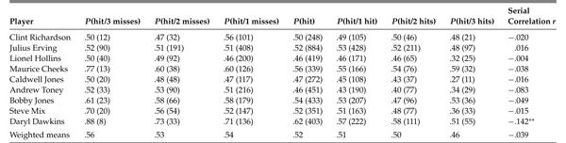
Note: Since the first shot of each game cannot be conditioned, the parenthetical values in columns 4 and 6 do not sum to the parenthetical value in column 5. The number of shots upon which each probability is based is given in parentheses.
* p < .05.
** p < .01.
A comparison of columns 4 and 6 indicates that for eight of the nine players the probability of a hit is actually lower following a hit (weighted mean: 51%) than following a miss (weighted mean: 54%), contrary to the hot-hand hypothesis. Consequently, the serial correlations in column 9 are negative for eight of the nine players, but the coefficients are not significantly different from zero except for one player (Dawkins). Comparisons of column 7, P(hit/2 hits), with column 3, P(hit/2 misses), and of column 8, P(hit/3 hits), with column 2, P(hit/3 misses), provide additional evidence against streak-shooting; the only trend in these data runs counter to the hot-hand hypothesis (paired t = −2.79, p *< .*05 for columns 6 and 4; t = −3.14, p *< .*05 for columns 7 and 3; t = −4.42, p *< .*01 for columns 8 and 2). Additional analyses show that the probability of a hit following a “hot” period (three or four hits in the last four shots) was lower (weighted mean: 50%) than the probability of a hit (weighted mean: 57%) following a “cold” period (zero or one hit in the last four shots).
When to use it
Assessing whether a player’s recent shots provide enough evidence to change expectations about the next one.
A gambler increasing bets after a winning streak, believing the luck will persist.
Examining whether a stock’s recent rise provides information about future returns or merely invites an assumption that the trend will continue.
Assessing whether an employee’s consecutive successes reflect skill, changing conditions, or chance before assigning more responsibility.
FROM THEORY TO EVERYDAY LIFE
In practice
Basketball Shooting Streaks
During the 1980–1981 season, the Philadelphia 76ers' nine major players were studied to test the hot-hand hypothesis. For eight out of nine players, the probability of making a shot was lower after having made the previous shot (weighted mean 51%) than after having missed (weighted mean 54%). The authors interpreted these results as evidence against streak-shooting in that dataset.
Gambling and Winning Streaks
A gambler at a roulette table observes that the last three spins landed on black. Believing in a hot hand, he increases his bet on black, assuming the streak will continue. In reality, each spin is independent, and the probability of black remains the same (approximately 47.4% in American roulette).
A MOMENT TO REFLECT
Put it to work.
What evidence would distinguish a genuine change in performance from a streak produced by chance?
How might the hot-hand fallacy affect decision-making in sports or investing?
Can you think of situations where you have observed the hot-hand fallacy in your own life?
Often confused with
CONTINUE THE CONVERSATION
Source texts
- Heuristics and Biases The Psychology of Intuitive Judgment (Thomas Gilovich, Dale Griffin, Daniel Kahneman)