Hindsight Bias and the Fallibility of Counterfactual Thinking
Hindsight bias makes past outcomes seem more predictable than they were. Generating alternatives can fail to reduce that bias when the task feels difficult. The study discussed here also found an opposite-direction memory bias when participants discounted that difficulty.
THE IDEA
Table 5.4. Recalled Election Predictions as a Function of Outcome Knowledge and Counterfactual Thoughts
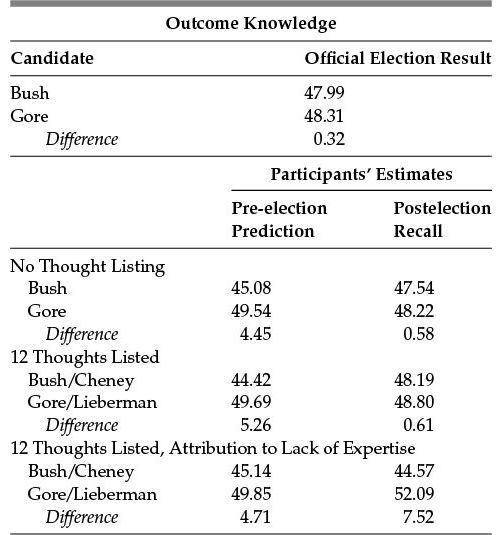
Note: Shown are the predicted percentages of each candidate’s share of the popular vote and the recalled predictions. Adapted from Sanna, Schwarz, and Stocker (2001, Experiment 4).
Some participants were asked to list 12 thoughts about how the election could have turned out otherwise, which they experienced as difficult. As shown in the third panel, this intervention did not attenuate the hindsight effect, nor did it result in a backfire effect. In this present case, the absence of a backfire effect is probably due to a floor problem. Given Gore’s minute lead in the actual results, a backfire effect would have required that participants erroneously recall that they actually predicted a Bush victory, thus reversing the ordinal placement of the candidates. More important, other participants were led to attribute the experienced difficulty to their own lack of knowledge. Prior to recalling their prediction, they were asked, “We realize that this was an extremely difficult task that only people with a good knowledge of politics may be able to complete. As background information, may we therefore ask you how knowledgeable you are about politics?” Following a rating of their political expertise, these participants recalled their pre-election predictions. The bottom panel of Table 5.4 shows the results. Whereas these participants had predicted a Gore lead of 4.71% prior to the election, they now recalled that they had predicted a lead of 7.52%. Thus, generating counterfactual thoughts not only eliminated the hindsight bias, but also introduced a significant bias in the opposite direction, once the informational value of the experienced difficulty was undermined.
In combination, these findings indicate that forcing oneself “to argue against the inevitability of the reported outcome” (Fischhoff, 1982b, p. 343) is a fallible strategy for debiasing hindsight. The more we try to do so, the more difficult we may find the task, leaving us all the more convinced that the outcome was inevitable. Moreover, once we discount our subjective experience of difficulty and rely on thought content, the successful elimination of hindsight may come at the price of a bias in the opposite direction.
When to use it
Evaluating post-hoc justifications in legal settings, such as jury decisions on liability.
Analyzing political forecasts and pundits' recollections of earlier predictions.
Improving corporate post-mortems by accounting for the backfire effect of counterfactual thinking.
Designing debiasing training that informs people about the subjective experience of difficulty.
FROM THEORY TO EVERYDAY LIFE
In practice
Election Prediction Recall
In an experiment, participants who were asked to generate 12 counterfactual thoughts about the 2000 U.S. presidential election experienced high difficulty. When this difficulty was attributed to their own lack of political knowledge, they overcorrected and recalled having predicted a wider lead for Gore than they actually did, demonstrating a bias opposite to hindsight.
A Hypothetical Sports Recall Test
After a close football match, fans try to imagine how the losing team could have won. Finding this difficult might reinforce their sense that the result was inevitable. If they discount that difficulty and focus on the alternatives they generated, they might instead remember expecting the losing team to do better than they actually predicted. This is an illustration of the proposed mechanisms, not another reported experiment.
A MOMENT TO REFLECT
Put it to work.
Recall a time when you were certain that a past event was inevitable. How might your memory of your own predictions have been skewed by hindsight?
Think of a situation where you tried to imagine alternative outcomes. Did the difficulty of that task affect your confidence in what actually happened?
How could you test your own tendency to reinterpret difficulty as evidence of inevitability in everyday decisions?
References
- Recalled Election Predictions as a Function of Outcome Knowledge and Counterfactual Thoughts — Sanna, Schwarz, and Stocker (2001)
- Debiasing — Fischhoff (1982)
CONTINUE THE CONVERSATION
Source texts
- Heuristics and Biases The Psychology of Intuitive Judgment (Thomas Gilovich, Dale Griffin, Daniel Kahneman)