Grey Areas
Grey areas often lead people into black-and-white thinking. Logical reasoning can include the middle ground, while arbitrary cutoffs risk obscuring it.
THE IDEA
GREY AREAS
People are often not very good at dealing with grey areas. There are many arguments in real life that turn into arguments about opposite extremes. If two people go to a concert together one might enthuse “That was great!” and the other refutes with “How can you think that? I thought it was terrible.” Political decisions usually result in some people saying it’s a great decision and everyone else saying it’s terrible.
People argue about whether a certain leader was good or bad, with people on one side mentioning all the good things they did, and people on the other mentioning all the bad things they did. In reality, most people do some good things and some bad things. In fact, most things are themselves partly good and partly bad. A more logical negation would be if someone was arguing that a leader did some good, and the other side argued that the leader did not do some good, i.e., did no good at all (which is very extreme). Or if one side argued that a leader was utterly evil, and someone else pointed out that they were evil overall but also did some good at some point. Unfortunately, if you don’t condemn every single thing a person did then it can sound to some (less logical) people that you are supporting them. This is the trouble with black and white thinking.
People are not very good at dealing with grey areas, and in fact nor is logic. We’ll come back to this later (in Chapter 12) but for now it’s important to note that the grey area should be included somewhere, otherwise we’re just ignoring part of reality.
In a formal debate situation it is clearly set out where the grey area is: it is included in the opposition. So with the strawberries and raspberries debate, the motion is that strawberries are “definitely” better than raspberries. All the grey areas are in the opposition: the two types of berry could be rougly equal, they could be sometimes better and sometimes worse, and so on.
If we’re thinking about the concept of “good”, then the grey (mediocre) is included in “not good”, so it gets lumped in with “bad”. If we’re thinking about whether or not the EU is terrible, then the grey (so-so) is included with “not terrible”, so it gets lumped in with “fantastic”.
If we’re looking at the (already flawed) notion of race and thinking about white people, then all shades of grey are included with black in “not white”. This idea was enacted in some parts of the US in the twentieth century when anyone with just one drop of “black blood” was considered to be black. At other times the arbitrary cut-off point was picked to be one eighth or one quarter ancestry.
If we only talk about black people and white people then we have either picked an arbitrary cut-off point as above, or actually erased everyone else from our discussion, including mixed-race people, Asians, Native Americans, and anyone else who is neither black nor white.
In logic this is called the Law of the Excluded Middle. It says that “true” and “not true” are the only two options we are going to deal with at the moment. So all types of “not true” have to be included. It also means that if something is not not true then it has to be true. It doesn’t mean we’ve excluded the middle in the sense of throwing it away or ignoring it, it just means we’ve included it with one side or the other so that there is effectively no middle any more.
Here is a picture of a sliding scale from white to black:

Where should we draw the line between white and black? One strictly logical approach is to consider black and not black:
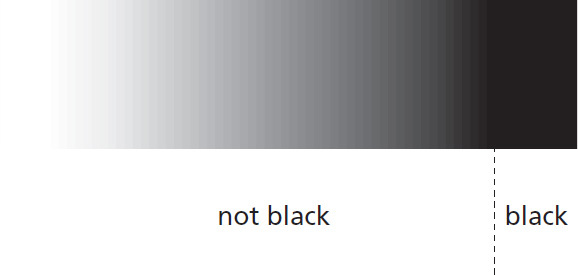
But another way that is just as logical is to consider white and not white, in which case the line is towards the opposite end:
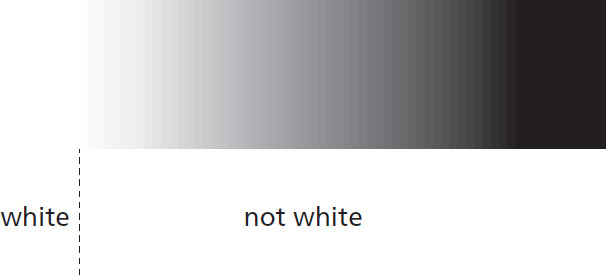
There is much that is unsatisfactory about these approaches as in both cases the line has been pushed to one extreme. When considering racial issues it can be productive to talk about white people and non-white people as the privilege of white people does not seem to extend to mixed-race people unless they can “pass” as white. However, on the other hand, calling everyone who is non-white some sort of “other” can be a symptom of white supremacy and the reluctance of white people to let others into their part of society.
Pushing the lines to the extremes is at least more logically sound than considering only the extremes and ignoring the whole grey area – after all, if we act as if the middle doesn’t exist then what we are saying is simply untrue.
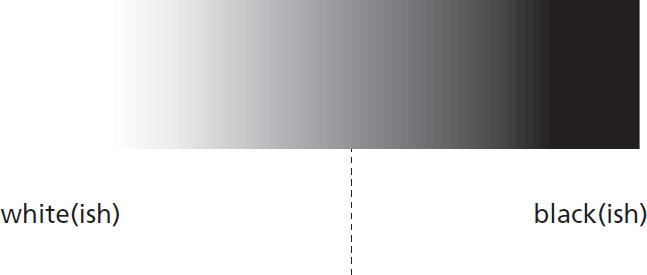
Another less extreme but less logical approach that happens a lot in real life is that we place the line abitrarily in the middle somewhere:
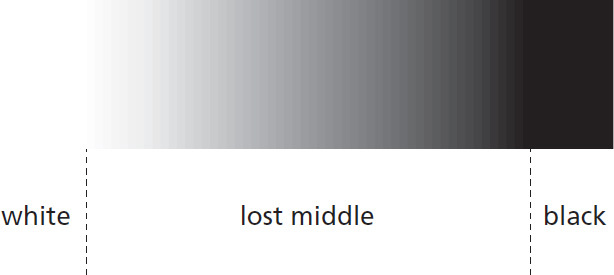
Yet another alternative is to designate an area in the middle and call it something like “grey”:
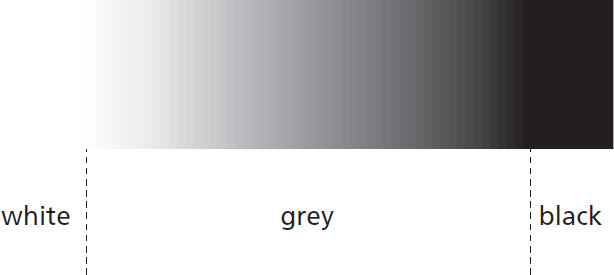
Of course, this still means we have to pick a place to put the lines between white and grey, and between grey and black. This is to some degree what happens with the terminology of “heterosexual”, “homosexual” and “bisexual”. One extreme consists of people who are sexually attracted exclusively to those of the opposite sex, and the other extreme those who are sexually attracted exclusively to those of the same sex. The middle is then those who are sexually attracted to both. However, where do we draw the lines? If someone is attracted to those of the opposite sex but also to one person of the same sex, is that enough to call them bisexual? What if someone is attracted to those of the same sex but also to one person of the opposite sex – are they in that case not gay? The simple answer, to me, is that everyone is entitled to call themselves what they choose, but, as with considerations of race, there is an undercurrent of power imbalance pulling these considerations in one direction: the scale is not symmetrical. After a long history of oppression, black people and gay people have a lot more at stake in these classification systems, whether it’s the need to assert one’s identity or hide it, the need to protect one’s community or the need to be allowed to integrate into the power-holding community as everyone deserves. While logic can helpfully simplify situations by ignoring irrelevant details, we should be careful not to oversimplify by ignoring important aspects of context.
In Chapter 12 we will come back to this issue and see that although the approach of placing lines somewhere in the middle is less extreme, and at least doesn’t ignore the entire grey area, it causes other contradictions instead. We will discuss more nuanced ways of dealing with grey areas with the aim of simultaneously avoiding extremes, ignorance and contradictions. Where grey areas are concerned this is easier said than done.
Absorbing the grey area into one side or the other is a simplification, but at least not incorrect or contradictory. Whereas denying its existence altogether is where black and white thinking usually goes wrong.
When to use it
When evaluating a politician's performance, avoid binary good/bad and consider specific policies and their mixed impacts.
In product reviews, rather than 'great' or 'terrible', use a scale or highlight both strengths and weaknesses.
When discussing controversial topics, acknowledge nuances and avoid forcing people into either/or camps.
In data analysis, avoid dichotomizing continuous variables without justification.
FROM THEORY TO EVERYDAY LIFE
In practice
Concert Experience
Two people attend a concert; one says 'That was great!' and the other says 'That was terrible!' The reality is likely a mix of good and bad aspects, but the argument becomes a binary extreme.
Political Leader Evaluation
People argue whether a leader was good or bad, citing only positive or negative actions. In truth, most leaders have a mix of good and bad actions. The logical negation would be that a leader did no good at all, which is extreme.
Race Classification
The 'one-drop rule' considered anyone with any black ancestry as black, absorbing all grey areas into one category. Arbitrary cut-off points can erase identities.
A MOMENT TO REFLECT
Put it to work.
Think of a recent argument that became polarized. How could the grey area be included to make the discussion more accurate?
In what situations might it be useful to deliberately absorb the grey area into one side, and when might it be harmful?
How does the asymmetrical power dynamic affect the classification of grey areas in topics like race or sexuality?
Often confused with
CONTINUE THE CONVERSATION
Source texts
- The Art of Logic How to Make Sense in a World that Doesn’t (Eugenia Cheng)