Freak Nonlinearities
Two advanced nonlinear patterns in economic variables: a convex-concave increasing function that produces extreme fragility with very fat tails, and pseudoconvexity where local antifragility masks global fragility.
THE IDEA
FREAK NONLINEARITIES (VERY TECHNICAL)
The next two types of nonlinearities are almost never seen outside of economic variables; they are particularly limited to those caused by derivatives.
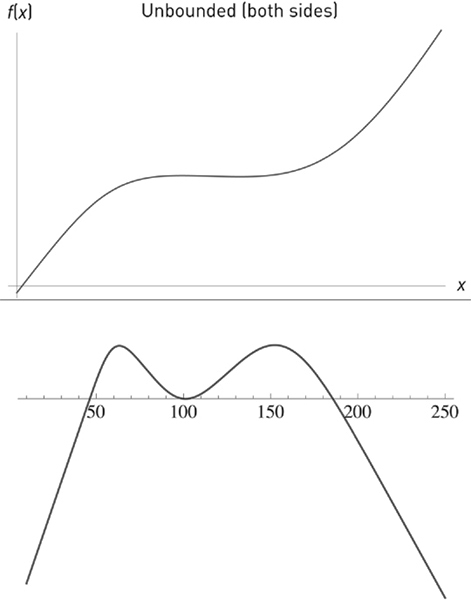
FIGURE 30. The top graph shows a convex-concave increasing function, the opposite of the bounded dose-response functions we see in nature. It leads to Type 2, Fragile (very, very fat tails). The bottom graph shows the most dangerous of all: pseudoconvexity. Local antifragility, global fragility.
When to use it
Evaluating the tail risk of hedge fund strategies that use complex derivatives
Designing stress tests for banks and insurance companies to reveal hidden global fragilities
Assessing the long-term stability of economic systems that exhibit short-term gains but exposure to rare shocks
Identifying fragile supply chain structures that perform well normally but break down under extreme demand or disruption
FROM THEORY TO EVERYDAY LIFE
In practice
Financial Derivative Payoffs
A derivative can have a convex payoff over a limited range while remaining fragile to larger moves outside that range. Local antifragility does not establish global robustness.
Leveraged Investment Portfolios
A leveraged portfolio may perform well in calm markets yet suffer disproportionately large losses in a crash. Examining the payoff curve is necessary to identify convexity or concavity; ordinary gains alone establish neither.
A MOMENT TO REFLECT
Put it to work.
Can you identify a system or asset that appears robust in normal times but is dangerously fragile under stress? How does that relate to pseudoconvexity?
How might understanding freak nonlinearities change the way you assess risk in financial markets or other domains?
In what situations might an individual or organization unknowingly mistake local antifragility for overall robustness?
CONTINUE THE CONVERSATION
Source texts
- Antifragile (Nassim Nicholas Taleb)