Fragility, Robustness, Antifragility
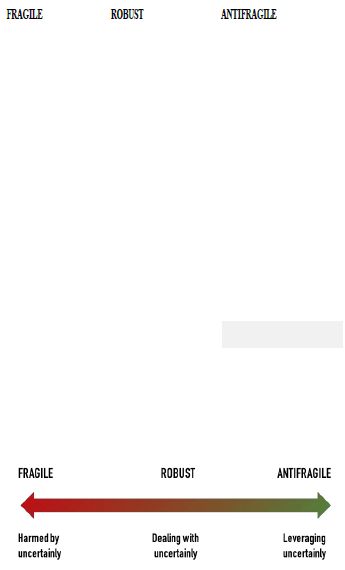
Antifragility describes systems that gain from disorder, volatility, and stress, improving rather than merely withstanding shocks. It contrasts with fragility (breaking under stress) and robustness (resisting but not improving).
THE IDEA
Fragility, Robustness, and Antifragility
Antifragility is beyond resilience or robustness. The resilient resists shocks and stays the same; the antifragile gets better.
—Nassim Taleb
Taleb uses antifragility to describe systems that benefit from variability or stress within a particular range. A fragile system suffers from those disturbances; a robust one withstands them; an antifragile one benefits. The distinction concerns how a system responds to variation, not whether a single setback happens to end well.
In Antifragile: Things That Gain from Disorder, Taleb applies the idea across biology, economics, education, and politics. He argues that attempts to eliminate all disturbance can weaken systems that depend on feedback, adaptation, or selection. His preference is forceful: “Humans are much more apt to do than to think. I’d rather be stupid but anti-fragile than very smart and fragile”.
This does not make every surviving system antifragile or every dose of stress beneficial. The relevant system, response, and range of variation matter. Taleb makes that qualification in a letter to Nature responding to a review of his book:
Simply, antifragility is defined as a convex response to a stressor or source of harm (for some range of variation), leading to a positive sensitivity to increase in volatility (or variability, stress, dispersion of outcomes, or uncertainty, what is grouped under the designation disorder cluster). Likewise, fragility is defined as a concave sensitivity to stressors, leading to a negative sensitivity to an increase in volatility. The relation between fragility, convexity, and sensitivity to disorder is mathematical, obtained by theorem, not derived from empirical data mining or some historical narrative. It is a priori.
—Nassim Taleb
When to use it
Startup strategy: Instead of seeking stability, structure the business to benefit from market volatility through optionality and rapid iteration.
Choosing challenging projects with room to learn from mistakes and limits on losses.
Government policy: Decentralize decision-making to allow local experiments and stress-testing, creating systems that improve through shocks.
Examining how the type and dose of a stressor affect a biological system before treating stress as beneficial.
FROM THEORY TO EVERYDAY LIFE
In practice
Antifragile Startup
A startup that faces a market downturn uses the crisis to pivot its business model, shed inefficiencies, and emerge stronger than competitors, capturing new market share.
Antifragile Biology
Antibiotic exposure can select for resistant bacteria. The population becomes harder to suppress as susceptible bacteria die and resistant ones persist. This illustrates a benefit to the bacterial population at a cost to the patient.
A MOMENT TO REFLECT
Put it to work.
Identify a system in your life that is fragile—how could you redesign it to become antifragile?
When have you experienced a failure that ultimately made you stronger? How can you deliberately cultivate that pattern?
How might overprotection (avoiding all stressors) weaken a system rather than strengthen it?
Often confused with
References
- Antifragile: Things That Gain from Disorder — Nassim Nicholas Taleb (2012)
CONTINUE THE CONVERSATION
Source texts
- Wisdom Theory 100 Mental Models (2020) (Wisdom Theory)