Finding Axioms
Comparing beliefs across different situations can reveal a shared underlying principle. Cheng uses analogies to identify her preference for preventing false negatives over false positives, then examines how that preference shapes her views.
THE IDEA
FINDING AXIOMS
Personal axioms are fundamental beliefs that support other beliefs and decisions. Comparing analogous situations can help reveal them, as discussed in Chapter 11.
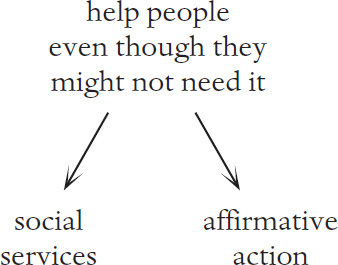
My example in Chapter 2 is the discovery that I care more about false negatives than false positives. It came from thinking about believing in social services, and the sense in which that is analogous to the following wide variety of situations.
When arguing about affirmative action on grounds of race, some people are opposed to it on the grounds that there are people of colour who come from well-off backgrounds who need help much less than some disadvantaged white people. Or, when arguing about school backgrounds and university entrance, some people argue that there are state schools (say, famous grammar schools in the UK) that give people just as much advantage as some private schools, if not more. Should we help those people? I still believe we should try to help all people of colour, and all people from less privileged schools, even if some of them don't "need" it.
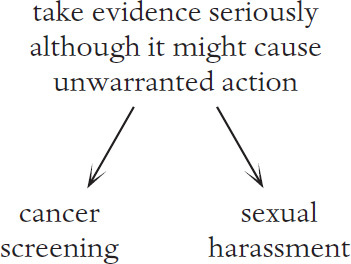
When arguing about screening for cancer, some people are concerned that the tests are not entirely accurate and result in some positive results even when people don't have cancer. This causes them unnecessary trauma and sometimes unnecessary treatment. This is a serious concern, but I still think this is better than people having cancer that is undiagnosed for too long, making treatment difficult or impossible.
When arguing about sexual harassment, some people are concerned that if we take all accusations seriously we will end up with people (usually men) suffering from the stigma of accusations even if they're innocent. However, up until now we have a huge problem of too many people getting away with sexual harassment, sexual assault and indeed rape, and thus widespread sexual misconduct being pervasive across society. Being falsely accused of sexual misconduct is indeed a trauma that nobody should have to go through, but I believe we need to be more concerned with the quantity of sexual misconduct going unstopped.
There is something analogous between all these situations although they range across many different aspects of life. The analogy may be implicit but I have found it helpful to isolate it and express it explicitly. At first sight it might appear that only the first two scenarios have something in common:
The second two might appear analogous separately, because of a different principle:
but at a further level of abstraction I can encapsulate all the scenarios in the fact that I seem to believe that false negatives are more important than false positives. The following diagram represents these levels of abstraction and analogy:
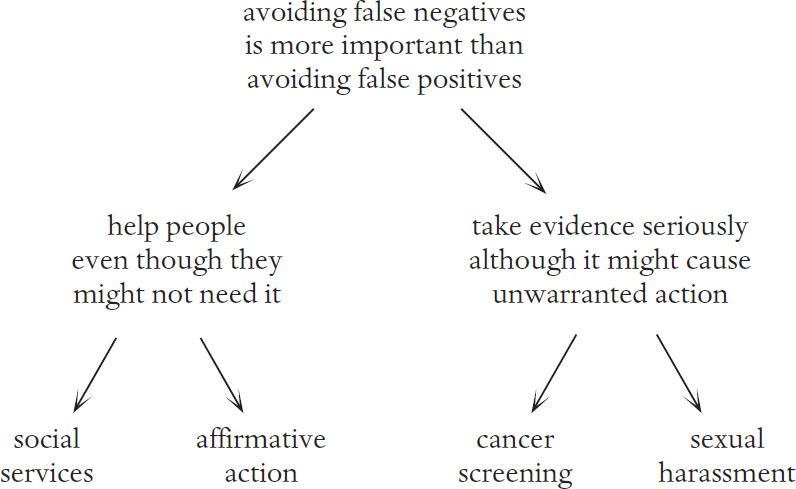
Going all the way to the top enables me to clarify my thinking about complex issues, by distilling the thought process behind my beliefs. I can then apply it to more situations, explain it succinctly to others, and hold it in my brain more easily and thus reason with it better.
Indeed after going up to that level of abstraction I realised I could encompass another situation: the idea of compulsory voting in general elections, as in Australia. I used to disagree with this principle, as I think democracy means that everyone should have the right to vote, not the obligation. However, I then read an article explaining that it's not about forcing people to vote, it's about forcing the government to make it possible for everyone to vote, to reduce voter suppression and disenfranchisement. I had not thought of that and immediately changed my mind. I now see that it is another example of false positives vs false negatives. Without compulsory voting, you risk false negatives, that is, people who are unable to vote for logistical or more nefarious reasons (such as voter suppression). With compulsory voting you risk false positives, that is, forcing people to vote who don't want to–but they can still leave their ballot blank or spoil it. It is yet another situation where I care about preventing false negatives the most; I just hadn't realised that was the issue until someone pointed it out to me.
When to use it
When evaluating policy positions, look for underlying axioms by comparing analogies across domains (e.g., affirmative action, cancer screening, sexual harassment).
When making personal decisions, consider what fundamental principles you are prioritizing, such as minimizing harm or maximizing freedom.
When debating with others, try to identify the axioms that drive their arguments by finding analogies in different contexts.
Use the method of ascending levels of abstraction to clarify your own thinking on complex issues and communicate it succinctly.
FROM THEORY TO EVERYDAY LIFE
In practice
Affirmative Action and School Backgrounds
When arguing about affirmative action on race, some oppose it because some well-off people of colour may not need help as much as disadvantaged white people. Similarly, in university admissions, some argue that certain state schools provide as much advantage as private schools. The author still believes in helping all people of colour and all from less privileged schools, even if some don't 'need' it – illustrating a preference for avoiding false negatives (not helping someone who needs it) over false positives (helping someone who doesn't).
Cancer Screening
Cancer screening tests can produce false positives, causing unnecessary trauma and treatment. Yet the author believes this is better than false negatives (undiagnosed cancer that becomes difficult to treat). This example shows the same underlying axiom.
Sexual Harassment Accusations
Cheng weighs the harm of unaddressed sexual misconduct against the harm of false accusations. She identifies her priority of preventing misconduct from going unstopped as another instance of her preference for avoiding false negatives.
Compulsory Voting
The author initially opposed compulsory voting (favouring right over obligation) but changed their mind after seeing it as a way to reduce false negatives (voter suppression and disenfranchisement) at the cost of false positives (forcing people to vote who don't want to, who can still leave ballots blank).
A MOMENT TO REFLECT
Put it to work.
What are some fundamental beliefs that underlie your decisions in different areas of life (e.g., politics, healthcare, personal relationships)?
Can you identify an analogy between two seemingly different situations that reveals a shared axiom you hold?
How might your preference for false negatives or false positives shape your views on issues like voting, healthcare, or justice?
CONTINUE THE CONVERSATION
Source texts
- The Art of Logic How to Make Sense in a World that Doesn’t (Eugenia Cheng)