Fano Plane
The Fano plane is the smallest finite projective plane, consisting of seven points and seven lines, each line containing three points. It satisfies the axioms that every pair of points lies on exactly one line and every pair of lines intersects at exactly one point, demonstrating that geometry can be defined purely by axioms rather than physical appearance.
THE IDEA
The geometry of the projective plane is governed by two axioms:
- Every pair of points is contained in exactly one common line.
- Every pair of lines contains exactly one common point.
Once mathematicians had found one kind of geometry that satisfied these two perfectly tuned axioms, it was natural to ask whether there were any more. It turns out there are a lot. Some are big, some are small. The very tiniest is called the Fano plane, after its creator, Gino Fano, who in the late nineteenth century was one of the first mathematicians to take seriously the idea of finite geometries. It looks like this:
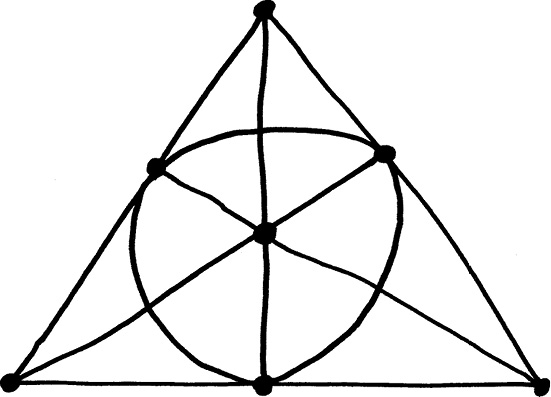
This is a small geometry indeed, consisting of only seven points! The “lines” in this geometry are the curves shown in the diagram; they’re small, too, possessing only three points each. There are seven of them, six of which look like lines and the other of which looks like a circle. And yet this so-called geometry, exotic as it is, satisfies axioms 1 and 2 just as well as Brunelleschi’s plane did.
Fano had an admirably modern approach—he had, to use Hardy’s phrase, “the habit of definition,” avoiding the unanswerable question of what geometry really was, and asking, instead: Which phenomena behave like geometry? In Fano’s own words:
A base del nostro studio noi mettiamo una varietà qualsiasi di enti di qualunque natura; enti che chiameremo, per brevità, punti indipendentemente però, ben inteso, dalla loro stessa natura.
That is:
As a basis for our study we assume an arbitrary collection of entities of an arbitrary nature, entities which, for brevity, we shall call points, but this is quite independent of their nature.
For Fano and his intellectual heirs, it doesn’t matter whether a line “looks like” a line, a circle, a mallard duck, or anything else—all that matters is that lines obey the laws of lines, set down by Euclid and his successors. If it walks like geometry, and it quacks like geometry, we call it geometry. To one way of thinking, this move constitutes a rupture between mathematics and reality, and is to be resisted. But that view is too conservative. The bold idea that we can think geometrically about systems that don’t look like Euclidean space, and even call these systems “geometries” with head held high, turned out to be critical to understanding the geometry of the relativistic space-time we live in; and nowadays we use generalized geometric ideas to map Internet landscapes, which are even further removed from anything Euclid would recognize. That’s part of the glory of math; we develop a body of ideas, and once they’re correct, they’re correct, even when applied far, far outside the context in which they were first conceived.
For example: here’s Fano’s plane again, but with the points labeled by the numbers 1 through 7:
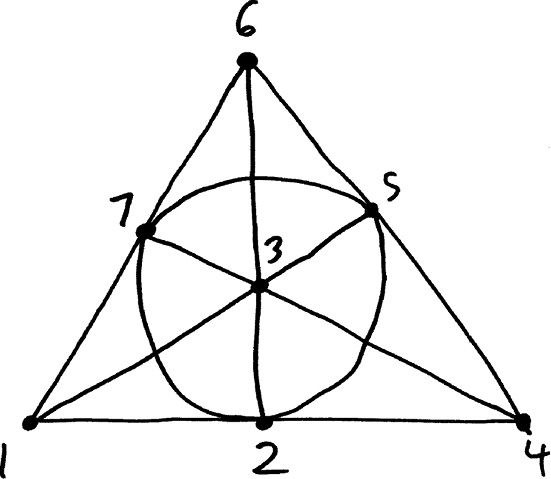
Look familiar? If we list the seven lines, recording for each the set of three points that constitute it, we get:
124 135 167 257 347 236 456
This is none other than the seven-ticket combo we saw in the last section, the one that hits each pair of numbers exactly once, guaranteeing a minimum payoff. At the time, that property seemed impressive and mystical. How could anyone have come up with such a perfectly arranged set of tickets?
But now I’ve opened the box and revealed the trick: it’s simple geometry. Each pair of numbers appears on exactly one ticket, because each pair of points appears on exactly one line. It’s just Euclid, even though we’re speaking now of points and lines Euclid would not have recognized as such.
When to use it
Designing efficient lottery or raffle systems to ensure every pair of entries is covered.
Error-correcting codes in telecommunications and data storage.
Network topology and routing algorithms that rely on finite geometries.
Understanding the structure of projective planes in computer graphics and perspective rendering.
FROM THEORY TO EVERYDAY LIFE
In practice
Lottery Ticket Design
The seven lines of the Fano plane correspond to a set of seven lottery tickets (each with three numbers from 1 to 7) that guarantees a win because every pair of numbers appears on exactly one ticket. The ticket design applies finite projective geometry to a practical problem in combinatorial design.
A MOMENT TO REFLECT
Put it to work.
How does the Fano plane challenge our intuitive notion of what constitutes a 'line' or a 'point'?
What are the implications of defining geometry purely by axioms, independent of physical space?
Can you identify other systems or structures that behave like geometry even though they do not resemble traditional Euclidean space?
Often confused with
CONTINUE THE CONVERSATION
Source texts
- How Not to Be Wrong The Power of Mathematical Thinking (Ellenberg, Jordan)