Evaluability Principle
The evaluability principle holds that the weight of an attribute in judgment or choice depends on how easily its value can be translated into an affective impression. Even important attributes may be ignored if they lack precise affective meaning.
THE IDEA
Table 23.3. Attributes of Two Dictionaries
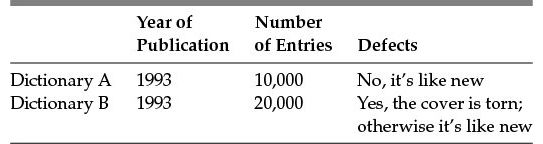
Source: Adapted from Hsee (1998).
According to the evaluability principle, the weight of a stimulus attribute in an evaluative judgment or choice is proportional to the ease or precision with which the value of that attribute (or a comparison on the attribute across alternatives) can be mapped into an affective impression. In other words, affect bestows meaning on information (cf., Osgood, Suci, & Tannenbaum, 1957; Mowrer, 1960a, 1960b) and the precision of the affective meaning influences our ability to use information in judgment and decision making. Evaluability can thus be seen as an extension of the general relationship between the variance of an impression and its weight in an impression-formation task (Mellers et al., 1992).
Hsee’s work in evaluability is noteworthy because it shows that even very important attributes may not be used by a judge or decision maker unless they can be translated precisely into an affective frame of reference. The authors report evaluability effects even for familiar attributes such as the amount of ice cream in a cup (Hsee, 1998), amounts of money, or human lives.
When to use it
Product design: provide comparisons or benchmarks that help customers interpret unfamiliar specifications.
Marketing: translate an efficiency claim into a concrete comparison where the evidence supports it. For example, 'saves 10 hours per week' and 'increases efficiency by 15%' require different baselines and should not be treated as interchangeable.
Policy communication: use a concrete example alongside statistics so people can understand both individual effects and their scale.
Personal finance: make costs and risks easier to compare so readily understood past returns do not crowd out other important information.
FROM THEORY TO EVERYDAY LIFE
In practice
Ice Cream Quantity
The excerpt cites Hsee (1998) without supplying the ice-cream quantities. As an illustration, compare 7 oz in an 8 oz cup with 8 oz in a 10 oz cup. Both cups are underfilled; the first is closer to full, although the second contains more ice cream. How full a cup looks can be easier to evaluate than its quantity. These figures are an illustration, not a reported result from the cited study.
Donations to Charity
An appeal featuring an identifiable person can make need easier to picture than an appeal describing a large group. Evaluating the donation also requires comparing what each contribution can accomplish.
A MOMENT TO REFLECT
Put it to work.
Think of a recent important decision you made. Which attributes were easy to evaluate emotionally, and how did that influence your final choice?
How could you reframe a complex attribute (e.g., long-term financial risk) to make it more evaluable and thus more influential in your decision-making?
In your workplace, identify a situation where an objectively important attribute is being ignored because it lacks affective meaning. How might you change the presentation to improve its evaluability?
References
- Hsee, C. K. (1998). The evaluability principle: An explanation for preference reversals and other inconsistent preferences. — Hsee (1998)
- Osgood, C. E., Suci, G. J., & Tannenbaum, P. H. (1957). The Measurement of Meaning. — Osgood, Suci, & Tannenbaum (1957)
- Mowrer, O. H. (1960a). Learning Theory and Behavior. — Mowrer (1960)
- Mowrer, O. H. (1960b). Learning Theory and the Symbolic Processes. — Mowrer (1960)
- Mellers, B. A., Ordóñez, L. D., & Birnbaum, M. H. (1992). A change-of-process theory for context effects. — Mellers, Ordóñez, & Birnbaum (1992)
CONTINUE THE CONVERSATION
Source texts
- Heuristics and Biases The Psychology of Intuitive Judgment (Thomas Gilovich, Dale Griffin, Daniel Kahneman)