Don’t Agree to Disagree
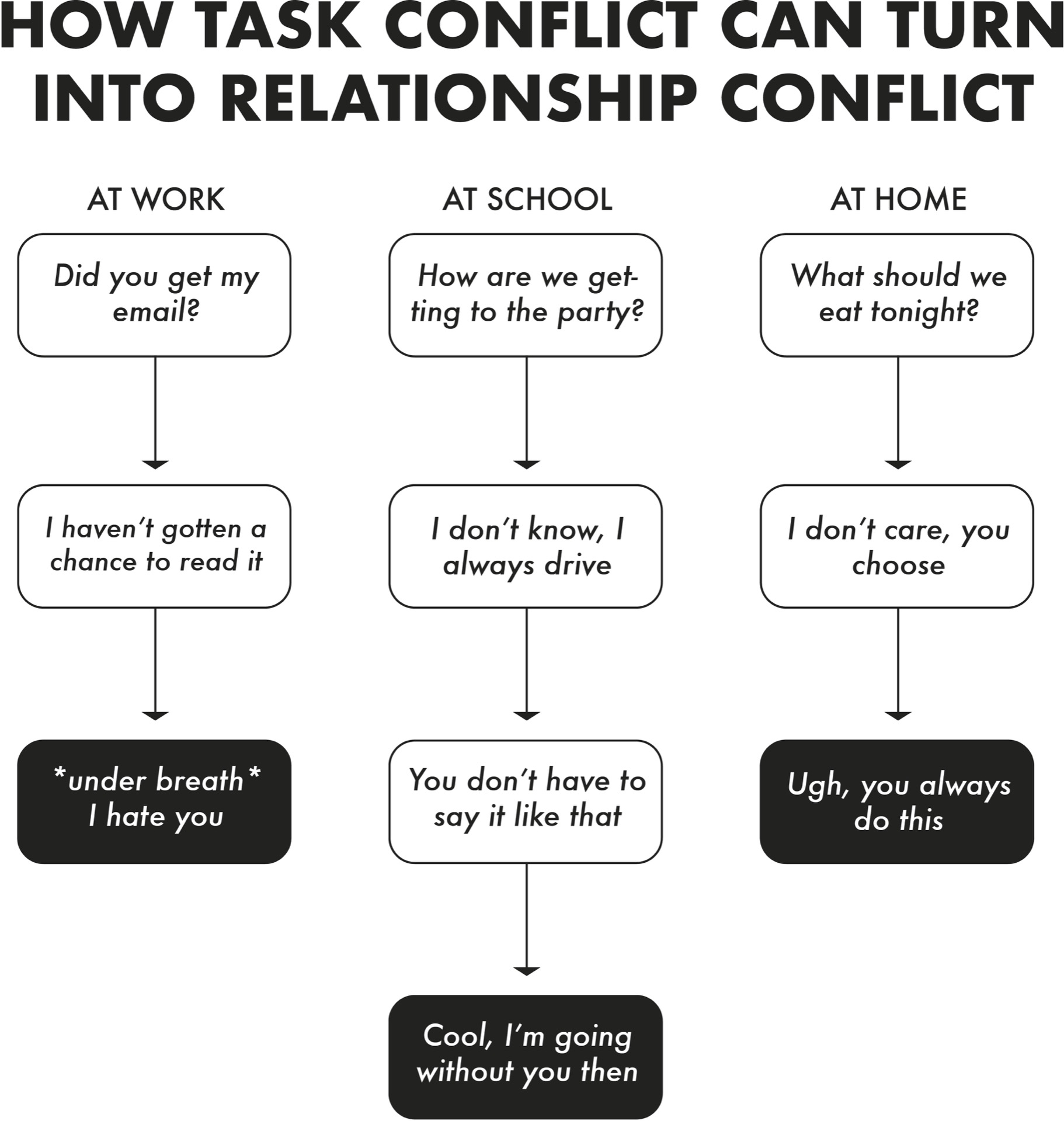
Agreeableness is about seeking social harmony, not cognitive consensus; it is possible to disagree without being disagreeable, and engaging in spirited debate can be a sign of respect and care for a common goal.
THE IDEA
DON’T AGREE TO DISAGREE
Hashing out competing views has potential downsides—risks that need to be managed. On the first Incredibles film, a rising star named Nicole Grindle had managed the simulation of the hair, watching producer John Walker and director Brad Bird’s interactions from a distance. When Nicole came in to produce the sequel with John, one of her concerns was that the volume of the arguments between the two highly accomplished leaders might drown out the voices of people who were less comfortable speaking up: newcomers, introverts, women, and minorities. It’s common for people who lack power or status to shift into politician mode, suppressing their dissenting views in favor of conforming to the HIPPO—the HIghest Paid Person’s Opinion. Sometimes they have no other choice if they want to survive.
To make sure their desire for approval didn’t prevent them from introducing task conflict, Nicole encouraged new people to bring their divergent ideas to the table. Some voiced them directly to the group; others went to her for feedback and support. As Nicole advocated for different perspectives, she became more comfortable challenging Brad on characters and dialogue. “Brad is still the ornery guy who first came to Pixar, so you have to be ready for a spirited debate when you put forward a contrary point of view.”
The notion of a spirited debate captures something important about how and why good fights happen. In the exchanges described here, Brad and his colleagues challenge ideas while continuing to work toward the same goal. The tone is vigorous and feisty rather than combative or aggressive. They don’t disagree just for the sake of it; they disagree because they care. “Whether you disagree loudly, or quietly yet persistently put forward a different perspective,” Nicole explains, “we come together to support the common goal of excellence—of making great films.”
After seeing their interactions up close, I finally understood what had long felt like a contradiction in my own personality: how I could be highly agreeable and still cherish a good argument. Agreeableness is about seeking social harmony, not cognitive consensus. It’s possible to disagree without being disagreeable. Although I’m terrified of hurting other people’s feelings, when it comes to challenging their thoughts, I have no fear. In fact, when I argue with someone, it’s not a display of disrespect—it’s a sign of respect. It means I value their views enough to contest them. If their opinions didn’t matter to me, I wouldn’t bother. I know I have chemistry with someone when we find it delightful to prove each other wrong.
Agreeable people don’t always steer clear of conflict. They’re highly attuned to the people around them and often adapt to the norms in the room. My favorite demonstration is an experiment by my colleagues Jennifer Chatman and Sigal Barsade. Agreeable people were significantly more accommodating than disagreeable ones—as long as they were in a cooperative team. When they were assigned to a competitive team, they acted just as disagreeably as their disagreeable teammates.
That’s how working with Brad Bird influenced John Walker. John’s natural tendency is to avoid conflict: at restaurants, if the waiter brings him the wrong dish, he just goes ahead and eats it anyway. “But when I’m involved in something bigger than myself,” he observes, “I feel like I have an opportunity, a responsibility really, to speak up, speak out, debate. Fight like hell when the morning whistle blows, but go out for a beer after the one at five o’clock.”
That adaptability was also visible in the Wright brothers’ relationship. In Wilbur, Orville had a built-in challenge network. Wilbur was known to be highly disagreeable: he was unfazed by other people’s opinions and had a habit of pouncing on anyone else’s idea the moment it was raised. Orville was known as gentle, cheerful, and sensitive to criticism. Yet those qualities seemed to vanish in his partnership with his brother. “He’s such a good scrapper,” Wilbur said. One sleepless night Orville came up with an idea to build a rudder that was movable rather than fixed. The next morning at breakfast, as he got ready to pitch the idea to Wilbur, Orville winked at a colleague of theirs, expecting Wilbur to go into challenge mode and demolish it. Much to his surprise, Wilbur saw the potential in the idea immediately, and it became one of their major discoveries.
Disagreeable people don’t just challenge us to think again. They also make agreeable people comfortable arguing, too. Instead of fleeing from friction, our grumpy colleagues engage it directly. By making it clear that they can handle a tussle, they create a norm for the rest of us to follow. That norm still needs limits: disagreement about the work can become personal, and quieter colleagues need room to contribute.
When to use it
In a product development team, encourage team members to critique designs openly, focusing on the work not the person.
During strategic planning, ask someone to challenge the assumptions behind the preferred proposal and examine the evidence offered in response.
When receiving feedback, separate the person from the problem: value the relationship while questioning the idea.
FROM THEORY TO EVERYDAY LIFE
In practice
Nicole Grindle and the Incredibles 2
Nicole Grindle, a rising star in Pixar, was concerned that the arguments between director Brad Bird and producer John Walker would drown out voices of newcomers, introverts, women, and minorities. She encouraged these individuals to bring divergent ideas to the table, either directly to the group or through her for support. By advocating for different perspectives, she herself became more comfortable challenging Brad on characters and dialogue, fostering a culture where intellectual disagreement was welcome.
The Wright Brothers’ Partnership
Wilbur Wright often challenged ideas, while Orville was generally gentler and sensitive to criticism. Yet Orville argued vigorously with his brother. When he proposed a movable rudder, he expected a challenge; Wilbur instead recognized its potential. The story shows that a habit of debate can include accepting an idea quickly.
A MOMENT TO REFLECT
Put it to work.
In a group discussion, how can you encourage others to challenge your ideas without feeling personally attacked?
Think of a time when you avoided a disagreement to maintain harmony. Could a respectful debate have led to a better outcome?
How can leaders create an environment where task conflict is welcomed and personal conflict is minimized?
CONTINUE THE CONVERSATION
Source texts
- Think Again The Power of Knowing What You Dont Know (Adam Grant)