Division
The mind's limited attention span leads to dividing the continuous environment into separate attention areas, enabling specific reactions, familiarity with new situations, recombination of parts, and communication.
THE IDEA
Division
De Bono describes attention through a model of the mind as a self-maximizing memory surface. This limited attention span means that one only reacts to a bit of the total environment. Over a period of time one bit may be attended to until the total environment is covered.
In effect the total, continuous and overwhelming environment is divided up into separate attention areas. The process may involve picking out a single attention area or it may involve dividing up the environment into a number of attention areas. This is shown in the diagram below. There is no basic difference between the two processes except that one covers the whole field and the other does not.
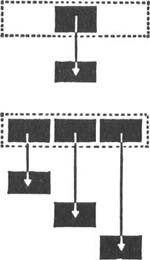
In this account, dividing attention into areas has several advantages:
- It means that some part of the environment can be reacted to specifically. Thus if the total environment contained something useful and something dangerous one could react differently to each part.
- It means that new and unfamiliar environments can be dealt with by picking out features that are familiar. Eventually the situation is explained in terms of such familiar parts.
- It means that the separate parts can be moved around and combined in different ways to produce effects that are not available in the environment.
- It makes communication possible because a situation can be described bit by bit instead of as a whole.
Separating, selecting, and recombining units together form the information-processing system described by this model.

Reassembly
The previous diagram shows how units can be created by dividing up a total situation. Units can however also be created by putting together other units to form a new one that is then treated as a complete unit.
When to use it
Engineering: Decomposing a system into components to analyze and optimize each part.
Education: Teaching a complex concept by chunking it into digestible segments.
Communication: Describing a sequence of events step by step to ensure clarity.
Innovation: Combining existing ideas or objects in novel ways to create new products or solutions.
FROM THEORY TO EVERYDAY LIFE
In practice
Learning a new topic
When studying a complex subject like molecular biology, a student divides the material into smaller topics (e.g., DNA replication, transcription, translation) and focuses on each one separately before integrating them.
Navigating a busy environment
At a crowded party, instead of trying to process all conversations at once, you focus on one speaker at a time, effectively dividing the auditory environment into separate attention areas.
A MOMENT TO REFLECT
Put it to work.
In what situations might dividing your attention lead to missing important connections between parts?
How do you naturally break down complex problems into smaller pieces? Does this ever hinder understanding the whole?
Can you recall a time when you reassembled familiar parts in a new way to solve a problem or create something innovative?
CONTINUE THE CONVERSATION
Source texts
- Lateral Thinking A Textbook of Creativity (Edward de Bono)