Disadvantages of Pattern-Based Thinking
The mind relies on preset patterns for quick recognition and efficient exploration, but this leads to rigidity, difficulty in changing patterns, polarization, and other limitations that hinder creativity and effective problem-solving.
THE IDEA
Disadvantages of the system
De Bono describes the mind as a system that organizes information into patterns. These patterns help us recognize things and react quickly, but he argues that the same process has several disadvantages:
-
The patterns tend to become established ever more rigidly since they control attention.
-
It is extremely difficult to change patterns once they have become established.
-
Information that is arranged as part of one pattern cannot easily be used as part of a completely different pattern.
-
There is a tendency towards ‘centering’ which means that anything which has any resemblance to a standard pattern will be perceived as the standard pattern.
-
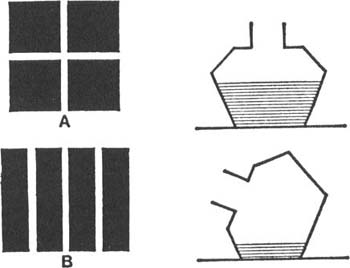
Patterns can be created by divisions which are more or less arbitrary. What is continuous may be divided into distinct units which then grow further apart. Once such units are formed they become self-perpetuating. The division may continue long after it has ceased to be useful or the division may intrude into areas where it has no usefulness.
-
There is great continuity in the system. A slight divergence at one point can make a huge difference later.
-
The sequence of arrival of information plays too important a part in its arrangement. Any arrangement of information is thus unlikely to be the best possible arrangement of the information that is available.
-
There is a tendency to snap from one pattern to another instead of having a smooth change over. This is like those ink bottles which have two stable positions (see page 35 on the right). This snapping change occurs as one switches from one stable pattern to another.
-
Even though the choice between two competing patterns may be very fine one of them will be chosen and the other one completely ignored.
-
There is a marked tendency to ‘polarize’. This means moving to either extreme instead of maintaining some balanced point between them.
-
Established patterns get larger and larger. That is to say individual patterns are strung together to give a longer and longer sequence which is so dominant that it constitutes a pattern on its own. There is nothing in the system which tends to break up such long sequences.
-
The mind is a cliché making and cliché using system.
The purpose of lateral thinking is to overcome these limitations by providing a means for restructuring, for escaping from cliché patterns, for putting information together in new ways to give new ideas. In order to do this lateral thinking makes use of the properties of this type of system. For instance the use of random stimulation could only work in a self-maximizing system. Also disruption and provocation are only of use if the information is then snapped together again to give a new pattern.
When to use it
When brainstorming new product ideas, deliberately challenge existing patterns to avoid clichés.
In problem-solving, list the assumptions (patterns) that are taken for granted and try to reverse them.
During team meetings, use random stimuli (like a random word) to provoke new connections and break established thinking patterns.
FROM THEORY TO EVERYDAY LIFE
In practice
Business Strategy Rigidity
A company that has successfully used a particular marketing pattern for years fails to adapt to new market trends because the established pattern dominates attention and blocks alternative approaches.
Educational Centering
A teacher sees a student’s diagram that resembles a familiar model and assumes it is the standard version, overlooking an important difference in the connections. This illustrates centering: treating a near-match as the established pattern.
A MOMENT TO REFLECT
Put it to work.
Recall a situation where a rigid pattern prevented you from seeing a better solution. How could lateral thinking have helped?
Identify a pattern in your daily routine that might be limiting your options. Can you intentionally disrupt it?
How does the tendency to polarize affect your decision-making in group discussions?
Often confused with
References
- Lateral Thinking: Creativity Step by Step — Edward de Bono (1970)
CONTINUE THE CONVERSATION
Source texts
- Lateral Thinking A Textbook of Creativity (Edward de Bono)