Detective Measure: What Could the Lookouts See?
The concept illustrates how seemingly simple questions about threat detection become complex when considering specific circumstances such as distance, size, lighting, and atmospheric conditions. It warns against high-level analysis that ignores critical details.
THE IDEA
Detective Measure: What Could the Lookouts See?
If you are a lookout up in the crow's nest, and it is daylight, you might see many kilometres into the distance. And with the Titanic travelling close to its top speed (37 kilometres per hour (20 knots)), she covers 600 metres in a minute. So, at face value, in clear conditions, a lookout should have plenty of time to see an obstacle several kilometres away and react to it.
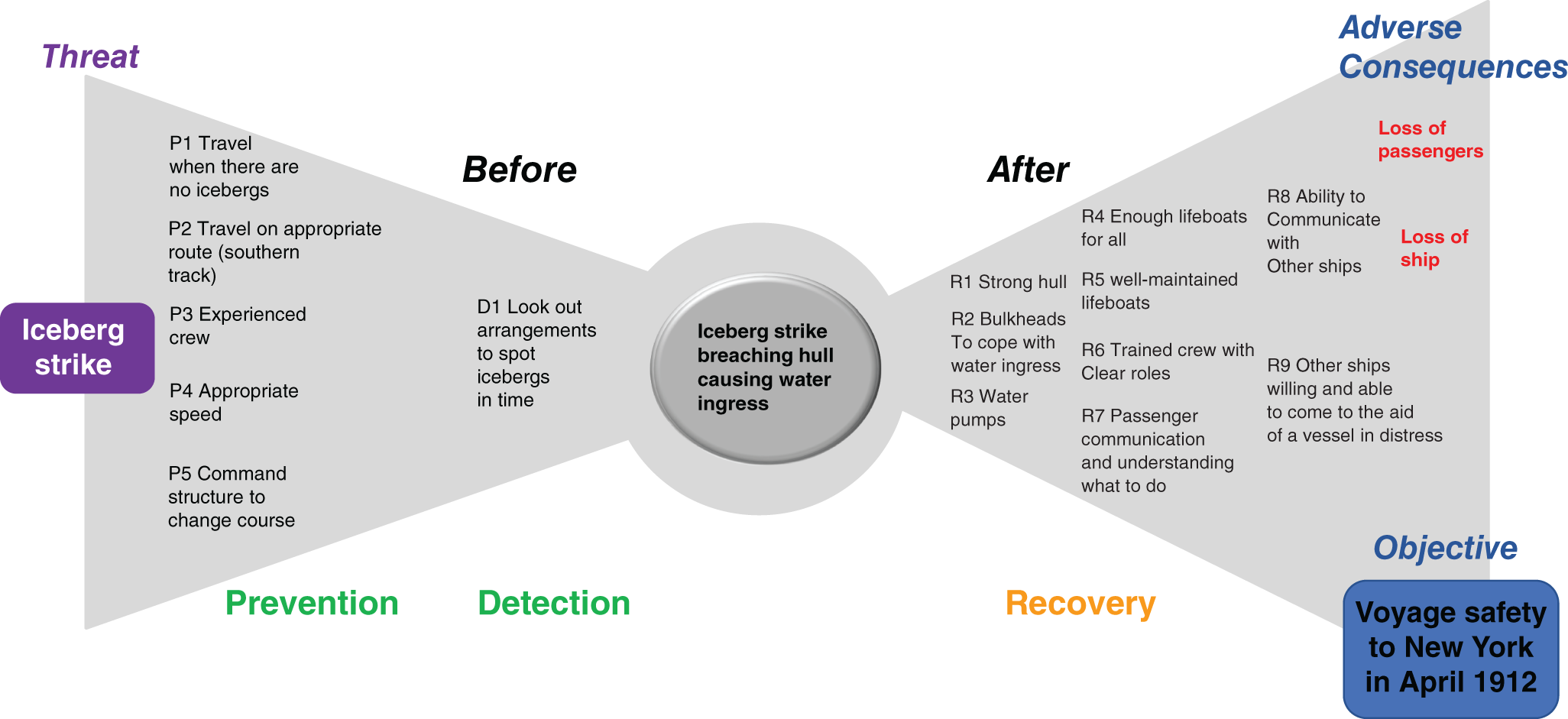
Diagram 12.1 Bowtie diagram applied to the Titanic/Iceberg strike
But the further away you are from something the smaller it seems, so you need to recognise that even though theoretically you might see several kilometres in the distance, the object needs to be big enough to be visible. So, if we dig into the question of detecting icebergs, there are a range of scenarios relevant to the Titanic's crossing, each of which would affect the chances of seeing it.
To illustrate the point, consider the chances of spotting an iceberg in the following situations:
- a 75‐metre‐wide iceberg in daylight in clear conditions from, say, 3 kilometres,
- a 3‐metre‐wide ‘growler’ (broken iceberg) in daylight, from 3 kilometres,
- a 75‐metre‐wide iceberg at night when it is clear, with a full moon, from 1 kilometre,
- a 75‐metre‐wide iceberg at night when it is clear, but with no moonlight, from 1 kilometre.
We can see the odds of spotting an iceberg will depend on its size and are likely to reduce as we go from day to night, and at night depending on whether you have moonlight or starlight. Note the circumstances closest to 14 April 1912 were scenario 4.38
There were other factors that we now know will have affected the lookouts' ability to see the iceberg that night, including:
- The calmness of the sea (which would have reduced the ‘cue’ of waves splashing against an iceberg);39
- The colour of the iceberg (witnesses said it appeared to be dark, almost black);40
- The source also cites an atmospheric explanation: freezing air near the ice‐cold Labrador Current may have produced distortions or mirage effects at the water’s surface.41
These external conditions could have affected what the lookouts were able to see.42
So, saying ‘it was obvious the lookouts should have seen the iceberg sooner’ is based on a high‐level analysis that isn't recognising the very particular circumstances that night.
The author treats the lookout arrangements as a contributing factor rather than a root cause, given the uncertainty about visibility at night. That interpretation directs attention to other decisions, including speed, rather than assuming earlier detection was straightforward.43 This takes us to the question of the speed of the Titanic that night (and more).
When to use it
Risk assessment in safety-critical systems (e.g., aviation, maritime) where surface-level analysis might miss critical failure modes.
Project planning: evaluating whether a timeline or budget is realistic by considering hidden dependencies and environmental factors.
Investigating past incidents: avoid hindsight bias by reconstructing the actual conditions and constraints faced by decision-makers.
User experience design: testing assumptions about how users will perceive or interact with a product under real-world conditions.
FROM THEORY TO EVERYDAY LIFE
In practice
Iceberg Detection Scenarios
The text presents four scenarios varying iceberg size, light conditions, and distance, demonstrating dramatically different chances of spotting an iceberg. Scenario 1 (75m iceberg, daylight, 3km) has high detectability, while scenario 4 (75m iceberg, clear night without moonlight, 1km) is much lower and closest to the actual Titanic conditions.
External Factors Affecting Visibility
The account identifies a calm sea and a dark-looking iceberg as possible limits on visual cues. It also cites an atmospheric-mirage explanation. Reconstructing these conditions is part of testing what the lookouts could reasonably have detected.
A MOMENT TO REFLECT
Put it to work.
Think of a time when you assumed a simple answer to a complex problem. What details did you overlook that would have changed your understanding?
How can you ensure you dig into the specific circumstances of a situation before drawing conclusions about cause and effect?
In your work or life, what common assumptions about risk or detection might be hiding similar 'hairline crack' details?
CONTINUE THE CONVERSATION
Source texts
- Beyond the Five Whys Root Cause Analysis and Systems Thinking (James C. Paterson)