Design Practice for Lateral Thinking
A method using visual and organizational design projects to stimulate lateral thinking by emphasizing variety, function analysis, and avoiding premature criticism. Students design solutions for specific tasks, such as an apple picking machine, to explore multiple approaches and challenge assumptions.
THE IDEA
Practice
The designs are to be visual and in black and white or colour. Verbal descriptions can be added to the pictures to explain certain features or to explain how they work. The advantages of a visual format are many.
-
There has to be a definite commitment to a way of doing something rather than a vague generalized description.
-
The design is expressed in a manner that is visible to everyone.
-
Visual expression of a complicated structure is much easier than verbal expression. It would be a pity to limit design by the ability to describe it.
The designs could be worked out as a classroom exercise or they could be done as homework. It is easier if the students all work on the same design rather than on individual choices for then any comments apply to them all, there is more comparison and they are all more involved in the analysis.
It is convenient if all the designs are executed on standard sized sheets of paper. Once the design task has been set no additional information is given. No attempt is made to make the design project more specific. ‘Do whatever you think is best’ is the answer to any question.

Comment on results
Unless the group is small enough to actually cluster around the drawings these would have to be copied and shown on an overhead projector or epidiascope. Or they could just be pinned up. Adequate discussion could be carried out without showing the drawings at all but just redrawing the important features on the blackboard. In commenting on the results the teacher would want to bear the following points in mind:
-
Resist the temptation to judge. Resist the temptation to say, ‘this would not work because…’
-
Resist the temptation to choose one way of doing things as being much better than any other for fear of polarizing design in one direction.
-
Emphasize the variety of the different ways of carrying out a particular function. List the different suggestions and add others of one’s own.
-
Try and look at the function underlying a particular design. Try to separate the intention of the designer from the actual way this was carried out.
-
Note the features that have been put there for a functional purpose and the ones that are there as ornaments to complete the picture.
-
Question certain points — not in order to destroy them but in order to find out if there was any special reason behind them which may not be manifest.
-
Note the borrowing of complete designs from what might have been seen on television, in the cinema or in comics.
Suggestions
Design projects can either ask for improvements on existing things or for the actual invention of something to carry out a task. It is easiest if the designs do involve something physical since this is easier to draw. They do not have to be mechanical in the strictest sense of the word; for instance the design of a new classroom or a new type of shoe would be very suitable. It is enough that they are concrete projects. In addition one can try organizational designs. Organizational designs would ask for ways of doing things such as building a house very quickly.
Design:
An apple picking machine.
A potato peeling machine.
A cart to go over rough ground.
A cup that cannot spill.
A machine to dig tunnels.
A device to help cars to park.
Redesign:
The human body.
A new milk bottle.
A chair.
A school.
A new type of clothes.
A better umbrella.
Organizational:
How to build a house very quickly.
How to arrange the checkout counters in a supermarket.
How to organize garbage collection.
How to organize shopping to take up the least time.
How to put a drain across a busy road.
Variety
The purpose of the design session is to show that there can be different ways of doing something. It is not the individual designs that matter so much as the comparison between designs. In order to show this variety one could compare the complete designs but it is more effective to pick out some particular function and show how this was handled by the different designers. For instance, in the design of an apple picking machine one could choose the function of ‘reaching the apples’. To reach the apples some students will have used extendable arms, others will have raised the whole vehicle on jacks, others will have tried to bring the apples to the ground, others might have planted the trees in trenches anyway. For each function the teacher lists the different methods used and asks for further suggestions. He can also add suggestions of his own or ones derived from previous experience with the design project.
Particular functions with the apple picking machine could include the following:
Reaching the apples.
Finding the apples.
Picking the apples.
Transporting the apples to the ground.
Sorting out the apples.
Putting the apples in containers.
Moving on to the next tree.
It is not suggested that in carrying out the design the student will have tried to cover all these functions. Most of them would be covered quite unconsciously. Nevertheless one can consciously analyse what has been done and show the different ways of doing it. In many cases no provision will have been made for carrying out a certain function (e.g. transporting the apples to the ground). In such cases one does not criticize the designs that do not show the function but commends those that do show it.
Evaluation
One could criticize designs for omissions, for errors of mechanics, for errors of efficiency, for errors of magnitude and for all sorts of other errors. It is difficult to resist the temptation to do this — but the temptation must be resisted.
If some designs have left things out then one shows this up by commenting on those designs which have put it in.
If some design shows an arrangement that is mechanically unsound then one comments on the function intended rather than on the particular way of carrying it out.
If some designs show a very roundabout way of doing something one describes the design without criticism and then describes more efficient designs.
One of the most common faults with designs by students in the 10–13 age group is the tendency to lose sight of the design project and to go into great detail drawing some vehicle that is derived directly from another source such as television or space comics. Thus an apple picking machine will be shown bristling with guns, rockets, radar and jets. Details will be given about number of crew, speed, range, power, how much it would cost to build, how long it would take to build, how many nuts and bolts, the materials used in construction and so on. There is no point in criticizing the superfluity of all this. Instead one emphasizes the functional economy and effectiveness of other designs.
It is important not to criticize actual mechanics. One designer of an apple picking machine suggested putting bits of metal in each of the apples and then using powerful magnets buried in the ground under each tree to pull the apples down. It would be easy to criticize this as follows:
-
Just as much trouble to put bits of metal in each apple as to pick each one directly.
-
The magnet would have to be very powerful indeed to pull the apples down from such a distance.
-
The apples would be badly damaged on hitting the ground.
-
Buried magnets would only be able to collect apples from one tree.
These are all valid comments and one could make many more. But rather than criticizing in this manner one could say: ‘Here is someone who instead of going up to pick the apples like everybody else wants to attract the apples to the ground. Instead of having to find the apples and then to pick them one by one he can get them all together and all at once.’ Both these are very valid points. The actual method for carrying out the function is obviously inefficient but it is better to let that be than to appear to criticize the concept of function by criticizing the way it is carried out. When that particular designer learns more about magnets he will find that they would not be much good. At the moment however they represent the only method he knows for carrying out ‘attraction from a distance’.
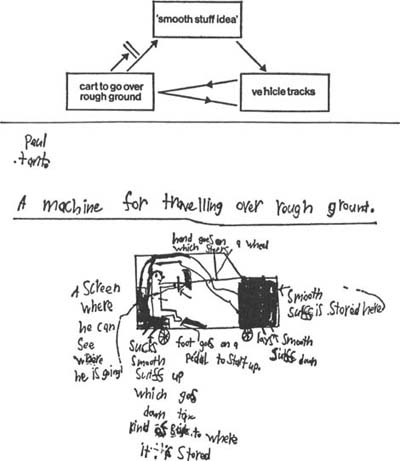
In another design for a cart that would go over rough ground the designer suggested some sort of ‘smooth stuff’ that was sucked up by the cart from behind itself and then spread down in front of it. Thus the cart was always travelling over smooth stuff. There was even a reservoir for evening out the supply of the smooth stuff. It would be easy to criticize the idea as follows:
-
What sort of ‘smooth stuff’ would fill in big hollows? One would need far too much.
-
One could never suck back all that had been laid down and so the supply would run out after a few feet.
-
The cart would have to move very slowly indeed.
Such criticisms are easy but instead one would appreciate that the designer had got away from the usual approach of providing special wheels or other devices for going over rough ground and instead was trying to alter the ground itself. From such a concept could come the notion of a tracked vehicle which does actually lay down smooth stuff and pick it up again. There are also those military vehicles which have a roll of steel mesh or glass fibre matting on their backs and this is laid down ahead of the vehicle to make a road on which the vehicle then runs.
Though an idea may seem silly in itself it can still lead to something useful. As shown in the diagram the smooth stuff idea though not a solution in itself might lead straight to the idea of a tracked vehicle. If one had rejected the smooth stuff idea then it might have been harder to get to the same point. The attitude is not, ‘This won’t work, let’s throw it out’ but, ‘This is not going to work but what does it lead us to?’
No one is silly for the sake of being silly no matter how it might appear to other people. There must be a reason why something made sense to the person who drew it at the moment when it was drawn. What it appears to other people is not so important if one is trying to encourage lateral thinking. In any case whatever the reason behind a design and however silly it may be it can still be a most useful stimulus to further ideas.
Assumptions
In the design process there is a tendency to use ‘complete units’. This means that when one borrows a unit from somewhere else in order to carry out some special function that unit is used ‘complete’. Thus a mechanical arm to pick apples will have five fingers because the human arm has that number. In an attempt to break up such complete units and isolate what is really required one can question the assumption behind them: ‘Why does a hand need five fingers to pick apples?’
One may also question assumptions that seem to be basic to the design itself.
Why do we have to pick the apples off the trees?
Why do trees have to be that shape?
Why does the arm have to go up and down with every apple it picks?
Some of the points challenged could easily have been taken for granted. By challenging them one can open up new ideas. For instance one could shake apples from trees instead of picking them. The book describes California experiments in shaping trees to make fruit easier to pick. The arm does not need to go up and down with each apple; the apples could be dropped into a chute or container.
The ‘why’ technique can be applied to any part of the design project. To begin with the teacher would apply it after discussing the designs. The students could also apply it to their own designs or those of others. As usual the purpose of the ‘why’ technique is not to try and justify something but to see what happens when one challenges the uniqueness of a particular way of doing things.
When to use it
In a design exercise, compare ways to bring fruit to the ground before selecting and testing a practical harvesting mechanism.
Redesigning a classroom layout to improve student interaction by challenging assumptions about seating and sight lines.
Organizing supermarket checkout lines to reduce wait times by analyzing the function of queuing and customer flow.
FROM THEORY TO EVERYDAY LIFE
In practice
Apple Picking Machine with Magnets
A student proposed putting bits of metal in each apple and using powerful magnets buried under each tree to pull the apples down. While mechanically inefficient, this approach shifted the function from reaching apples to attracting them to the ground, illustrating a lateral thinking alternative.
Cart with Smooth Stuff for Rough Ground
A student imagined a cart that picks up smooth material behind itself and spreads it ahead. De Bono suggests using the impractical mechanism as a prompt: what if the vehicle carried a reusable surface? A tracked vehicle illustrates where that line of thought could lead.
A MOMENT TO REFLECT
Put it to work.
How can you focus on the underlying function of a design rather than immediately judging its feasibility?
What assumptions are you currently taking for granted in a problem you are trying to solve? How might challenging those assumptions open new possibilities?
Think of a 'silly' idea you had recently. How could it be used as a stimulus for a more practical solution?
CONTINUE THE CONVERSATION
Source texts
- Lateral Thinking A Textbook of Creativity (Edward de Bono)