Design as a Lateral Thinking Exercise
Design is a special case of problem solving that requires creativity and open-ended thinking. It uses drawings to commit to specific visual descriptions, revealing alternative approaches and cliché units.
THE IDEA
Design
Design is really a special case of problem solving. One wants to bring about a desired state of affairs. Occasionally one wants to remedy some fault but more usually one wants to bring about something new. For that reason design is more open ended than problem solving. It requires more creativity. It is not so much a matter of linking up a clearly defined objective with a clearly defined starting position (as in problem solving) but more a matter of starting out from a general position in the direction of a general objective.
A design does not have to be a drawing but for the practice of lateral thinking it is much more useful if the design always takes the form of a drawing. It does not matter how good the drawing is so long as there is an attempt to give a visual description of what is meant.
Explanatory notes may be added to the drawing but they must be brief. The advantage of a drawing is that there is far more commitment than with a verbal explanation. Words can be very general but a line has to be put in a definite place. For instance in the design of a potato peeling machine it would be easy to say, ‘The potatoes go in there and then they get washed.’ But when this is described visually one can get the effect shown on p. 250. The designer wanted to use a bucket of water to wash the potatoes and the best way to fit the bucket into his machine was by turning it on its side — so the water level had to be turned on its side as well. This beautiful cliché use of the bucket of water would never have been apparent in a purely verbal description.

Comparison
The first purpose of the design exercise is to show that there are alternative ways of carrying out some function. A single designer will only be able to see one or perhaps a few alternative ways of doing something. But with a large number of designers there will be a large number of alternative approaches. Thus by simply exposing any single designer to the efforts of the others one shows how it is possible to look at things in different ways. The object of the design session is not to teach design but to teach lateral thinking — to teach the ability to generate alternative ways of looking at something.
In practice some general design theme is given to the class (apple picking machine, cart to go over rough ground, potato peeling machine, cup that does not spill, redesigning the human body, redesigning a sausage, redesigning an umbrella, a machine to cut hair etc). The students are asked to come up with designs for the particular design task set. To make comparison easier it is best to only set one design project rather than let the students select their own from a list. The individual designs are then collected and compared.
The comparisons may refer to the whole design (e.g. picking the apples off a tree as compared to shaking the tree) or to some particular function (e.g. grabbing the apples with a mechanical hand as compared to sucking them through a hole).
Cliché units
In examining the submitted designs one very quickly becomes aware of cliché units. Cliché units are standard ways of doing something that are borrowed entire from another setting. For instance a bucket and water to wash potatoes in is a cliché unit. The second purpose of the design exercise is to point out these standard ways of doing things and to show how they may not be the best way.
In pointing out the cliché units one does not judge them. Certainly one does not condemn them for being cliché units. In the design process one has to go through cliché units before moving on to something more appropriate. One merely points out the cliché unit and encourages the designer to go further.
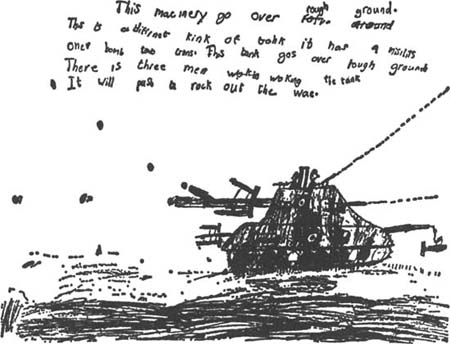
The entire design may be a cliché unit. Thus when children were asked to design a cart to go over rough ground one boy drew a warlike tank complete with cannon, machine guns and rocket missiles. Such entire cliché units are borrowed directly from films, television, comics, encyclopedias etc.
More often the cliché unit is only part of the design. In the apple picking machine project one student drew a large robot man picking apples off a tree. From the top of the robot’s head a wire went to a control switch in the hand of a normal man standing just behind. The large robot was complete down to eyelashes. Another picture showed a boxlike structure with a plain disc for a head. This structure stood on two legs and it was equipped with two simple picking arms each of which had five fingers. Another design had done away with the legs and converted the disc-like head into a dial with a pointer showing ‘fast… faster… stop’; but the two arms with five fingers were retained. A further design did away with the head but kept the arms. Finally a very sophisticated design showed a small mobile wheeled car with a long arm that stretched out to the apples. At the end of the arm was a complete hand with five fingers. One might have supposed this was just a neat way of indicating a picking function but there was a black hole in the middle of the hand and an explanatory note, ‘Apples are sucked through this hole.’ In this series cliché units ranged from the complete duplicate man to the hand with five useless fingers.
As suggested above one may have to pass through cliché units in the course of the design process. The cliché units may be handled in the following ways (among others).
1. Trimming and splitting
A complete cliché unit is taken and then the inessentials are trimmed away much as one might trim a rosebush. For instance in a sophisticated design for a potato peeling machine one designer wanted to go further and fry the potatoes to make chips. So he included a frying pan complete with handle. Since the potatoes were mechanically transported into and out of the pan the handle was obviously superfluous.
Through repeated trimming one gradually narrows down the cliché unit to that part which is really necessary. (This is the whole purpose of that branch of engineering known as Value Engineering.) Trimming may be a gradual process with a small amount removed each time or it may involve large slashes. For instance from the cliché unit of a tank one may slash off all the warlike function and keep only the caterpillar track. Where the jump is very large it may be more a matter of splitting a cliché unit than trimming it. Trimming and splitting are concept breaking procedures and being able to use them is a process of lateral thinking — the escape from rigid patterns.
When to use it
When designing a new product, use the design exercise to generate multiple visual alternatives.
In education, have students redesign everyday objects to develop lateral thinking.
In business, when solving a problem, create visual representations to commit to specific solutions and reveal cliché units.
Use trimming and splitting to refine a concept in engineering or product design by removing non-essential elements.
FROM THEORY TO EVERYDAY LIFE
In practice
Apple Picking Machine Design Series
In a design exercise for an apple picking machine, students submitted designs ranging from a complete robot man with eyelashes to a mobile car with a long arm and a suction hole. This series illustrates the progression from cliché units (humanoid robot) to more functional designs (wheeled car with suction).
Potato Peeling Machine with Cliché Bucket
One design for a potato peeling machine used a bucket of water turned on its side to wash potatoes. This is a cliché unit borrowed from everyday context. The cliché nature was only apparent when visualized in a drawing, not in a verbal description.
A MOMENT TO REFLECT
Put it to work.
Think of a design task you are working on. What are some alternative ways to approach it?
Identify any cliché units in your current design. How can you trim or split them to generate a new approach?
How does creating a visual representation force you to commit to specifics that a verbal description might avoid?
Often confused with
CONTINUE THE CONVERSATION
Source texts
- Lateral Thinking A Textbook of Creativity (Edward de Bono)