Delayed Feedback (Feedback Lag)
When feedback is delayed, individuals or organizations tend to overcorrect or give up because they cannot see the effects of their actions, leading to instability.
THE IDEA
Structure
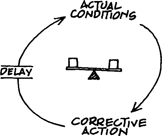
Description: A person, a group, or an organization, acting toward a goal, adjusts their behavior in response to delayed feedback. If they are not conscious of the delay, they end up taking more corrective action than needed, or (sometimes) just giving up because they cannot see that any progress is being made.
Early Warning Symptom: “We thought we were in balance, but then we overshot the mark.” (Later, you may overshoot in the other direction again.)
Management Principle: In a sluggish system, aggressiveness produces instability. Either be patient or make the system more responsive.
Business Story: Real estate developers keep building new properties until the market has gone soft—but, by then, there are already enough additional properties still under construction to guarantee a glut.
Other Examples: A shower where the hot water responds sluggishly to changes in the faucet positions; production/distribution glut and shortage cycles (such as that of the beer game); cycles in production rates and in-process inventory due to long manufacturing cycle times; the Tiananmen Square massacre, in which the government delayed its reaction to protest, and then cracked down unexpectedly hard; sudden, excessive stock market soars and crashes.
When to use it
Managing supply chains where order-to-delivery times are long; avoid over-ordering due to delayed sales data.
Setting personal goals (e.g., fitness or learning) where progress is slow; avoid giving up too early or overtraining.
Controlling inflation: central banks must consider the lag between interest rate changes and economic effect to prevent overshooting.
FROM THEORY TO EVERYDAY LIFE
In practice
Real Estate Development Cycle
Developers continue building until the market softens, but the lag in feedback from completed projects causes a surplus that leads to a glut.
Shower Temperature Adjustment
Turning the faucet produces a delayed change in water temperature, causing the person to over-adjust and oscillate between too hot and too cold.
A MOMENT TO REFLECT
Put it to work.
Recall a situation where you made repeated adjustments to achieve a goal but overshot. How might a delay in feedback have contributed?
In your work or personal life, where do you encounter feedback delays (e.g., response times from colleagues, results of a marketing campaign)? How could you increase system responsiveness or patience?
Can you identify a 'sluggish system' in your organization? What would happen if you became more aggressive in your actions without accounting for the delay?
CONTINUE THE CONVERSATION
Source texts
- The Fifth Discipline The Art Practice of the Learning Organization (Peter M. Senge)