Deceptively Cropped Video
Deceptive cropping removes context from a video or quotation so that it appears to support a different claim. Checking the longer recording can reveal the omitted qualification, question, or population being discussed.
THE IDEA
A time-honored tradition in political campaign advertisements is to take a quote from one’s opponent out of context and present it as the full story. “Some people say if we enact this law, there will be starving in the streets,” says an incumbent for office, “but the opposite is true.” Several months later, a campaign ad runs from the opposition. Now the video is cut so that the incumbent says, simply, “If we enact this law, there will be starving in the streets.”
With the internet and cheap video editing, what used to be the province of professionals is now available to the masses. Any person can crop a video, frame it as an outrage, and get it trending before the full context catches up. The “suitcases of ballots” example discussed by the authors required a longer recording to establish the context. But in many cases, just getting a bit of video on each side of the crop changes everything.
For example, a video was circulated where the US director of the Centers for Disease Control and Prevention (CDC) said, regarding COVID-19, “The overwhelming number of deaths, over 75% occurred in those with over four comorbidities. So really these were people unwell to begin with.” In this case, the video was from Good Morning America—not exactly a hotbed of antivaccine activism—and featured the director of the CDC saying this directly.
Social media went berserk. Had the CDC director just admitted—after pushing everyone to get vaccinated—that COVID-19 wasn’t dangerous to people of moderate health? Hadn’t this been what the antivaccine activists were saying all along: that COVID was less dangerous than the flu? “We were told (COVID-19) killed like that of the Spanish flu or the Black Plague,” said one poster, “but finally the truth is beginning to resound and I pray it sets you free.”18 And while you might think that this is a statistical argument, its significance to those viewing the tightly edited clip was not the statistics but the fact that they finally had proof it had all been a deception.
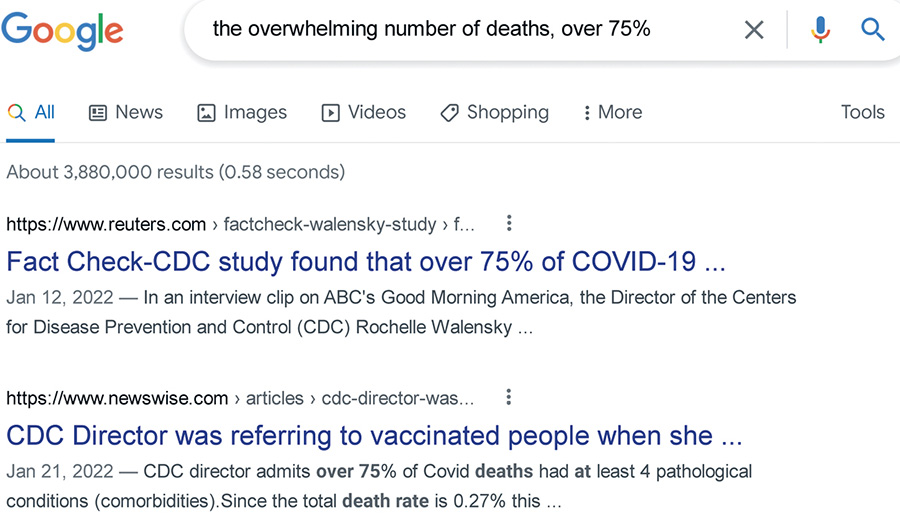
Searching the partial quotation reveals the omitted context.
Here’s the full context of what the CDC director said: “A study of 1.2 million people who were vaccinated between December and October and demonstrated that severe disease occurred in about 0.015% of the people who received their primary series and death in 0.003% of those people. The overwhelming number of deaths, over 75 percent, occurred in people who had at least four comorbidities.”19 The director was describing outcomes among vaccinated people. The cropped clip omitted that population; the quoted rates alone do not provide a comparison with unvaccinated people.
Could we have known this just by looking at the cropped video? Should we have suspected it? Our general advice is to do quick checks on anything we find compelling—suspicious or not. In this case there was a particular tell. The shorter a video is, the easier it is to create a false context. This is part of what we call Molloy’s Law, named after Parker Molloy, a researcher who has documented dozens (perhaps hundreds) of falsely contextualized videos over the years: “The tighter a video is clipped, the less inclined you should be to share it.”20 If the content is compelling and the video is short, seek out the longer version (please!).
What can we do? Because it is important to keep up with events, we can’t mistrust every video that comes across our feeds. But we can take a few seconds to seek context before engaging with it and setting our emotions on fire. We should particularly do that when the video or quote is short. And we can seek our own context instead of relying on the links that others feed us to verify their claims. Once we have the context and re-engage with the video, quote, or news article, we sometimes come to see the event in a very different light.
We want you to be careful, but we don’t want to turn you into cynics. So many things that shape our world for the better start out with an unexpected video, inspiring picture, or disturbing news item. We should be open to it all and share it if it is useful to others. But before handing over the keys to our emotional reactions, we need to exercise a bit of restraint. The old adage of the master carpenter—“measure twice, cut once”—can be adapted here: think twice, share once.
When to use it
Evaluating political campaign ads for deceptive editing.
Fact-checking viral social media clips that provoke strong emotional reactions.
Assessing news reports that quote individuals partially.
Teaching media literacy skills to students.
FROM THEORY TO EVERYDAY LIFE
In practice
Political campaign ad
An opposition ad retains only 'If we enact this law, there will be starving in the streets.' The full statement begins 'Some people say...' and ends 'but the opposite is true.' Removing those parts reverses the speaker’s position.
CDC director quote on COVID-19
A clip shows the CDC director saying 'The overwhelming number of deaths, over 75% occurred in those with over four comorbidities. So really these were people unwell to begin with.' The longer statement specifies that the study concerned vaccinated people, a qualification omitted from the clip.
A MOMENT TO REFLECT
Put it to work.
When you see a short, compelling video on social media, what steps can you take to verify its context before sharing?
Think of a time you were misled by a cropped quote. How did discovering the full context change your understanding?
How does Molloy's Law ('The tighter a video is clipped, the less inclined you should be to share it') apply to your own media consumption habits?
CONTINUE THE CONVERSATION
Source texts
- Verified How to Think Straight, Get Duped Less, and Make Better Decisions about What to Believe Online (Mike Caulfield, Sam Wineburg)