Cynefin Framework for Workplace Well-being
The authors use Cynefin to examine workplace well-being through relationships, working practices, policies, and structures. Surveys can describe reported well-being, but a score alone does not explain what needs to change. Their approach combines those measurements with attention to the conditions employees experience.
THE IDEA
Prior to Marion’s introduction to Cynefin, she saw the world through an ordered lens. She was well versed in validated surveys that told you what the problems were by giving you oodles of quantitative data. It was very straightforward: issue the survey designed by the experts, (often using Likert scales and questions that constrain the available responses) and then look at your numbers to see where you were. Its appeal was both its wide use and promotion by many well-respected bodies.
We reflected that much of how well-being experts define and measure well-being is as capacities or traits within individuals. The result of focusing on employees, per se, falls short of giving the necessary context as to what conditions in the workplace, and interactions that employees have within it, are truly impacting well-being. A survey score alone cannot explain how workplace conditions and interactions affect personal and professional well-being. Instead, they analyze things into component parts so that much of well-being work goes on in the Complicated domain and exhibits a linear approach. While surveys do give a high level overview of stress and well-being levels, decision makers end up working with fragmented, and context-poor data. For example, while a survey may reveal we score 3.9 on a 5-point scale of well-being, we still don’t know what would move us to a better number, e.g. 4.5.
Context-poor numbers also open us up to data manipulation. Measures can become targets for manipulation. The Cobra effect is named after a story set in India when authorities wanted to reduce the number of venomous cobras. They offered a bounty of 2 rupees for each dead cobra head they were brought. This worked for a while and the number of cobras fell. After some time, however, some innovative types opened up cobra breeding farms, whereby they bred cobras and then made a killing in more ways than one. When the authorities found out they stopped the reward scheme, and the cobra breeders let the snakes go free, making the problem bigger than what it was initially!
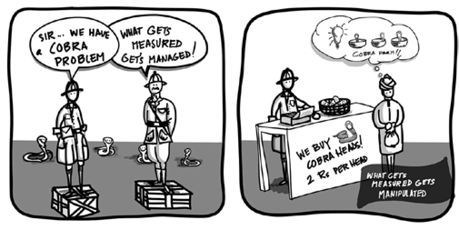
Figure 2. The Cobra Effect
Understanding well-being requires attention to biology, social and cultural conditions, and how these interact in people’s lives. (3)(4) Ultimately, we must create an environment – physical and psychosocial – that supports individuals to flourish in their interaction with each other. We need to define well-being beyond the Complicated domain, where cause-and-effect thinking, fail-safe formulas and surveys dominate our toolbox.
In business we noticed two dominant reactions to the idea of working with complexity. Either people would nod their heads thoughtfully yet have no clear understanding how to access what that means in practice, or people would bury their heads in the sand and try to ignore the enormity of what was going on. We use Cynefin to ask how these conditions interact and what kinds of response they call for.
Looking at well-being through the lens of Cynefin
We treat workplace well-being as an emergent property of relationships, working practices, procedures, and structures. It develops through people’s interactions over time, so prescribing an intervention does not determine its effects.
This approach asks how workplace practices can support well-being, rather than placing the whole responsibility on employees to change their behavior. (5)
Well-intentioned, linear type approaches, as we’ve mentioned, often manifest in programs that aim to make employees ‘more resilient.’ Individual support can help, but it does not replace attention to workplace structures, hierarchies, policies, and interactions. Consider interrupting the current approaches you may be using that categorize well-being as simple or merely complicated, by becoming familiar with the Cynefin Framework below. It provides a lens to see well-being from multiple perspectives.
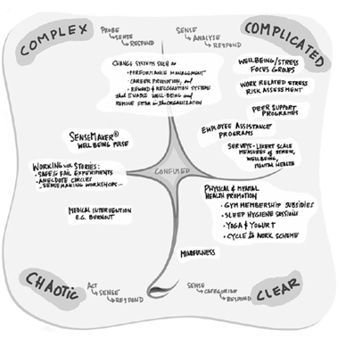
Figure 3. The Cynefin Framework and Wellbeing
The situations facing stressed employees may be Complex, Confused or, at times, Chaotic. A response designed for a Clear or Complicated situation may miss important features of those conditions. Let’s say an employee is told to “Practice mindfulness meditation and you’ll be stress free.” (The Clear domain.) The same employee may be advised to seek the services of an expert, for instance, psychotherapist or yoga teacher. (The Complicated domain). Both actions may help the employee, but neither “solution” by itself changes the workplace practices or environment contributing to the stress response (e.g., unachievable workload, bullying). (6)
When to use it
Assessing whether an employee well-being program addresses working conditions as well as individual coping skills.
Designing organizational change initiatives that account for complex interactions between policies, culture, and individual experiences.
Evaluating the effectiveness of mental health interventions by considering both the person and the environment.
Using narrative and qualitative data to complement quantitative surveys for a richer understanding of well-being.
FROM THEORY TO EVERYDAY LIFE
In practice
The Cobra Effect on Well-Being Data
Context-poor numbers from surveys can lead to manipulation, like the Cobra effect story where a bounty on cobras led to breeding farms, worsening the problem. Similarly, focusing on a single metric (e.g., well-being score of 3.9) can incentivize gaming the system rather than improving actual well-being.
Individual Support and Workplace Conditions
An employee is offered mindfulness practice or therapy while facing an unachievable workload or bullying. The support may help, but the organization still needs to address those working conditions. Cynefin can help examine the situation; the intervention’s name alone does not determine its domain.
A MOMENT TO REFLECT
Put it to work.
How does viewing well-being through the Cynefin framework change your approach to workplace wellness?
What can a well-being survey score tell you, and what additional information would you need before choosing an intervention?
Can you identify a situation where a simple fix (like a meditation app) failed to address the underlying complex issue?
Often confused with
CONTINUE THE CONVERSATION
Source texts
- Cynefin - Weaving Sense-Making into the Fabric of Our World ED02 (Dave Snowden Sonja Blignaut Zhen Goh)