Cynefin
Cynefin is a sense-making decision framework that categorizes systems into Ordered, Complex, and Chaotic domains based on constraint types, and provides guidance on appropriate actions and transitions between domains.
THE IDEA
What is Cynefin?
Cynefin is a key framework in what is known as Naturalizing sense-making. The term naturalizing relates to the use of natural science, and sense-making (with a hyphen) is defined as, “How do we make sense of the world so that we can act in it?” Cynefin is also part of a body of work looking at the dynamic interplay between deductive, inductive, and abductive sense-making. Figure 1 shows this version of the Framework.
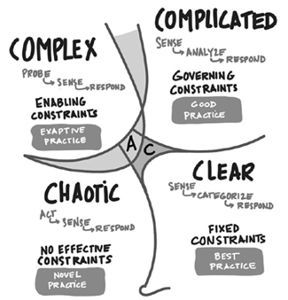
Figure 1. Visual of Cynefin in 2020
The Framework has five main features:
- Domains – Cynefin is a typology that describes three primary types of systems: Ordered, Complex, and Chaotic, each defined by the type of constraint, or absence thereof. Order is constrained and future outcomes are predictable as long as the constraints can be sustained. The Complex domain has enabling constraints, and many levels of entanglement that make it dispositional in nature, with no linear material causality. Chaos is the absence of effective constraints. The shifts between the primary domains are all phase shifts for which the best metaphor is latent heat – energy is required to achieve the phase shift from liquid to gas even though the temperature does not change, similarly phasing from liquid to solid gives off energy.
The early historical use of Unorder, as a collective name for Complex and Chaotic, has been dropped because Complexity and Chaos are as different from each other as they are from Order. Further, we have the Confused domain, formerly known as Disorder. This means not knowing which domain you are in. It is often mistaken for Chaos. The Confused domain is appreciated as A/C (Aporia/Confused). Point 3 explains the Liminal Line.
-
Order – To accommodate the disconnect between reality (ontology: how things are), perception (phenomenology: how we perceive things), and knowledge (epistemology: how we know things) in human systems, Order in Cynefin divides into two domains: 1) Clear (constraints are rigid or fixed and the relationship between cause and effect is self-evident and clear to any reasonable person) and 2) Complicated (causal relationships exist but require expertise or analysis to discover them. Constraints are governing, providing confidence in the boundary of expertise).
-
Liminal Line – Cynefin is a dynamic framework; things transition between domains. The liminal zones in Cynefin are demarcated by the intersections between the liminal lines. These liminal zones provide a space to accommodate significant transitions between domains. The liminal line is open at the top (Figure 2), closed at the bottom, and intersects all domains except Clear. Liminality in the Clear domain is not visible, making the boundary between Clear and Chaotic a cliff or catastrophic fold. It is easy to walk blindly off this cliff through excessive confidence in the context-free applicability of rigid constraints.
The liminal line creates liminal states in Complex (still uncertain but transiting to Complicated), Chaos (the deliberate removal of effective constraints for decision support and/or innovation), Complicated (where the analysis method or type of expertise is in question) and Confusion where the liminal area is one of aporia, a state of authentic confusion i.e., being confused and aware. To be unknowingly in the Confused domain is not advisable, and it is adjacent to the catastrophic fold for a reason. Aporia is also something that can be intentionally created to stimulate pathways into any of the domains other than Clear.
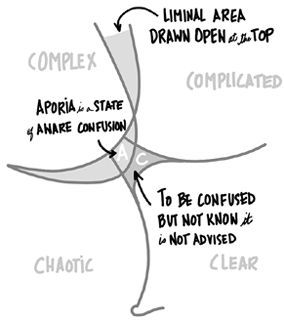
Figure 2. Liminality in Cynefin
-
Practice – There are different types of practice in each of the Cynefin domains including the liminal areas. In the Complex domain practice is ‘exaptive,’ or focused on radical re-purposing of existing capability. In the Complicated domain we apply ‘good practice,’ in Clear we have the only legitimate application of ‘best practice,’ In the liminal area between Complex and Complicated, practice is iterative in nature. Transitions into Clear require confidence that a practice is established and will not need to change for some time. Shifting a practice into Clear, where it is treated as 100% best practice, requires considerable effort. In Chaos, practice is generally novel, either by accident or, in the liminal area, by design. In the liminal area of Confused, practice is aporetic – the deliberate creation of paradox and puzzlement to get people thinking differently.
-
Framework (not method) – Cynefin is at its heart a decision support framework, not a method or model. It is based on the principle of ‘bounded applicability’; there are few if any context-free solutions, but many valid context-specific ones. The Framework is a way of determining what methods or approaches you should adopt, and when you should change them. Movement between domains can take many forms, which have been represented in the past as ‘dynamics.’ The most stable pattern of movement is a constant iteration between Complex and Complicated, with things being consigned to Clear when there is sufficient stability to warrant and the risk of getting it wrong is low (black dotted line paths in Figure 3).
Occasionally there is a need to dip into the ‘aporetic liminal’ area from Complicated, to disrupt entrained expert thinking (grey dotted path in figure 3 formerly known as a shallow dive into the Chaos domain). The ‘aporetic liminal’ area is the normal target for an exit from involuntary Chaos. There is also a dynamic that constantly moves from Complexity through all liminal zones and then back again (dashed line path in figure 3). This means stability of any type is not possible and you are, in effect, to quote one of my favorite authors and interlocutors, Anne Pendleton-Julian, living in a “white water world.” If you can’t navigate the flow, you drown. If you can, you emerge from the rapids, changed. The α β γ & δ points are key monitoring points where you have to make decisions.
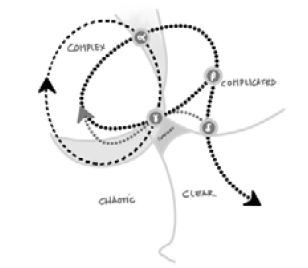
Figure 3. Dynamics and decision points in Cynefin
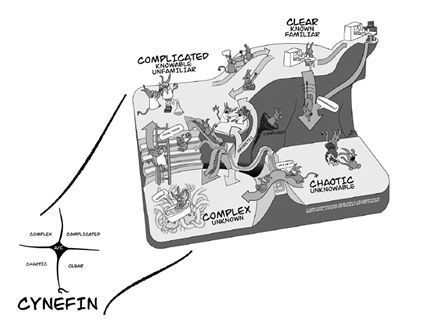
Figure 4. Martin Berg’s Vige cartoon of Cynefin adapted with permission from the 3D version by Rob England in collaboration with Chris Bramley

When to use it
A leader uses Cynefin to decide whether to apply best practices (Clear), seek expert advice (Complicated), run experiments (Complex), or take immediate action (Chaos).
An innovation team uses the liminal zone between Complex and Complicated to iterate rapidly between exploration and exploitation.
A policy maker uses Cynefin to understand that a stable system can suddenly become chaotic if rigid constraints are enforced without adaptation.
FROM THEORY TO EVERYDAY LIFE
In practice
Applying Cynefin to a Business Crisis
A disruption leaves a company without effective constraints on a rapidly deteriorating situation. Leaders treat it as Chaotic and act to establish stability. They then reassess the domain before choosing how to investigate and respond.
Using the Liminal Line for Innovation
A team stuck in Complicated analysis deliberately questions its assumptions and creates room for uncertainty. It uses this aporetic liminal area to explore other explanations before returning to analysis or experimentation.
A MOMENT TO REFLECT
Put it to work.
Which Cynefin domain best describes your current situation based on the type of constraints you face?
How can you intentionally create aporia to break out of entrenched thinking?
What are the risks of assuming a problem is Clear when it is actually Complex?
Often confused with
References
- The Social Ecology of Knowledge Management — Snowden, D. (2000)
- Knowledge assets : securing competitive advantage in the information economy — Boisot, M. (1998)
- Structural Stability and Morphogenesis — Thom, Rene (1989)
- The New Dynamics of Strategy: Sense-Making in a Complex and Complicated World — Kurtz, C F and Snowden, D J. (2003)
- A Leader’s Framework for Decision Making — Snowden, D.J and Boone, M.E. (2007)
- Dynamics in action : intentional behavior as a complex system — Juarrero, A. (1999)
- The Lord of the Rings — Tolkien, J.R.R. (2007)
CONTINUE THE CONVERSATION
Source texts
- Cynefin - Weaving Sense-Making into the Fabric of Our World ED02 (Dave Snowden Sonja Blignaut Zhen Goh)