Convexity Effects (Nonlinear Response)
A convex cost rises at an increasing rate as its input increases. Taleb uses congestion to show why fluctuations can matter: periods above capacity may add more delay than quiet periods remove, so average demand alone can mislead.
THE IDEA
TRAFFIC IN NEW YORK
Let us apply "convexity effects" to things around us. Traffic is highly nonlinear. When I take the day flight from New York to London, and I leave my residence around five in the morning (yes, I know), it takes me around 26 minutes to reach the British Air terminal at JFK airport. At that time, New York is empty, eerily non–New York. When I leave my place at six o’clock for the later flight, there is almost no difference in travel time, although traffic is a bit denser. One can add more and more cars on the highway, with no or minimal impact on time spent in traffic.
Then, a mystery—increase the number of cars by 10 percent and watch the travel time jump by 50 percent (I am using approximate numbers). Look at the convexity effect at work: the average number of cars on the road alone does not determine traffic speed. If you have 90,000 cars for one hour, then 110,000 cars for another hour, traffic would be much slower than if you had 100,000 cars for two hours. Note that travel time is a negative, so I count it as a cost, like an expense, and a rise is a bad thing.
So travel cost is fragile to the volatility of the number of cars on the highway; it does not depend so much on their average number. Every additional car increases travel time more than the previous one.
This is a hint to a central problem of the world today, that of the misunderstanding of nonlinear response by those involved in creating "efficiencies" and "optimization" of systems. For instance, European airports and railroads are stretched, seeming overly efficient. They operate at close to maximal capacity, with minimal redundancies and idle capacity, hence acceptable costs; but a small increase in congestion, say 5 percent more planes in the sky owing to a tiny backlog, can give rise to chaos in airports and cause scenes of unhappy travelers camping on floors, their only solace some bearded fellow playing French folk songs on his guitar.
We can see applications of the point across economic domains: central banks can print money; they print and print with no effect (and claim the "safety" of such a measure), then, "unexpectedly," the printing causes a jump in inflation. Many economic results are completely canceled by convexity effects—and the happy news is that we know why. Alas, the tools (and culture) of policy makers are based on the overly linear, ignoring these hidden effects. They call it "approximation." When you hear of a "second-order" effect, it means convexity is causing the failure of approximation to represent the real story.
I have put a (very hypothetical) graph of the response of traffic to cars on the road in Figure 14. Note for now the curved shape of the graph. It curves inward.
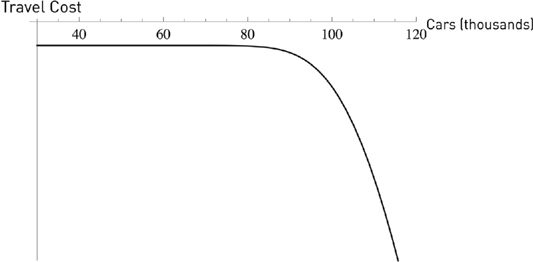
FIGURE 14. The graph shows how the author’s travel time (and travel costs) to JFK depend, beyond a certain point, nonlinearly on the number of cars on the road. Travel costs rise at an increasing rate beyond a certain point: the cost curve is convex, which makes fluctuations costly here.
When to use it
When analyzing traffic flow and planning road capacity, avoid optimizing for average usage; instead, plan for volatility and peak loads.
In supply chain management, consider the nonlinear effects of adding more suppliers or inventory; a small disruption can have large consequences.
In economic policy, be cautious of linear models that ignore convexity in inflation, unemployment, or growth.
FROM THEORY TO EVERYDAY LIFE
In practice
New York traffic to JFK
Travel time from residence to JFK at 5 AM is about 26 minutes with light traffic. At 6 AM, traffic is denser but time is similar. However, a 10% increase in cars beyond a threshold can cause a 50% increase in travel time, illustrating convexity (travel cost curve is concave upward).
European airports and railroads
Systems operating near maximal capacity with minimal redundancy appear efficient. A small increase in congestion (e.g., 5% more planes) can lead to chaos and traveler discomfort, as seen in airport delays.
Central bank money printing
Printing money may have no effect initially, but beyond a threshold, it can cause a sudden jump in inflation, a convex response in the price level.
A MOMENT TO REFLECT
Put it to work.
What are systems in your daily life where adding more input (e.g., time, money, people) initially has little effect but eventually causes a sharp change?
Why might focusing on average measures be misleading when a system has convex responses?
How can you identify when a system is operating near a convexity tipping point?
Often confused with
CONTINUE THE CONVERSATION
Source texts
- Antifragile (Nassim Nicholas Taleb)