Constraints: Helpful or Harmful?
A constraint can limit output while also helping organize a system. The Theory of Constraints focuses on managing what limits progress toward a goal; Cynefin distinguishes fixed, governing, enabling, and ineffective constraints in different contexts.
THE IDEA
Constraints: Helpful or Harmful?
In TOC, constraints are limiting factors that keep you from reaching your goal. The aim is to improve progress toward the goal by managing the limiting factor, which may involve using it better, organizing other work around it, or increasing its capacity. Consider this definition from the Theory of Constraints Dictionary V2:
“Constraint: The factor that ultimately limits the performance of a system or organization. That factor that, if the organization were able to increase it, more fully exploit it, or more effectively subordinate to it, would result in achieving more of the goal.” (6)
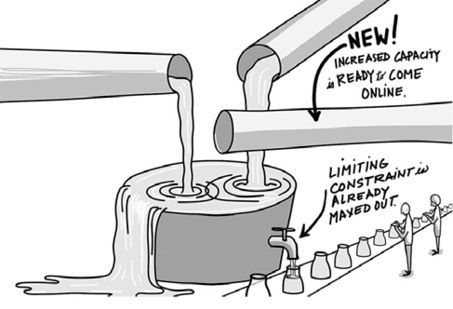
Figure 1. Don’t produce more than the system constraint can handle, it is wasteful
Readers of The Goal tend to remember the Boy Scout hike and Herbie, the slowest hiker. On the hike, Herbie was the constraint and the story involves coming up with ways to speed Herbie up. This reinforces the perception that constraints are a problem to be fixed.
Recent versions of the Cynefin Framework seem to present a different view. Consider how the word “constraint” shows up in four of the domains:
- The Clear domain has ‘fixed constraints’
- The Complicated domain has ‘governing constraints’
- The Complex domain has ‘enabling constraints’
- The Chaotic domain has ‘no effective constraints’
But are these the same or different principles than those ascribed by TOC? Well, it depends. It’s essential to look at the types of constraints in Cynefin to answer the question.
A ‘fixed constraint,’ as found in the Clear domain, means that there is only one way to do something. You must do Step 1 before you can do Step 2. There is no alternative.
As found in the Complicated domain, a ‘governing constraint’ means that some specific rules or policies have been imposed on the system to guide what is allowed to be done and how. These frequently vary with context and there are often alternative approaches. For instance, in many countries people drive on the right... except when they pass another vehicle, or swerve to avoid something by driving on the left. There are often no physical barriers to keep them driving on the right, they just do so because that is the policy. That is a governing constraint. Similarly, a traffic signal is a governing constraint. A red light does not physically stop a car from proceeding, but drivers are taught to stop and wait for it to turn green by policy.
An ‘enabling constraint,’ in the Complex domain, is a bit different. It is a limitation, but it enables emergent system behavior that would have otherwise not been possible. Alicia Juarrero, in Dynamics in Action: Intentional Behavior as a Complex System, uses the knee’s restricted range of movement as an example. (7) The joint’s limitations also provide the stability and control that support walking and running.
In the Chaotic domain saying that there is ‘no effective constraint’ means that we cannot perceive any causal relationship between local cause and system effect. We don’t know how to influence the system and attempts are essentially random guesses.
Fixed and governing constraints are clearly on the Ordered side of the Cynefin Framework. They are known and defined. Enabling constraints are on the Unordered side of the Cynefin Framework and will result in emergent behavior which is not predictable by analysis, it must be discovered by experimentation.
If we compare TOC and Cynefin versions of constraints, we see that the TOC definition of a constraint is most closely aligned with Cynefin’s fixed and governing constraints. Where things get interesting is when we look at enabling constraints. TOC does have the concept of applying a limiting factor to improve system performance but does not call it, or even think of it, as a constraint. In TOC these are referred to as ‘Injections’ and they are the actions taken to improve system performance. This may include actions to remove constraints seen as limiting.
In his earlier writings, Goldratt also described a ‘policy constraint,’ a rule or policy that blocked a system from reaching its goal. These rules were likely put in place at a time when they provided real value, but over time they became limitations to system performance, and over constrained a system making things worse.
Examples might include a rule requiring employees to get senior executive approval to spend more than $25 in expenses, or a laborious process to order software. TOC’s policy constraints are fully aligned with Cynefin’s concept of a governing constraint. My conclusion is that these uses of constraints can be compatible, even though TOC and Cynefin describe different aspects of systems and use different terms.
When to use it
Identifying bottlenecks in a manufacturing or service process to improve throughput (TOC application).
Designing organizational policies as governing constraints that guide behavior without becoming overly restrictive.
Creating innovation challenges with specific, fixed constraints (e.g., time, resources) to encourage novel solutions (enabling constraint).
Diagnosing chaotic situations by recognizing the absence of effective constraints and introducing simple rules to establish order.
FROM THEORY TO EVERYDAY LIFE
In practice
Herbie the Slow Hiker
In The Goal, the character Alex’s son is on a Boy Scout hike and the slowest hiker, Herbie, becomes the constraint. The story focuses on speeding Herbie up, illustrating the TOC view that constraints are problems to be fixed.
Traffic Signal Governing Constraint
A red traffic light is a governing constraint: it does not physically stop a car but drivers follow the policy to stop, allowing orderly traffic flow. If ignored, the system degrades.
Knee Enabling Constraint
The knee’s structure limits its range of movement while providing stability for walking and running. In this illustration, restricting some movements helps make other coordinated movements possible.
A MOMENT TO REFLECT
Put it to work.
Identify a constraint in your personal or professional life. Is it limiting or enabling? How could you reframe it?
When faced with a policy or rule, ask yourself: Is this a necessary governing constraint or a leftover that now over-constrains the system?
How can you intentionally set an enabling constraint (e.g., a fixed budget or deadline) to foster creativity and emergent solutions?
Often confused with
References
- Theory of Constraints Dictionary V2 — Unknown
- Dynamics in Action: Intentional Behavior as a Complex System — Alicia Juarrero
CONTINUE THE CONVERSATION
Source texts
- Cynefin - Weaving Sense-Making into the Fabric of Our World ED02 (Dave Snowden Sonja Blignaut Zhen Goh)