Connect My Dots (Creating a False Sense of Research)
Connect My Dots is a manipulation technique where context is stripped from facts, then the audience is invited to verify those facts themselves, creating a false sense of independent research while actually being led to a predetermined conclusion.
THE IDEA
Connect My Dots, or Creating a False Sense of "Research"
Sometimes the problem is not the absence of a link but that the link you’re provided comes shorn of the context you need to understand it. This can be particularly pernicious: on the one hand, you feel like you’re verifying something (after all, isn’t following a link to a source the last part of SIFT?). On the other hand, the false framing you’ve been fed prevents you from understanding the real meaning of the materials you’ve pulled up.
Consider the odd TikTok conspiracy that circulated in spring of 2021. A user on that site made a video that pointed at the party-supply pages of a seller on Amazon, saying that they were suspiciously overpriced. A party hat for fifteen thousand dollars? Was it possible that this store was actually a front for child sex-trafficking? That the party hat was really a secret way to “order up” an abducted child?
An expensive listing does not establish trafficking. Yet the presentation can still feel compelling. After all, you can go and look at the Amazon listing yourself, right? It feels like verification; you’re “doing your own research,” after all. And when you get to the link and find there are party-themed fedoras for fifteen thousand dollars, maybe you don’t necessarily buy the conspiracy. But you have to admit, something seems fishy.
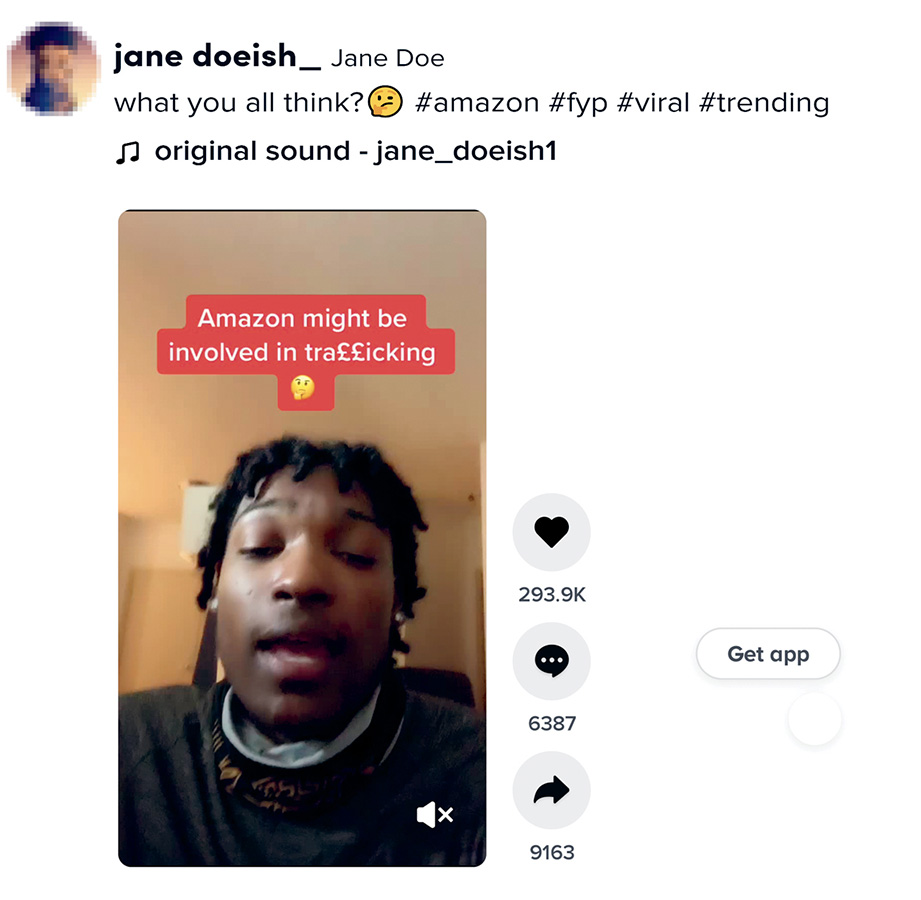
Except you’ve been had. That research you’re doing is a setup. The facts are presented without context. Then you are invited to verify these contextless facts. But what you’re not given is the information that would allow you to make sense of them. We call this technique “Connect My Dots”: you feel like you are drawing a picture yourself, directly from evidence, but in reality, you have been given the dots to connect and the order in which to connect them. The dots that don’t fit the chosen narrative are not supplied.
In this case, the crucial piece of context? Sometimes people buy party supplies in bulk for large events. And if, for example, you buy a bulk order of three thousand hats, the price will be, more or less, fifteen thousand dollars. In cases like this, it’s not always clear if the conspiracy theorists know the context and don’t supply it, or if they’re confused themselves. But the consequences are pretty horrific. Spreading like wildfire on TikTok, this video received over six million views! Viewers confused by it went on Amazon and left outraged comments. Employees received threats, the police were called, and users down-ranked the store on Amazon, dealing the small business of seventeen years a financial blow. In the mind of the conspiracy theorists, of course, they were sure that they were the critical thinkers. After all, hadn’t they used reasoning to figure out whether this was “plausible”? They hadn’t taken the TikTok poster’s word for it; they had verified these prices on Amazon directly.
We see this technique in even more weighty cases. As we noted in chapter 2, one technique of antivaccine activists is to link people to the VAERS website, an unverified database of things that people claim to have experienced within a certain period after getting a vaccine. It’s meant to alert researchers to issues they may want to research; it is not a running record of vaccine issues. A lot of things happen to people every day, including the days after they get a vaccination, and the vast majority of those things are not related in any real way to vaccines. If you look carefully at the page itself, it will tell you that, just as Amazon’s interface was pretty clear you were ordering three thousand hats. But the wrong person presenting the database as something else—and providing a link—can make people blind to cues that should be obvious.
The techniques you should use here are not that different from what we have shown before. For the TikTok conspiracy, it’s notable that there was another video debunking it and explaining it before the theory went viral. So, by the time most people shared it, a search for “TikTok conspiracy Ionized” (Ionized is the name of the company) would have turned up the debunking video and provided the context. For a deep-linked source like VAERS, our standard “Investigate” advice applies: don’t assume that how a source has been described by the person sending it to you is necessarily accurate.
When to use it
Evaluating sensational claims on social media that provide links to seemingly supporting evidence.
Fact-checking political advertisements that quote statistics or cite databases without full context.
Teaching information literacy: helping students recognize when they are being led to a conclusion rather than conducting genuine inquiry.
Identifying manipulation in online conspiracy theories that invite users to 'do their own research' on curated sources.
FROM THEORY TO EVERYDAY LIFE
In practice
TikTok Party Hat Conspiracy (2021)
A TikTok user claimed an Amazon party supply store was a front for child sex-trafficking because a party hat was listed for $15,000. Viewers verified the price on Amazon, missing the context that the price was for a bulk order of 3,000 hats. The video received over 6 million views, leading to harassment of the seller and financial damage to the small business.
VAERS Database Misuse by Antivaccine Activists
Someone links to VAERS as though its reports were a list of vaccine-caused injuries. A reader may check that the reports exist and feel the claim has been verified. The missing context is that an event reported after vaccination does not, by that fact alone, establish that vaccination caused it.
A MOMENT TO REFLECT
Put it to work.
Think of a time you followed a link to verify a claim. Did you check the original source’s context, or did you rely on the description provided by the person who shared the link?
How can you detect when you are being asked to 'connect the dots' in a predetermined way? What red flags would you look for?
In what ways might your own confirmation bias make you more susceptible to the 'Connect My Dots' technique?
Often confused with
CONTINUE THE CONVERSATION
Source texts
- Verified How to Think Straight, Get Duped Less, and Make Better Decisions about What to Believe Online (Mike Caulfield, Sam Wineburg)