Conditionally Dependent Probability
For two events, multiply the first event’s probability by the second event’s probability given the first. For independent fair coin tosses, two heads have probability 0.5 * 0.5 = 0.25. Sequence alone does not imply dependence.
THE IDEA
Conditionally Dependent Probability
For two events, multiply the probability of the first by the conditional probability of the second given the first. If the events are independent, that conditional probability equals the second event’s ordinary probability.
What is the probability of tossing two heads in a row with a coin?
The probability tree in Figure 13-4 illustrates the possible sequences of events. The probability of getting heads on the first toss is .5. If we get tails, the sequence ends; it’s over, and we’re stuck on that limb of the tree. We toss the coin a second time only on condition that we get heads on the first toss. The decision to make another toss depends on the first result in this procedure. The result of an independent fair toss does not become statistically dependent merely because it comes second. If we get heads on the first toss, what is the probability of getting heads on the second toss? Still .5, so we have a 50 percent chance of a 50 percent chance (.5 times .5) of tossing two heads in a row, which equals a probability of .25.
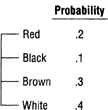
FIGURE 13-3
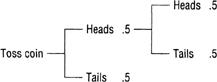
FIGURE 13-4
The same multiplication rule applies to the jelly beans with replacement. What is the probability that we will first pick a single red bean (and return it to the jar) and then pick a green bean? Figure 13-5 portrays this sequence. The probability of picking a single red bean is .5; the probability of a single green bean is .1. So the probability of picking a red and then a green bean is .5 times .1, which equals .05.
When to use it
Calculating the chance of rain on both days using the first day’s probability and the probability of rain on the second day given rain on the first.
Determining the probability of two hits using the first-shot hit rate and the second-shot rate given the first hit, checking whether independence is justified.
Modeling the probability of success in a two-step process where each step depends on the previous one.
FROM THEORY TO EVERYDAY LIFE
In practice
Tossing two heads in a row
The probability of getting heads on the first toss is 0.5; given that, the probability of heads on the second toss is also 0.5. Multiplying gives 0.25 for two heads in a row.
Picking red then green jelly beans
If the probability of picking a red bean is 0.5 and the probability of picking a green bean (with replacement) is 0.1, then the probability of red then green is 0.5 * 0.1 = 0.05.
A MOMENT TO REFLECT
Put it to work.
How would you calculate the probability of rolling a 4 on a six-sided die and then flipping a heads on a coin?
If you draw two marbles from a bag without replacement, does the probability of the second draw depend on the first? How would you calculate it?
Think of a real-life scenario where you need to calculate the probability of two events happening in sequence. What is the probability?
CONTINUE THE CONVERSATION
Source texts
- The Thinkers Toolkit by Morgan D Jones