Concept Rigidity
The tendency for named concepts to become fixed and resistant to change, making it difficult to adopt new divisions or assemblies of ideas.
THE IDEA
Limitations of the naming system
The great practical advantage of the named unit system is its permanence and the great practical disadvantage of the named unit system is its permanence.
Names, labels, words, are themselves fixed and permanent. Hence the units which have been taken over by these names have also to be fixed and permanent. Hence the patterns which are arrangements of such units tend also to be fixed and permanent.
The major disadvantage is that a named unit which might have been very convenient, at one time may no longer be convenient, indeed it may be restricting. The named assemblies of units (which are called concepts) are even more restricting because they impose a rigid way of looking at a situation. When there is a famine in a rice eating country and maize is sent in by other countries the starving people prefer to starve. Such is the rigidity of the concept, ‘maize is food for animals’.
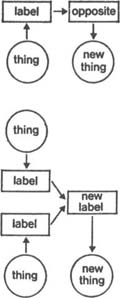
Even without a name a concept would be fixed by repeated use and growing familiarity. Putting a label on it accelerates the process.
Some of the limitations that arise from this named unit process are outlined below.
-
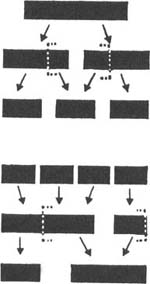
A division at a point of convenience produces two units which then become established and named. Subsequently it may be more convenient to divide the original situation into three units. This is shown in the top figure opposite. The establishment of the new units is very difficult as it means carving bits out of the previous units and putting them together so that they form a new unit rather than revert back to the old units.
-
The lower figure shows how an assembly of units becomes established as a new unit. If it becomes more convenient to change this assembly so that it includes some new units but excludes some old ones this is very difficult.
-
When a unit is separated out and named it is difficult to realize that it is part of a whole.
-
When an assembly of units is given an overall name it may be difficult to realize that it is made up of parts.
-
When a division has been made it is difficult to bridge across that division. If a process has been cut at some point and what goes before that point is called ‘cause’ and what comes after is called ‘effect’ then it is difficult to bridge across the point and call the whole thing ‘change’.
This is not a comprehensive list by any means. What is implied is that if units have been cut out and assembled in various ways which are then fixed by labels it becomes very difficult to use different units or different ways of putting them together.
When to use it
When designing educational curricula, avoid overly rigid categories that may hinder interdisciplinary learning.
In product development, be wary of fixed labels for functions that might limit innovation.
In conflict resolution, recognize that entrenched labels (e.g., 'enemy') can prevent seeing common ground.
When analyzing historical events, question how fixed concepts may have biased decision-making.
FROM THEORY TO EVERYDAY LIFE
In practice
Famine and Maize
De Bono describes famine aid being rejected because recipients regarded maize as animal food. He uses the anecdote to illustrate how a fixed label can make an available alternative seem unacceptable.
Re-dividing a concept
If a situation is initially divided into two convenient named units, it becomes very difficult to later re-divide it into three units because the existing labels resist carving out new parts.
A MOMENT TO REFLECT
Put it to work.
Can you identify a label or concept in your own thinking that might be unnecessarily rigid?
How might a fixed concept like 'maize is animal food' prevent creative solutions to a problem?
Think of a time when you struggled to see a situation from a new perspective because an existing category was too strong.
CONTINUE THE CONVERSATION
Source texts
- Lateral Thinking A Textbook of Creativity (Edward de Bono)