Choice of Entry Point and Attention Area
An entry point is the part of a problem you attend to first. De Bono argues that changing this starting point can change the sequence of ideas and lead to a different interpretation, even when the available information stays the same.
THE IDEA
Choice of entry point and attention area 17
De Bono models the mind as an information-processing system with a limited area of attention. In this model, what receives attention is selected from a larger field. Such a system has a limited area of attention. A limited area of attention can only settle on part of an information field. That part of the information field on which the limited attention area settles is thereby ‘chosen’ or ‘selected’. The process is in fact a passive one but one can still talk of choice or selection. The behaviour of this limited attention area and the system mechanics underlying it are described elsewhere in de Bono’s account.
‘Attention area’ refers to the part of a situation or problem that is attended to. ‘Entry point’ refers to the part of a problem or situation that is first attended to. An entry point is obviously the first area of attention and it may or may not be succeeded by others depending on the complexity of the situation.
From an insight restructuring point of view the choice of entry point is of the utmost importance. One could almost say that when no further information is added to the system that it is the choice of entry point which brings about insight restructuring. Why this is so follows directly from the mechanics of this type of information processing system.
Patterns are established on the memory surface that is mind by the sequence of arrival of information. Once established these patterns have a ‘natural’ behaviour in so far as they tend to develop in certain ways, and to link up with other patterns. The purpose of lateral thinking is to restructure these patterns and arrange information to give new patterns.
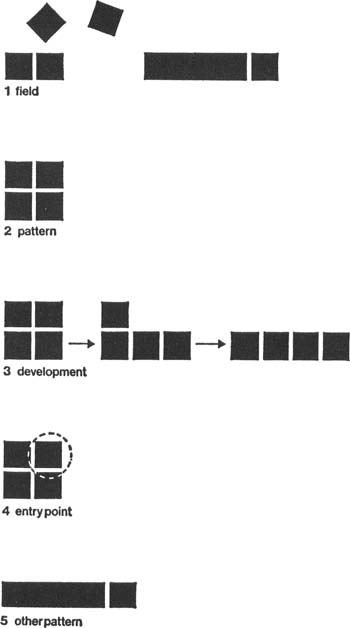
The series of diagrams above illustrates the natural patterning behaviour of the memory surface of mind:
-
This shows the available information field.
-
Information is structured into a natural pattern.
-
The natural pattern has a natural line of development.
-
In developing the pattern there is a natural entry point from which one starts.
-
From the original information field only a limited area was selected by attention. Had the attention field been different then the pattern and its development would also have been different.
The choice of entry point is of huge importance because the historical sequence in which ideas follow one another can completely determine the final outcome even if the ideas themselves are the same. If you fill a bath using only the hot tap and then add the cold water at the end the bathroom will be thoroughly steamed up and the walls will be damp. If however you run some of the cold water in right at the beginning then there will be no steaming up and the walls will remain dry. Yet the actual amounts of hot and cold water will be exactly the same in each case.
The difference may be huge even if the actual ideas considered are the same but in practice a different entry point will usually mean a different train of ideas. A picture of a man with a stick in his hand followed by a picture of a dog running might suggest that the man is throwing sticks for the dog to retrieve. A picture of a dog running followed by a picture of the man with a stick in his hand might suggest that the man is chasing the dog out of his garden.
When to use it
Brainstorming sessions: deliberately vary the starting point to generate diverse ideas and avoid fixation on a single entry point.
Problem-solving: When stuck, try approaching the problem from a different angle, e.g., start with constraints instead of goals, or consider the end state first.
Conflict resolution: Sequence matters in discussions; bringing up sensitive issues later after building rapport can lead to more constructive dialogue.
Learning and instruction: Presenting information in different sequences can enhance understanding or highlight different aspects of a concept.
FROM THEORY TO EVERYDAY LIFE
In practice
Filling a Bath with Hot and Cold Water
To illustrate the importance of sequence: if you fill a bath using only the hot tap and then add the cold water at the end, the bathroom will steam up and walls become damp. But if you run some cold water first, there is no steaming. The total amounts of hot and cold water are identical; only the order differs.
Man with Stick and Dog
The sequence of images changes interpretation: first a man with a stick, then a dog running suggests the man is throwing sticks for the dog to retrieve. But if the dog runs first, followed by a man with a stick, it suggests the man is chasing the dog out of his garden. Same elements, different meaning due to entry point.
A MOMENT TO REFLECT
Put it to work.
How might the order in which you consider factors in a decision affect your final conclusion? Can you think of an example where a different entry point would lead to a different outcome?
Consider a problem you are currently facing. What is your natural entry point? How might deliberately choosing a different starting point change your perspective?
In a team discussion, how could the sequence of presented ideas influence the group's decision? How can you ensure a more balanced exploration of the problem space?
CONTINUE THE CONVERSATION
Source texts
- Lateral Thinking A Textbook of Creativity (Edward de Bono)