Check Institutional Credentials
Before trusting an unfamiliar source, investigate its founding, funding, leadership, and political leanings to assess reliability and potential bias.
THE IDEA
NATIONAL CONSTITUTION CENTER
You were reading something about the Second Amendment and ended up at constitutioncenter.org. Is it right-wing, left-wing, a gathering point for conspiracy theorists? Should you dig in only to learn an hour later that you stumbled on a site that says the Constitution guarantees the right to child sacrifice?
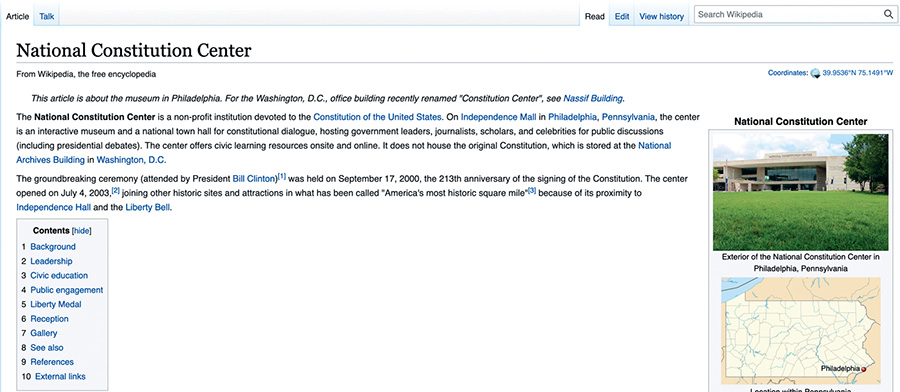
Figure 7.5 Wikipedia entry for the National Constitution Center (https://en.wikipedia.org/wiki/National_Constitution_Center)
Nothing in Wikipedia sticks out. The Center was funded as part of the Constitution Heritage Act of 1988, supported by President Ronald Reagan, a Republican. Both George H. W. Bush, another Republican, and Bill Clinton, a Democrat, served as chairmen of the board. The Center seems to be the rare bipartisan institution that tries to preserve the heritage of the Constitution for adherents in both parties. You conclude: “Looks OK.”
This heuristic involves quickly checking the institutional background of a source—especially its funding, history, and leadership—to determine if it has a strong political or ideological bias. One quick step is to look up the institution on Wikipedia or a similar encyclopedia, then follow relevant references if the claim needs further checking.
When to use it
When you come across a new website or think tank while researching a controversial topic.
Before sharing a news article from an unknown outlet on social media, check the institution's credentials.
When evaluating political or scientific claims from an organization you've never heard of.
FROM THEORY TO EVERYDAY LIFE
In practice
Evaluating the National Constitution Center
The authors use the National Constitution Center’s history and board leadership to assess its institutional background. Connections with leaders from both parties give context for their initial judgment. They do not prove that every claim on the site is accurate or free of bias.
A MOMENT TO REFLECT
Put it to work.
Think of a website or organization you often rely on. How would you go about checking its institutional backing and political leanings?
What are the potential pitfalls of only relying on Wikipedia for institutional background? How could you supplement that check?
CONTINUE THE CONVERSATION
Source texts
- Verified How to Think Straight, Get Duped Less, and Make Better Decisions about What to Believe Online (Mike Caulfield, Sam Wineburg)