Chaos and Confusion in the Cynefin Framework
Two embodied exercises that illustrate the difference between the chaotic and confused domains in the Cynefin framework, using a milling game and an ambiguous organizational challenge.
THE IDEA
Illustrating Chaos and Confusion
While the Clear, Complicated and Complex domains are enough to pursue, if you have more time it’s fun to take people into the Chaotic and Confusion domains with their own exercises. These exercises take more time so I typically leave out these two challenges, but it can be useful to illustrate the distinction between them.
I would suggest you start with chaos. I use a milling game from the world of improv theatre in which I give a group a set of paired commands, train them to follow orders, then mix up the orders and finally produce orders at such a rate that the system fails.
It goes like this:
- Have the group walk around the room, randomly, changing direction, and filling all spaces.
- Give them an instruction: “When I say ‘stop,’ you stop and when I say ‘go,’ you start moving again.” Repeat the instruction a few times.
- Next say: “Now I will add two more instructions. When I say ‘clap,’ you clap when I say ‘bow,’ you make a little bow.” Ask the group to stop, go, bow and clap for a minute.
- Now give one more set of instructions: “When I say ‘hop’ you hop in the air and when I say “woohoo!’ you say ‘woohoo!’”
- Now you begin to mix things up. Tell the group, “This time when I say ‘stop’ you go and when I say ‘go’ you stop. The other instructions remain the same.” Continue giving commands as the group is walking in the space.
- Then give this instruction: Switch the second and third pair of commands, so that “stop” means “go,” “go” means “stop,” “bow” means “clap,” “clap” means “bow,” “hop” means say ‘woohoo!’” and “woohoo” means “clap.” People will begin to fail because it becomes confusing.
- Increase the tempo of your commands so that they are coming too fast and furious for people to respond accurately. Some people will find this hilarious. Others will get deeply anxious.
The printed instructions contain a mismatch in the final reversed pair: the last command maps back to clapping rather than reversing the hop/woohoo pair. A facilitator using the exercise should settle on a consistent mapping before starting.
The huge cognitive load in this exercise creates frustration. Some people will stop participating. Notice that this is a form of applying a safety constraint. When people are in deep chaos, a highly structured constraint helps them reset and come back online.
Following this exercise, you can illustrate the difference between chaos and confusion by providing a one-line challenge to the group:
- Ask the group to, “Organize yourselves economically”
This always gives a group pause. They want to know what you mean. In English, the adverb “economically” is ambiguous and also activates biases, assumptions, and broader societal meanings.
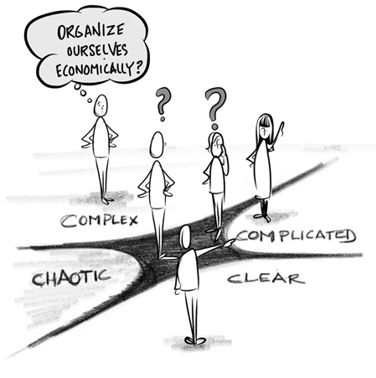
Once when I ran this exercise with a group of sustainability activists from mixed economic classes, the group sat in a circle and discussed what “economically” could mean. They came up with:
- Let’s just line up by how much money we make.
- How much cash do you have on you right now?
- How about those who come from poor backgrounds, step into the middle…
...and so on. Emotions ran high, biases and privilege got exposed, class warfare broke out, a small trauma was triggered, arguments broke out. They talked about all of it and I never once intervened. It took 45 minutes for the group to come to a solution. One person, who had been watching the whole time, quietly finally spoke up and said, “What if economically means “in the least amount of time and using as little energy as possible?” In that case, I suggest we just line ourselves up by height and be done with it.” The group held a collective moment of astonishment and then did just that.
In reflection, people recognized how critical the Confusion domain is and what happens when approaching problems from bias and habit. It was a rich learning moment, and I highly recommend exploring embodied confusion, especially as a contrast to embodied chaos.
When to use it
Team-building workshops to illustrate decision-making under pressure and the need for constraints in chaos.
Teaching systems thinking and complexity management in business or education settings.
Training facilitators to recognize when a group is in chaos versus confusion and apply appropriate interventions.
Exploring how language ambiguity can trigger biases and escalate conflict, as a lesson in clear communication.
FROM THEORY TO EVERYDAY LIFE
In practice
The Milling Game (Chaos)
A group exercise using paired commands (stop/go, clap/bow, hop/woohoo) that are progressively swapped and accelerated until participants fail under cognitive overload. Demonstrates the chaotic domain and how a safety constraint can reset the system.
Organize Yourselves Economically (Confusion)
A group is asked to physically organize themselves using the ambiguous word 'economically'. The exercise reveals biases, assumptions, and emotional reactions, illustrating the confusion domain where the problem itself is unclear and requires sense-making before action.
A MOMENT TO REFLECT
Put it to work.
How did your emotional state change during the chaos exercise as the commands became faster and more contradictory?
Why did the 'organize yourselves economically' challenge take so long? What assumptions and biases surfaced in your group?
When does a situation require immediate action to establish stability, and when do you first need to clarify what kind of problem you face?
Often confused with
CONTINUE THE CONVERSATION
Source texts
- Cynefin - Weaving Sense-Making into the Fabric of Our World ED02 (Dave Snowden Sonja Blignaut Zhen Goh)