Causal Conjunctions
The conjunction fallacy can also arise from a causal link between two events, where an event A provides a plausible cause for event B, leading people to judge the conjunction A&B as more probable than B alone, even when A is not representative of the broader context.
THE IDEA
A Linda-type conjunction problem has three elements: a personality description, called the causal model M; a basic target event B that seems unrepresentative of that description (she is a bank teller); and an added event A that seems highly representative (she is a feminist). In these problems, the model M is positively associated with A and is negatively associated with B. This structure, called the M → A paradigm, is depicted on the left side of Fig. 1.1. We found that when the sketch of Linda’s personality was omitted and she was identified merely as a “31-year-old woman,” almost all respondents obeyed the conjunction rule and ranked the conjunction (bank teller and active feminist) as less probable than its constituents. The conjunction error in the original problem is therefore attributable to the relation between M and A, not to the relation between A and B.
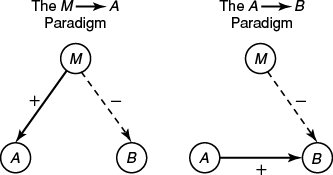
Figure 1.1. Schematic representation of two experimental paradigms used to test the conjunction rule. (Solid and broken arrows denote strong positive and negative associations, respectively, between the model M, the basic target B, and the added target A.)
The conjunction fallacy was common in the Linda problem despite the fact that the stereotypes of bank teller and feminist are mildly incompatible. When the constituents of a conjunction are highly incompatible, the incidence of conjunction errors is greatly reduced. For example, the conjunction “Bill is bored by music and plays jazz for a hobby” was judged as less probable (and less representative) than its constituents, although “bored by music” was perceived as a probable (and representative) attribute of Bill. Quite reasonably, the incompatibility of the two attributes reduced the judged probability of their conjunction.
The effect of compatibility on the evaluation of conjunctions is not limited to near contradictions. For instance, it is more representative (as well as more probable) for a student to be in the upper half of the class in both mathematics and physics or to be in the lower half of the class in both fields than to be in the upper half in one field and in the lower half in the other. Such observations imply that the judged probability (or representativeness) of a conjunction cannot be computed as a function (e.g., product, sum, minimum, weighted average) of the scale values of its constituents. This conclusion excludes a large class of formal models that ignore the relation between the constituents of a conjunction. The viability of such models of conjunctive concepts has generated a spirited debate (Jones, 1982; Osherson & Smith, 1981, 1982; Zadeh, 1982; Lakoff, 1982).
The preceding discussion suggests a new formal structure, called the A → B paradigm, which is depicted on the right side of Fig. 1.1. Conjunction errors occur in the A → B paradigm because of the direct connection between A and B, although the added event A is not particularly representative of the model M. In this section, we investigate problems in which the added event A provides a plausible cause or motive for the occurrence of B. Our hypothesis is that the strength of the causal link, which has been shown in previous work to bias judgments of conditional probability (Tversky & Kahneman, 1980), will also bias judgments of the probability of conjunctions (see Beyth-Marom, 1982). Just as the thought of a personality and a social stereotype naturally evokes an assessment of their similarity, the thought of an effect and a possible cause evokes an assessment of causal impact (Ajzen, 1977). The natural assessment of propensity is expected to bias the evaluation of probability.
To illustrate this bias in the A → B paradigm, consider the following problem, which was presented to 115 undergraduates at Stanford University and UBC:
A health survey was conducted in a representative sample of adult males in British Columbia of all ages and occupations. Mr. F. was included in the sample. He was selected by chance from the list of participants. Which of the following statements is more probable? (check one)
Mr. F. has had one or more heart attacks.
Mr. F. has had one or more heart attacks, and he is over 55 years old.
This seemingly transparent problem elicited a substantial proportion (58%) of conjunction errors among statistically naive respondents. To test the hypothesis that these errors are produced by the causal (or correlational) link between advanced age and heart attacks, rather than by a weighted average of the component probabilities, we removed this link by uncoupling the target events without changing their marginal probabilities.
A health survey was conducted in a representative sample of adult males in British Columbia of all ages and occupations. Mr. F. and Mr. G. were both included in the sample. They were unrelated and were selected by chance from the list of participants. Which of the following statements is more probable? (check one)
Mr. F. has had one or more heart attacks.
Mr. F. has had one or more heart attacks, and Mr. G. is over 55 years old.
Assigning the critical attributes to two independent individuals eliminates in effect the A → B connection by making the events (conditionally) independent. Accordingly, the incidence of conjunction errors dropped to 29% (N = 90).
The A → B paradigm can give rise to dual conjunction errors in which A&B is perceived as more probable than each of its constituents, as illustrated in the next problem.
Peter is a junior in college who is training to run the mile in a regional meet. In his best race, earlier this season, Peter ran the mile in 4:06 min. Please rank the following outcomes from most to least probable.
Peter will run the mile under 4:06 min.
Peter will run the mile under 4 min.
Peter will run the second half-mile under 1:55 min.
Peter will run the second half-mile under 1:55 min and will complete the mile under 4 min.
Peter will run the first half-mile under 2.05 min.
The critical event (a sub-1:55 minute second half and a sub-4 minute mile) is clearly defined as a conjunction and not as a conditional. Nevertheless, 76% of a group of undergraduate students from Stanford University (N = 96) ranked it above one of its constituents, and 48% of the subjects ranked it above both constituents. The natural assessment of the relation between the constituents apparently contaminated the evaluation of their conjunction. In contrast, no one violated the extension rule by ranking the second outcome (a sub-4 minute mile) above the first (a sub-4:06 minute mile). The preceding results indicate that the judged probability of a conjunction cannot be explained by an averaging model because in such a model P(A&B) lies between P(A) and P(B). An averaging process, however, may be responsible for some conjunction errors, particularly when the constituent probabilities are given in a numeric form.
When to use it
Evaluating compound probabilities in medical diagnostics, where a test result and a disease cause are causally linked.
Assessing legal evidence where a motive (cause) and an action (effect) are presented as a conjunction.
Making predictions in sports or finance where two events might be causally related, leading to overestimation of their joint occurrence.
Checking that an estimated joint probability is no greater than the probability of either component, whether or not the events are independent.
FROM THEORY TO EVERYDAY LIFE
In practice
Heart Attack and Age
In the probability-judgment experiment, 58% of respondents ranked Mr. F. having had a heart attack and being over 55 years old above his having had a heart attack alone. Age and heart-attack risk are associated, making the conjunction seem plausible. When the age condition concerned a different person, the conjunction-error rate dropped to 29%.
Mile Run Performance
For a runner named Peter, 48% of subjects ranked the conjunction 'second half-mile under 1:55 min and mile under 4 min' as more probable than each of its constituents individually, The causal connection between a fast second half and a mile under 4 minutes can make the combined outcome seem especially plausible, but it cannot make it more probable than either component.
A MOMENT TO REFLECT
Put it to work.
Think of a time when you assumed two events were more likely to occur together because you saw a causal link between them. How could that assumption have led you to an incorrect probability judgment?
How might the causal conjunction bias affect medical diagnoses, where a patient's symptoms and a potential cause are often evaluated together?
Can you identify a real-world decision (e.g., in business or law) where recognizing the causal conjunction fallacy might improve your reasoning?
Often confused with
References
- Judgments of and by representativeness — Tversky, A., & Kahneman, D. (1980)
- Causal schemata in judgments under uncertainty — Ajzen, I. (1977)
- Conjunction and disjunction in intuitive probability — Beyth-Marom, R. (1982)
- Representativeness and fallacies of probability judgment — Jones, G. V. (1982)
- On the adequacy of prototype theory as a theory of concepts — Osherson, D. N., & Smith, E. E. (1981)
- A theory of concepts — Osherson, D. N., & Smith, E. E. (1982)
- A note on prototype theory and fuzzy sets — Zadeh, L. A. (1982)
- Categories and logical forms — Lakoff, G. (1982)
CONTINUE THE CONVERSATION
Source texts
- Heuristics and Biases The Psychology of Intuitive Judgment (Thomas Gilovich, Dale Griffin, Daniel Kahneman)