Calculus (Derivative and Infinitesimals)
A smooth curve can be approximated locally by its tangent line. The derivative describes the local rate of change; for position measured over time, it gives instantaneous velocity. Ellenberg uses zooming in on a curved path to explain the idea.
THE IDEA
THE PAGE WHERE I TEACH YOU CALCULUS
I will now teach you calculus. Ready? The idea, for which we have Isaac Newton to thank, is that there’s nothing special about a perfect circle. Every smooth curve, when you zoom in enough, looks just like a line. Doesn’t matter how winding or snarled it is—just that it doesn’t have any sharp corners.
When you fire a missile, its path looks like this:
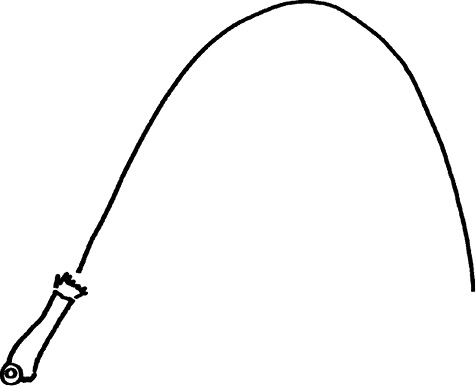
The missile goes up, then down, in a parabolic arc. Gravity makes all motion curve toward the earth; that’s among the fundamental facts of our physical life. But if we zoom in on a very short segment, the curve starts to look like this:
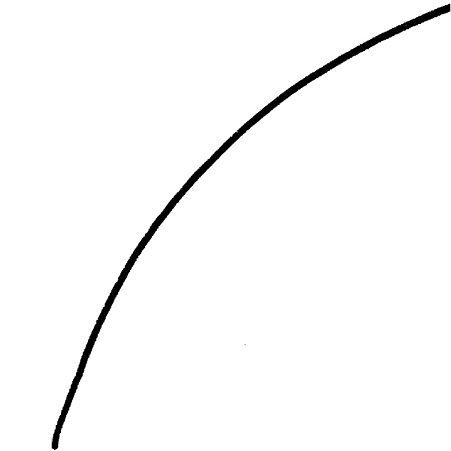
And then like this:
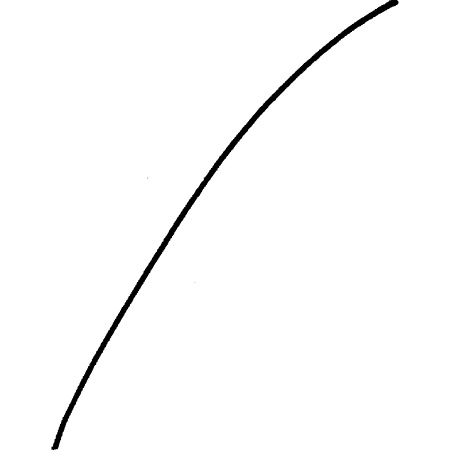
Just like the circle, the missile’s path looks to the naked eye like a straight line, progressing upward at an angle. The deviation from straightness caused by gravity is too small to see—but it’s still there, of course. Zooming in to an even smaller region of the curve makes the curve even more like a straight line. Closer and straighter, closer and straighter . . .
Now here’s the conceptual leap. Newton said, look, let’s go all the way. Reduce your field of view until it’s infinitesimal —so small that it’s smaller than any size you can name, but not zero. You’re studying the missile’s arc, not over a very short time interval, but at a single moment. What was almost a line becomes exactly a line. And the slope of this line is what Newton called the fluxion, and what we’d now call the derivative.
That’s a kind of jump Archimedes wasn’t willing to make. He understood that polygons with shorter sides got closer and closer to the circle—but he would never have said that the circle actually was a polygon with infinitely many infinitely short sides.
Some of Newton’s contemporaries, too, were reluctant to go along for the ride. The most famous objector was George Berkeley, who denounced Newton’s infinitesimals in a tone of high mockery sadly absent from current mathematical literature: “And what are these fluxions? The velocities of evanescent increments. And what are these same evanescent increments? They are neither finite quantities, nor quantities infinitely small, nor yet nothing. May we not call them the ghosts of departed quantities?”
And yet calculus works. If you swing a rock in a loop around your head and release it, its initial direction is tangent to the loop, as calculus predicts. It would continue at constant velocity if no other force acted; gravity and air resistance change its subsequent motion. That’s yet another Newtonian insight; objects in motion tend to proceed in a straight-line path, unless some other force intercedes to nudge the object one way or the other. That’s one reason linear thinking comes so naturally to us: our intuition about time and motion is formed by the phenomena we observe in the world. Even before Newton codified his laws, something in us knew that things like to move in straight lines, unless given a reason to do otherwise.
When to use it
Calculating the instantaneous velocity of a moving object from its position over time.
Optimizing a function to find maximum profit or minimum cost in business.
Modeling population growth with differential equations.
Designing curves in engineering, such as roller coaster loops, where smoothness (no sharp corners) is required.
FROM THEORY TO EVERYDAY LIFE
In practice
Missile Trajectory
In an idealized model without air resistance and with uniform gravity, a projectile follows a parabolic arc. A tangent line approximates the path near a point, and the derivative of position with respect to time gives the instantaneous velocity. The curve does not literally become a straight path.
Rock on a String
A released rock initially moves in the direction tangent to its circular path. It would continue straight at constant speed in the absence of other forces; gravity causes its later path to curve.
A MOMENT TO REFLECT
Put it to work.
How does the concept of infinitesimals help in understanding change and motion?
Where could studying small changes near a particular state help you understand a larger problem? What would a local approximation leave out?
Why might someone resist the leap from approximations to exact infinitesimals, as Berkeley did?
Often confused with
CONTINUE THE CONVERSATION
Source texts
- How Not to Be Wrong The Power of Mathematical Thinking (Ellenberg, Jordan)