Blocked by Openness
A mental block where an adequate solution prevents the search for a better one, because the current path seems sufficient and there is no awareness of alternatives. This is the core problem that lateral thinking aims to overcome.
THE IDEA
Blocked by openness 21
I knew the town quite well but I had to ask for instructions as to how to get to this particular restaurant. The instructions were easy to follow as the route was made up of three segments with each of which I was familiar for each of them involved some obvious landmark. The segments had been made familiar by ordinary driving around the town. One day some friends set out for the restaurant from the same place as myself and at the same time. But they got there long before I did. I asked them if they had driven quickly but they denied this. Then I asked them what route they had taken. They explained and it was obvious that they had taken a short cut as shown below.
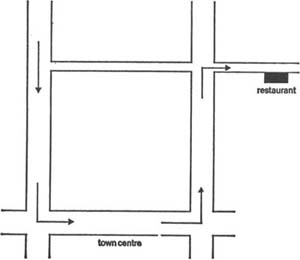
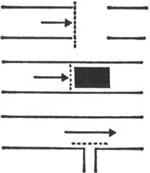
A small side turning had led them directly to the restaurant while I was making an unnecessary detour through the centre of the town. My own route had always seemed satisfactory so I had never looked for a shorter one. Nor had I ever been aware that there was a shorter one. I had driven past the small side turning each time but had never explored it because there had been no reason to explore it. And without exploring it I could never have found out how useful it was. My original instructions had been in terms of large well-known segments of route, cliché segments, because that is the easiest way to give instructions. There had never been any reason to break off along one of these cliché segments. There are three ways in which thinking can be blocked. These three ways are shown diagrammatically.
-
One is blocked by a gap. One cannot proceed further because the road runs out. One needs to find more road or to construct a bridge across the river. This is equivalent to having to look around for more information or having to generate some by experiment.
-
One is blocked by there being something in the way. Here there is a definite obstacle which bars progress. In order to go on one has to find a way of removing the obstacle or getting round it. Once this has been done progress is easy because the road is there. One can concentrate one’s problem solving efforts on overcoming the block.
-
One is blocked because there is nothing in the way. The road is smooth and clear and so one goes shooting past the important side turning unaware that it is even there. Here a particular way of looking at things leads one straight past a better way of looking at them. Because the first way is adequate one does not even consider that there might be another way — let alone look for it.
This third type of block is what happens when one is blocked by the adequate, blocked by openness. Trying to avoid this sort of block is what lateral thinking is all about. Instead of proceeding with the patterns that have been established on the memory surface of mind one tries to find short cuts to restructure the patterns. Like the route in the restaurant story the established patterns have been constructed out of familiar cliché segments. Even when the patterns are adequate this cannot exclude there being very much more effective patterns.
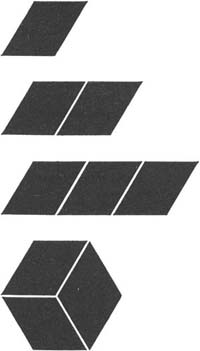
If things are put together in a certain way to give one pattern then this prevents them being put together in another way to give a different pattern. One way of arranging the three pieces shown overleaf excludes the other way. There is an exclusivity about patterns. Nevertheless a satisfactory pattern cannot preclude the possibility of there being a different and better arrangement. The trouble is that the different and better arrangement does not arise from the current pattern but arises instead of it. There is no logical reason to look for a better way of doing something if there is already an adequate way. Adequate is always good enough. It is interesting that in our thinking we have developed methods for dealing with things that are wrong but no methods for dealing with things that are right. When something is wrong we explore further. When something is right our thinking comes to a halt. That is why we need lateral thinking to break through this adequacy block and restructure patterns even when there is no need to do so.
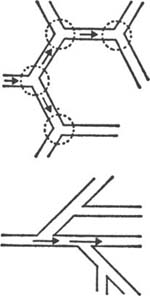
The difficulty with being blocked by openness is that there is no indication as to where the block has occurred. It might have occurred anywhere along the apparently correct pathway. Two types of branching pattern are shown on p. 235. In the first type there is a definite change of direction at each branch point. One has either to go right or left. This means that one is always aware of the branch points. In the second type of branching pattern the branches stem off a straight trunk. If you go along the main pathway you may not even be aware that there was a side branch or a choice point. One is blocked by the openness of the main pathway.
If one comes to a dead end in the first type of branching system one goes back to the branch point and tries the other branch. This can be done again and again for each branch point. But in the second type of branching pattern when one comes to a dead end one cannot just go back to the preceding branch point because one does not even know where the branch points are since one has never had to pause and make a choice at them.
Cliché patterns strung together constitute the trunk of a straight branching system. As one proceeds smoothly along them one is not even aware that there are possible side turnings. So when one comes to a dead end one does not know where to go.
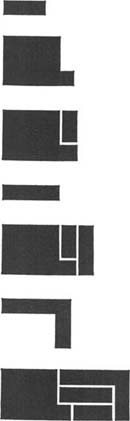
A plastic piece is shown overleaf. Another plastic piece is provided and the task is to arrange them both together to give a simple shape that would be easy to describe. The arrangement is obvious as shown. A further piece is added and once again the arrangement is obvious. When a fourth piece is added there is difficulty in fitting them all together. The original placing of the second piece so that it nestled in the angle of the first piece is such an obvious pattern that it becomes a cliché. And as a cliché one wants to use it, not disrupt it. This makes the final solution difficult since the small piece has to be placed in quite a different position.
Cliché patterns are satisfactory established patterns which are very useful and which do a good job. They can be used in three ways:
-
For communication. It is easier to explain a situation in terms of cliché patterns than to devise new patterns.
-
One picks out a cliché pattern more easily than other patterns from an environment that offers several alternative patterns.
-
Given only part of a pattern one elaborates this part to a whole pattern — but a cliché whole.
I was having lunch one day in a university cafeteria when I noticed sitting at another table a student with very long hair and a delicate, sensitive face. As I looked at the student I thought to myself that here was a person whose sex could not be determined by appearance. It was several minutes before I suddenly noticed that the student had a long straggling moustache! In my mind I had gone at once from the long hair and delicate face to the assumption that the student might be a girl and so I had never noticed the moustache.
 So it is in picking out cliché patterns that one is not even aware that alternative patterns could just as easily have been picked out.
If an ordinary letter is partially hidden under a piece of paper one elaborates the pattern to give the standard letter. Letters are cliché patterns and one only needs a hint in order to be able to elaborate the rest of the letter. It is easy enough to recognize letters in this way because one knows all the possibilities to begin with and also one knows that the pattern must be a letter. But suppose the patterns were not all letters but completely different patterns which were covered up so that the exposed bits did look like letters? One would elaborate the expected cliché pattern and one would be wrong. Or suppose that one did not know the shape of all the letters? The same thing would happen. In real life one is always elaborating patterns as if they could only be standard cliché patterns.
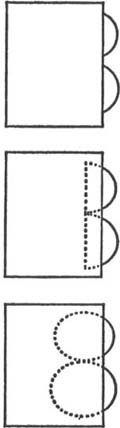
This process of being blocked by openness is very prevalent in thinking. In a way it is the basis of thinking for thinking has to make guesses and assumptions based on past experience. Useful as it is, the process has definite disadvantages especially in terms of new ideas and of bringing patterns up to date. This process of being blocked by openness is at the very centre of the need for lateral thinking. Lateral thinking is an attempt to find alternative pathways, an attempt to put things together in a new way, no matter how adequate the old way appears to be.
When to use it
When designing a new product, avoid relying solely on existing successful features and deliberately explore alternative approaches.
In personal habits, periodically question routines that work well to see if there is a more effective way.
During brainstorming sessions, encourage participants to challenge obvious solutions and search for unconventional pathways.
In problem-solving, when a solution seems to work, pause to consider if it's the best possible solution or just an adequate one.
FROM THEORY TO EVERYDAY LIFE
In practice
The Restaurant Route
The author knew a familiar route to a restaurant but never noticed a shortcut because the current route was adequate. Friends took the shortcut and arrived much faster.
Plastic Pieces Puzzle
Arranging plastic pieces into a shape becomes difficult when a fourth piece is added because the initial arrangement becomes a cliché that prevents seeing a new configuration.
The Student with a Moustache
De Bono initially thought that a student’s sex could not be determined from appearance. He later noticed a moustache he had overlooked while considering his first interpretation. The anecdote illustrates how an initial pattern can direct attention away from other details.
Partial Letter Recognition
When only part of a letter is visible, the mind elaborates the pattern to fit a standard letter, which can lead to errors if the hidden pattern is actually something else.
A MOMENT TO REFLECT
Put it to work.
Think of a time when you stuck with an adequate solution and missed a better one. What would have happened if you had actively looked for alternatives?
In your daily routines, what cliché patterns might be preventing you from finding more efficient ways?
How can you intentionally disrupt a successful pattern to discover new possibilities without waiting for a problem to arise?
Often confused with
CONTINUE THE CONVERSATION
Source texts
- Lateral Thinking A Textbook of Creativity (Edward de Bono)