Big Data and the Researcher's Option
The researcher's free option to select statistical results that confirm their beliefs, while discarding contradictory evidence, leads to a proliferation of spurious correlations in large datasets. This bias undermines the reliability of empirical research, especially as data volume grows faster than real information.
THE IDEA
BIG DATA AND THE RESEARCHER’S OPTION
This is a bit technical, so the reader can skip this section with no loss. But optionality is everywhere, and here is a place to discuss a version of cherry-picking that destroys the entire spirit of research and makes the abundance of data extremely harmful to knowledge. More data means more information, perhaps, but it also means more false information. We are discovering that fewer and fewer papers replicate—textbooks in, say, psychology need to be revised. As to economics, fuhgetaboudit. You can hardly trust many statistically oriented sciences—especially when the researcher is under pressure to publish for his career. Yet the claim will be “to advance knowledge.”
Recall the notion of epiphenomenon as a distinction between real life and libraries. Someone looking at history from the vantage point of a library will necessarily find many more spurious relationships than one who sees matters in the making, in the usual sequences one observes in real life. He will be duped by more epiphenomena, one of which is the direct result of the excess of data as compared to real signals.
We discussed the rise of noise in Chapter 7. Here it becomes a worse problem, because there is an optionality on the part of the researcher, no different from that of a banker. The researcher gets the upside, truth gets the downside. The researcher’s free option is in his ability to pick whatever statistics can confirm his belief—or show a good result—and ditch the rest. He has the option to stop once he has the right result. But beyond that, he can find statistical relationships—the spurious rises to the surface. There is a certain property of data: in large data sets, large deviations are vastly more attributable to noise (or variance) than to information (or signal).1
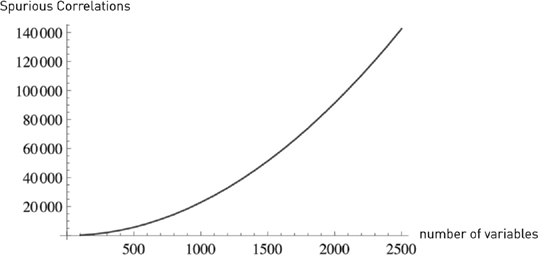
FIGURE 18. The Tragedy of Big Data. The more variables, the more correlations that can show significance in the hands of a “skilled” researcher. Falsity grows faster than information; it is nonlinear (convex) with respect to data.
There is a difference in medical research between (a) observational studies, in which the researcher looks at statistical relationships on his computer, and (b) the double-blind cohort experiments that extract information in a realistic way that mimics real life.
The former, that is, observation from a computer, produces all manner of results that tend to be, as last computed by John Ioannides, now more than eight times out of ten, spurious—yet these observational studies get reported in the papers and in some scientific journals. Thankfully, these observational studies are not accepted by the Food and Drug Administration, as the agency’s scientists know better. The great Stan Young, an activist against spurious statistics, and I found a genetics-based study in The New England Journal of Medicine claiming significance from statistical data—while the results to us were no better than random. We wrote to the journal, to no avail.
Figure 18 shows the swelling number of potential spurious relationships. The idea is as follows. If I have a set of 200 random variables, completely unrelated to each other, then it would be near impossible not to find in it a high correlation of sorts, say 30 percent, but that is entirely spurious. There are techniques to control the cherry-picking (one of which is known as the Bonferoni adjustment), but even then they don’t catch the culprits—much as regulation doesn’t stop insiders from gaming the system. This explains why in the twelve years or so since we’ve decoded the human genome, not much of significance has been found. I am not saying that there is no information in the data: the problem is that the needle comes in a haystack.
Even experiments can be marred with bias: the researcher has the incentive to select the experiment that corresponds to what he was looking for, hiding the failed attempts. He can also formulate a hypothesis after the results of the experiment—thus fitting the hypothesis to the experiment. The bias is smaller, though, than in the previous case.
The fooled-by-data effect is accelerating. There is a nasty phenomenon called “Big Data” in which researchers have brought cherry-picking to an industrial level. Modernity provides too many variables (but too little data per variable), and the spurious relationships grow much, much faster than real information, as noise is convex and information is concave.
Increasingly, data can only truly deliver via negativa–style knowledge—it can be effectively used to debunk, not confirm.
The tragedy is that it is very hard to get funding to replicate—and reject—existing studies. And even if there were money for it, it would be hard to find takers: trying to replicate studies will not make anyone a hero. So we are crippled with a distrust of empirical results, except for those that are negative. To return to my romantic idea of the amateur and tea-drinking English clergyman: the professional researcher competes to “find” relationships. Science must not be a competition; it must not have rankings—we can see how such a system will end up blowing up. Knowledge must not have an agency problem.
When to use it
Evaluating the validity of studies in psychology and medicine that rely on large datasets.
Designing experiments in data science to avoid false discoveries due to multiple comparisons.
Reading news articles about new scientific findings—question whether the researchers had a free option to select results.
Making policy decisions based on empirical evidence: prefer negative (debunking) knowledge over positive claims.
FROM THEORY TO EVERYDAY LIFE
In practice
Genetics Study in The New England Journal of Medicine
Stan Young and the author found a genetics-based study published in The New England Journal of Medicine that claimed significance from statistical data, but the results were no better than random. Researcher optionality can lead even top journals to publish spurious findings.
Observational vs. Double-Blind Studies in Medicine
Observational studies, where researchers look for patterns in existing data, produce spurious results more than 80% of the time (per John Ioannides). In contrast, double-blind cohort experiments mimic real life and are more reliable. The FDA does not accept observational studies for this reason.
A MOMENT TO REFLECT
Put it to work.
How can you guard against the temptation to cherry-pick results when analyzing a large dataset?
What methods can you use to distinguish between a genuine signal and noise in high-dimensional data?
Why is replication of studies crucial for scientific knowledge, and what incentives discourage it?
Often confused with
References
- Why Most Published Research Findings Are False — John Ioannidis (2005)
- Activist against spurious statistics — Stan Young
CONTINUE THE CONVERSATION
Source texts
- Antifragile (Nassim Nicholas Taleb)