Bermuda Triangle
Bermuda Triangle stories suggest that ships and planes face an unusual mysterious hazard. Harrison examines their publication history, Kusche’s investigations and statements from maritime authorities to show why unexplained individual losses do not establish that broader claim.
THE IDEA
BERMUDA TRIANGLE
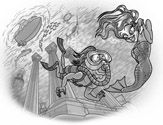
There is a mysterious zone over a patch of sea that functions as some kind of natural or supernatural black hole, sucking up ships and planes that are never to be heard from again. Is it a portal to another universe? Could there be extraterrestrial involvement? Is the lost city of Atlantis involved? All we know for sure is that something very strange and very dangerous is happening in the area known as the Bermuda Triangle. Wow! What an exciting claim! I have lived much of my life very close to the Bermuda Triangle. I’ve even gone swimming in it. How exciting! Too bad it’s nonsense.
One way to better understand and evaluate a weird claim such as the Bermuda Triangle is to look at its history. Where does it come from? Who was the first person to make the claim? What was the original context? How was the case for it first made? Finding the answers to such basic questions often sheds enough light on the belief to expose it as unworthy of your time. As we will see shortly, there are the usual problems with evidence and interpretation that slay the Triangle myth. But first, its origin makes it clear that this claim was hopelessly lost at sea from the start.
The earliest known mention of the Bermuda Triangle was an article in Argosy (February 1964). This was a pulp-fiction magazine that published fictional stories designed to excite and entertain young males. That’s right, it wasn’t the US Navy, the US Coast Guard, or National Geographic that broke the story and first alerted the world to the dangers of the Bermuda Triangle. No, it was a magazine that specialized in adventure fiction. The article’s author, Vincent Gaddis, was probably looking for nothing more than another freelance check and never imagined he would help to create one of the great myths of modern times. But he did. The publication venue alone does not settle the claim; the evidence about the incidents matters.
A writer named Charles Berlitz outdid Gaddis and really cashed in on the Triangle with his “nonfiction” bestseller The Bermuda Triangle in 1974.57 Against all reason, it was such a hit that it anchored the Bermuda Triangle in pop culture by convincing millions around the world that the threat was real and deadly. Sadly, it didn’t matter that he failed to present a convincing case based on facts and logic. Berlitz’s “evidence” consists of nothing more than a collection of outrageous, unproven claims and heavily embellished sea tales. Berlitz also wrote other books, such as Atlantis: The Eighth Continent and The Roswell Incident, whose “evidence” is of similarly questionable accuracy.58
For a comprehensive takedown of this belief, read Larry Kusche’s excellent book, The Bermuda Triangle Mystery—Solved.59 Kusche dismantles claim after claim and shows how a minor story, or a made-up story, can be twisted and embellished to seem like compelling evidence of something sinister and supernatural. For example, the tragic incident of Flight 19 is probably the most famous of all Triangle stories. According to Berlitz and other Triangle proponents, however, the five US Navy Avenger torpedo planes took off from Fort Lauderdale airbase on December 19, 1945, and in ideal flying conditions vanished without a trace in a way that defies any natural explanation. Kusche shows that an honest look at the facts reveals a different story, however. Flight 19’s commander was new to the base and unfamiliar with south Florida. He probably got his group lost, and they ran out of fuel before they could find land. They then ditched at sea, in the dark and in rough sea conditions. It should surprise no one that no wreckage was ever found. Heavy things like airplanes tend to sink in the ocean. Suddenly it doesn’t seem quite so paranormal, right?
This leads us to the greatest of all problems with the Bermuda Triangle claim: When planes and ships travel over water, bad things sometimes happen. We should expect this. Due to the nature of accidents at sea away from land, there are not always clear and obvious explanations available. But a mystery or unanswered questions is not proof of a supernatural or paranormal event. This is the problem with the Bermuda Triangle. People have attempted to explain many different incidents with one overall theory. But there is not one cause, supernatural or natural, for thousands of mishaps over many decades in this one area or any other. “My research, which began as an attempt to find as much information as possible about the Bermuda Triangle, had an unexpected result,” writes Kusche. “After examining all the evidence I have reached the following conclusion: there is no theory that solves the mystery. It is no more logical to try to find a common cause for all the disappearances in the Triangle than, for example, to try to find one cause for all automobile accidents in Arizona. By abandoning the search for an overall theory and investigating each incident independently, the mystery began to unravel.”60
I’m confident that ships and planes do not vanish in the Bermuda Triangle at a rate or in a manner that indicates there is anything unusual going on there. But I like to be thorough, so I checked with both the US Navy and the US Coast Guard, just to be safe. Neither organization seems worried about this. The US Navy has more reasons than anyone to be concerned about threats to ships and planes. After all, it routinely sends thousands of sailors and aviators into the zone, along with billions of dollars’ worth of ships, submarines, and aircraft. Yet the navy has gone on record rejecting any consideration of the Bermuda Triangle as an unusual threat to them.61
Finally, if anyone should know if there is anything to the Bermuda Triangle claim, possibly even more so than the US Navy, it would be the people who are specifically responsible for safety and rescue in and around the Triangle area. So I phoned the Miami station of the United States Coast Guard and spoke to an officer there who told me that they do not believe in the Bermuda Triangle story, nor do they give it any consideration when going about their duties. He also referred to this official statement by the Coast Guard:
The Coast Guard does not recognize the existence of the so-called Bermuda Triangle as a geographic area of specific hazard to ships or planes. In a review of many aircraft and vessel losses in the area over the years, there has been nothing discovered that would indicate that casualties were the result of anything other than physical causes. No extraordinary factors have ever been identified.62
Case closed. Mystery solved. Let’s have a long-overdue burial at sea for this one. The Bermuda Triangle needs to go back to being what it originally was: just a good story meant to entertain and not to be taken seriously by serious people. It’s a great campfire tale to tell the kids while vacationing in South Florida or the Caribbean but nothing more.
Harrison describes a revival of the Bermuda Triangle story after it appeared to fade in the 1990s. No doubt this is due to the abundance of misleading websites that promote its existence as historical truth and scientific fact. There has also been an avalanche of terribly misleading pseudo-documentaries about it on cable TV. These have modernized and popularized the myth for a whole new generation of uncritical thinkers.
When to use it
Evaluating sensational news stories by examining their sources and original context.
Teaching critical thinking skills by analyzing how a compelling narrative can override evidence.
Identifying the pitfalls of confirmation bias when people seek paranormal explanations for ordinary accidents.
Comparing proposed explanations for an incident by their evidence and assumptions, rather than treating unanswered questions as proof of a paranormal cause.
FROM THEORY TO EVERYDAY LIFE
In practice
Flight 19
Harrison recounts the story of five US Navy Avenger torpedo planes and gives their departure date as December 19, 1945. He contrasts supernatural accounts with Kusche’s reconstruction: a commander unfamiliar with the area could have become lost, exhausted the planes’ fuel and ditched at sea in rough conditions. This offers a natural explanation without requiring a mysterious zone.
Coast Guard and Navy Rejection
Both the US Navy and the US Coast Guard have officially stated that the Bermuda Triangle is not a geographic area of special hazard. Their records show no evidence of anything beyond normal physical causes for accidents.
A MOMENT TO REFLECT
Put it to work.
What other popular myths or sensational claims might be debunked by tracing their origins and checking with authoritative sources?
How does the Bermuda Triangle myth illustrate the danger of seeking a single overarching explanation for disparate events?
In what ways do modern media (websites, pseudo-documentaries) revive and spread beliefs that have been thoroughly discredited?
References
- Argosy article (February 1964) — Vincent Gaddis (1964)
- The Bermuda Triangle — Charles Berlitz (1974)
- The Bermuda Triangle Mystery—Solved — Larry Kusche
- US Coast Guard statement (via phone interview) — US Coast Guard
CONTINUE THE CONVERSATION
Source texts
- Think (Guy P. Harrison)