Availability Heuristic: The Role of Subjective Ease of Recall
The availability heuristic uses ease of recall to judge frequency or probability. In the experiment described here, people’s estimates changed when they were given different explanations for why recalling words felt easy, indicating a role for subjective experience beyond the number recalled.
THE IDEA
Table 5.1. Frequency of Words Having t as the First or Third Letter
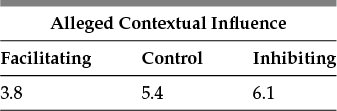
Note: N is 9 or 10 per condition. Shown are mean ratings along an 8-point scale, with 1 = “many more third-letter words than first-letter words” and 8 = “many more first-letter words than third-letter words.” Adapted from Wänke, Schwarz, and Bless (1995).
As in the original study, this inference may either be based on the experience that words beginning with t came to mind more easily, or on the observation that they could recall a larger number of these words (although they were only asked to record 10). To isolate the role of experienced ease, the diagnosticity of the experience was manipulated in two experimental conditions. Specifically, participants had to record 10 words that begin with t on a sheet of paper that was imprinted with pale but visible rows of t s. Some participants were told that this background would make it easy to recall words beginning with t (“facilitating condition”), whereas others were told that this background would interfere with the recall task (“inhibiting condition”). As expected, participants who could attribute the experienced ease of recall to the impact of their work sheet assumed that there are fewer words beginning with t than participants in the control condition. Conversely, participants who expected their worksheet to interfere with recall but found recall easy nevertheless estimated that there are more words beginning with t than did participants in the control condition.
In combination, the obtained discounting and augmentation effects indicate that participants did indeed base their frequency estimates on the subjective experience of ease of recall, rather than on the number of words they could bring to mind. Moreover, the misattribution effects obtained here have been replicated in other domains addressed later (e.g., Haddock et al., 1999; Schwarz et al., 1991). Hence, we may conclude that recall experiences are informative in their own right, much as has been observed for other types of experiential information (for reviews see Clore, 1992; Schwarz, Chapter 29, this volume; Schwarz & Clore, 1996; Strack, 1992).
When to use it
Risk assessment: After seeing dramatic news coverage of plane crashes, people overestimate the frequency of such accidents because vivid examples come to mind easily.
Performance evaluation: Managers may overestimate the prevalence of a behavior if recent or striking examples are easily recalled, ignoring base rates.
Public opinion: Poll results can be skewed if respondents rely on easily recalled instances rather than statistical aggregates.
Self-assessment: Individuals may judge their own abilities based on how easily they recall past successes rather than objective performance data.
FROM THEORY TO EVERYDAY LIFE
In practice
Estimating Words Starting with 't'
Participants listed 10 words beginning with 't' on a sheet with faint 't' patterns. Some were told the pattern would help recall; others were told it would interfere. Participants who expected help could attribute easy recall to the worksheet and estimated fewer words than the control group. Those who expected interference but nevertheless found recall easy estimated more. The manipulation changed how they interpreted the experience of recall.
A MOMENT TO REFLECT
Put it to work.
Recall a time you judged the likelihood of an event based on how easily examples came to mind. How might your judgment have been biased by the subjective ease of recall rather than actual frequency?
Think of a scenario where you attributed the ease of recalling examples to an external factor (e.g., a vivid story). How did that affect your estimate?
How could marketers or politicians manipulate your perception of frequency by making certain examples more memorable?
References
- — Wänke, Schwarz, and Bless (1995)
- Chapter 29 — Schwarz
CONTINUE THE CONVERSATION
Source texts
- Heuristics and Biases The Psychology of Intuitive Judgment (Thomas Gilovich, Dale Griffin, Daniel Kahneman)