Atoms, Molecules, and Ions
An element is defined by the number of protons in its atoms; isotopes differ in neutron count. Molecules contain bonded atoms, while ions carry a net electric charge. Chemical reactions rearrange atoms and electrons without changing the elements involved.
THE IDEA
Atoms, Molecules, and Ions
All matter originates and exists only by virtue of a force which brings the particle of an atom to vibration and holds this most minute solar system of the atom together… We must assume behind this force the existence of a conscious and intelligent mind. This mind is the matrix of all matter.
—Max Planck
An atom has a small, dense nucleus surrounded by electrons. Its protons carry positive charge; electrons carry negative charge. Neutrons are electrically neutral. Hydrogen-1, the common stable hydrogen isotope, has no neutrons.
The number of protons defines the element. Atoms of that element with different neutron counts are its isotopes. An atom with equal numbers of protons and electrons is electrically neutral.
Subatomic Particles
Electrons have much less mass than protons or neutrons, so their contribution is often neglected in approximate atomic-mass calculations. A proton has a mass of about 1 atomic mass unit, or amu, and a neutron also has a mass of about 1 atomic mass unit. Their charges differ, but their masses are similar.
Molecules and Ions
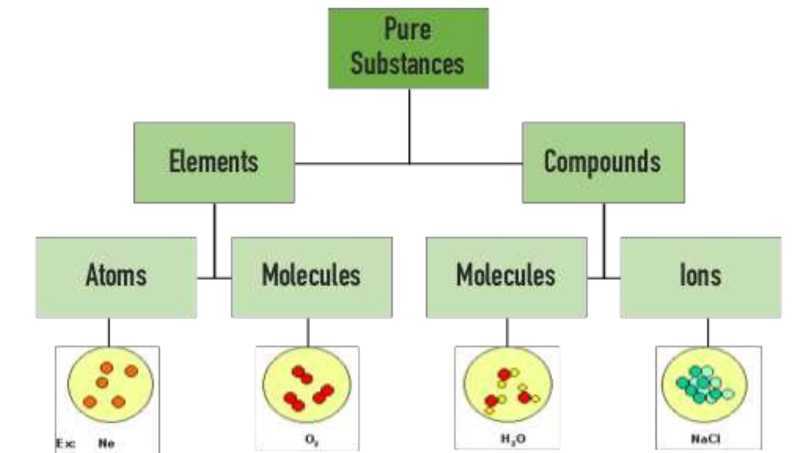
A molecule consists of atoms held together by chemical bonds. An ion is an atom or group of atoms with a net electric charge. An ion with more electrons than protons is an anion; one with fewer electrons is a cation. Not all ions are single atoms. A charged group of bonded atoms is a polyatomic ion.
Dalton’s Atomic Theory
Dalton’s theory helped explain chemical reactions in terms of atoms:
- Elements consist of atoms.
- Dalton proposed that atoms of a given element were identical. The later discovery of isotopes qualified this claim.
- Ordinary chemical reactions rearrange atoms rather than create or destroy them, providing the chemical account of conservation of matter.
- Atoms of different elements combine chemically to form compounds.
These chemical principles should not be confused with a claim that matter and energy are separately unchangeable in nuclear reactions.
When to use it
Understanding the periodic table organization: The atomic number (number of protons) determines the element's identity and chemical behavior.
Predicting chemical bonding: Electrons are gained, lost, or shared to form ions or molecules, such as in the formation of ionic compounds (salts) or covalent compounds (water).
Nuclear energy and isotopes: The number of neutrons defines isotopes, some of which are radioactive and used in medicine or energy.
FROM THEORY TO EVERYDAY LIFE
In practice
Hydrogen Atom
The most common isotope of hydrogen has one proton and one electron, with zero neutrons. It is the simplest and lightest atom.
Sodium Ion Formation
When sodium (Na) loses its single valence electron, it becomes a positively charged sodium ion (Na+). This often occurs when sodium bonds with chlorine, which gains an electron to become the negatively charged chloride ion (Cl-), forming table salt (NaCl).
A MOMENT TO REFLECT
Put it to work.
How does the concept of an ion explain why pure water is a poor conductor of electricity, but salt water conducts well?
If atoms of the same element are identical, how can there be different isotopes like hydrogen-1, hydrogen-2 (deuterium), and hydrogen-3 (tritium)?
Why is the law of conservation of matter/energy important in understanding chemical reactions?
CONTINUE THE CONVERSATION
Source texts
- Wisdom Theory 100 Mental Models (2020) (Wisdom Theory)