Appreciative Inquiry (AI Model)
Appreciative Inquiry develops strengths and promising possibilities. The source illustrates the approach with four responses to suggestions, contrasting early rejection with a willingness to build on an idea.
THE IDEA
THE AI MODEL
WHAT KIND OF DISCUSSION TYPE ARE YOU?
The abbreviation AI stands for Appreciative Inquiry, a method attributed to the American management expert David Cooperrider that involves concentrating on the strengths, positive attributes and potential of a company or a person, rather than weaknesses. “What is going really well at the moment?” replaces the classic question “What is the problem?” Concentrating on weakness creates a negative impression from the outset.
Every person, every system, every product, every idea has faults. In the best-case scenario, an awareness of this fact can lead to a determined pursuit of perfection. But in many cases, focusing too strongly on the flaws of an idea or project stifles the open and positive approach that is essential for good working practices. The basic principle is to take an idea that is not yet fully developed and to continue developing it, instead of prematurely abandoning it.
The book illustrates different responses to suggestions with four conversational labels. A person may use different responses in different situations:
• The fault-finder: “The idea is good, but…” • The dictator: “No!” • The schoolteacher: “No, the idea isn’t good because…” • The AI thinker: “Yes, and we could also…”
Any fool can criticize. And most fools do. Benjamin Franklin
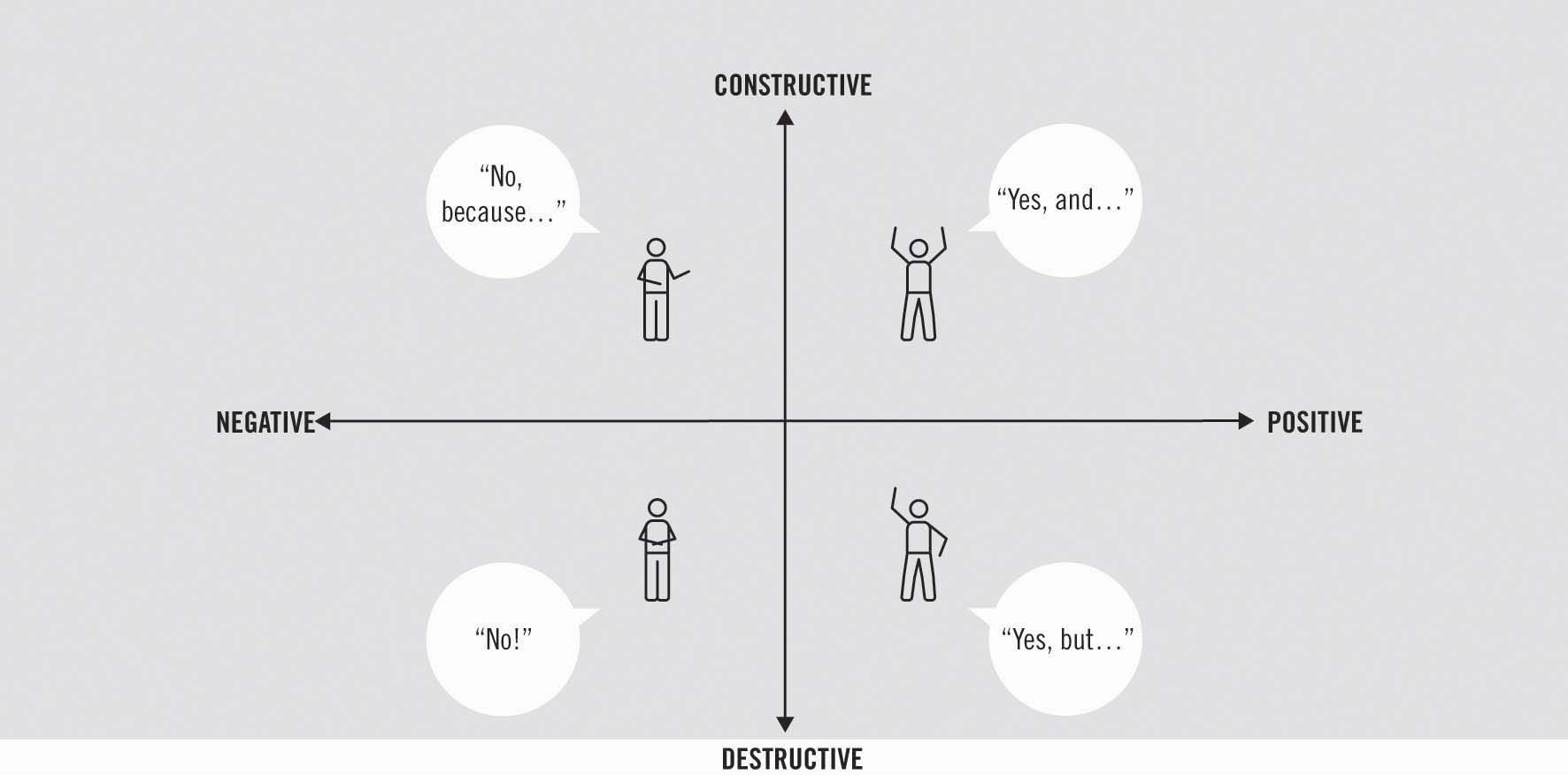
The next time you are in a group discussion, make a note of how each person presents their arguments.
When to use it
Brainstorming sessions to encourage creative ideas.
Performance evaluations to motivate employees.
Strategic planning to identify organizational strengths.
Conflict resolution by focusing on common goals and positive outcomes.
FROM THEORY TO EVERYDAY LIFE
In practice
Using AI in a Team Meeting
During a brainstorming session, instead of shooting down ideas, team members practice AI by saying 'Yes, and we could also...' This encourages creative collaboration.
Appreciative Inquiry in Performance Reviews
In a performance review, a manager asks what has gone well, which strengths contributed, and how the employee could build on them. Specific problems can still be discussed rather than excluded by a rule to remain positive.
A MOMENT TO REFLECT
Put it to work.
In your next group discussion, identify which of the four types you tend to be. How can you adopt the AI thinker stance more often?
Think of a recent project. What positive aspects did you overlook because you were focusing on problems?
How might applying Appreciative Inquiry change the dynamics of your team meetings?
Often confused with
CONTINUE THE CONVERSATION
Source texts
- The Decision Book Fifty Models for Strategic Thinking