Aporetic Meditations
A concept from Cynefin framework highlighting a state of aware confusion (aporia) where one recognizes being stuck and adopts reflexive methods to explore paradoxes and unknowns, enabling new sense-making and decision-making.
THE IDEA
Aporetic Meditations
The Aporetic/Confused (A/C) distinction in Cynefin separates awareness of confusion from a state in which that confusion goes unrecognized.
The development of the A/C domain took place over two years. Two St David’s Days marked iterations of Cynefin – first, in 2019, where Dave introduced the liminal domain, (4) then in 2020, when he renamed Disorder – the often overlooked domain in the center of the Framework – “Confused.” (5)
Combining the Confused domain with the idea of liminality allowed A/C to emerge. (5)
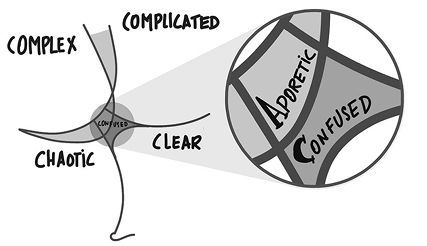
Figure 3. In Dave Snowden’s annual St David’s Day series in 2019, he introduced the update of Cynefin with liminal (to the left), and in his 2020 iteration, Dave introduced the update with A/C (to the right).
When we look at these two iterations side-by-side, the evolution of the Framework becomes clearer. When we are in any of the four domains of either Clear, Complicated, Complex or Chaotic, there are appropriate actions that can be taken. The Confused domain refers to a state of not knowing where to situate ourselves in the rest of Cynefin. It is, therefore, challenging to make decisions or take appropriate action.
The carving out of A/C introduces nuance to the state of confusion. In Confusion alone we might be unaware that we are confused and choose to proceed with familiar actions and solutions without much thought. We tend to be led by yesterday’s “knowns” even though the situation has evolved. This is a dangerous state of ignorant confusion that may cause us to take a not so shallow dive into Chaos.
The Aporetic domain highlights the importance of reflexivity and awareness of one’s state of confusion. In the Aporetic domain, we are well aware that we are confused and we know that we need to adopt different ways of learning, perceiving, interpreting, and exploring to work our way out. Aporia was introduced by Aristotle to describe a state of impasse in our thinking. Translating from the Greek root of the word, “‘a’ not + ‘poros’, path or passage”, aporia means no way through. (6)
“The aporia of our thinking points to a knot in the object; for in so far as our thoughts are in aporia... it is impossible to go forward.” (7) Aristotle also emphasized that the undoing of this “knot” can only be done by those who are aware of this impasse. In the Aporetic/Confused domain, we place importance on our awareness of being in a new type of confusion. This awareness is what shifts the Aporetic from domain to method.
The Aporetic turn refers to the method of intentionally creating doubt and paradox, so we may explore the many contrasting truths present in this space. We may be concerned with a lack of, or contradictory information, differing perceptions, ethical dilemmas, resource constraints – and how all these concerns impact each other. There are also unknown unknowns and questions we haven’t thought to ask yet. The Aporetic method facilitates discussion across the many interconnected parts of the problem.
When to use it
Facilitating team discussions when facing contradictory information or ethical dilemmas.
Strategic planning in volatile or uncertain environments where traditional approaches fail.
Designing interventions for wicked problems that require exploration of unknown unknowns.
Improving individual and group reflexivity during complex problem-solving.
FROM THEORY TO EVERYDAY LIFE
In practice
Team grappling with a wicked problem
A product team realizes it does not know which Cynefin domain fits its problem. Members compare contradictory information, surface ethical dilemmas and ask which questions they have not examined. The discussion helps them explore the confusion before committing to a familiar solution.
Strategic planning in uncertain environment
An organization faces conflicting market signals and internal disagreements. Leaders acknowledge their confusion and use the aporetic turn to intentionally create doubt, exploring multiple contrasting truths before deciding on a course of action.
A MOMENT TO REFLECT
Put it to work.
When have you experienced a state of confusion in a complex situation? Were you aware of it, or did you proceed with familiar actions?
How can you intentionally create doubt and paradox in your decision-making process to explore contrasting truths?
What methods can you use to become more aware of your own confusion and shift from ignorant confusion to aporetic awareness?
Often confused with
References
- St David's Day series – Liminal Domain — Dave Snowden (2019)
- St David's Day series – Confused Renamed — Dave Snowden (2020)
- Aristotle on Aporia — Aristotle
CONTINUE THE CONVERSATION
Source texts
- Cynefin - Weaving Sense-Making into the Fabric of Our World ED02 (Dave Snowden Sonja Blignaut Zhen Goh)