Anchoring Heuristic (I'm As Good As My Last Trade)
People's decisions are influenced by arbitrary reference points (anchors), and they react to changes from that anchor rather than absolute values, leading to inconsistent preferences and biases.
THE IDEA
WHERE IS NAPOLEON WHEN WE NEED HIM?
If your mind operates through disconnected rules, those rules may be inconsistent. Even when they do the job locally, they may not work globally. Consider them stored as a rulebook of sorts. Your reaction will depend on which page of the book you open to at any point in time. I will illustrate it with a socialist example.
After the collapse of the Soviet Union, Western businesspeople involved in what became Russia discovered an annoying (or entertaining) fact about the legal system: It had conflicting and contradictory laws. It just depended on which chapter you looked up. I don't know whether the Russians wanted it as a prank (after all, they lived long, humorless years of oppression) but the confusion led to situations where someone had to violate a law to comply with another. I have to say that lawyers are quite dull people to talk to; talking to a dull lawyer who speaks broken English with a strong accent and vodka breath can be quite straining—so you give up. This spaghetti legal system came from the piecewise development of the rules: You add a law here and there and the situation is too complicated as there is no central system that is consulted every time to ensure compatibility of all the parts together. Napoleon faced a similar situation in France and remedied it by setting up a top-down code of law that aimed to dictate a full logical consistency. The problem with us humans is not so much that no Napoleon has showed up so far to dynamite the old structure then reengineer our minds like a big central program; it is that our minds are far more complicated than just a system of laws, and the requirement for efficiency is far greater.
Consider that your brain reacts differently to the same situation depending on which chapter you open to. The absence of a central processing system makes us engage in decisions that can be in conflict with each other. You may prefer apples to oranges, oranges to pears, but pears to apples—it depends on how the choices are presented to you. The fact that your mind cannot retain and use everything you know at once is the cause of such biases. One central aspect of a heuristic is that it is blind to reasoning.
“I’m As Good As My Last Trade” and Other Heuristics
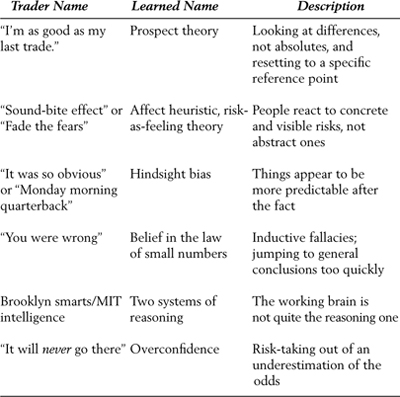
There exist plenty of different catalogues of these heuristics in the literature (many of them overlapping); the object of this discussion is to provide the intuition behind their formation rather than list them. For a long time we traders were totally ignorant of the behavioral research and saw situations where there was with strange regularity a wedge between the simple probabilistic reasoning and people's perception of things. We gave them names such as the “I’m as good as my last trade” effect, the “sound-bite effect,” the “Monday morning quarterback” heuristic, and the “It was obvious after the fact” effect. It was both vindicating for traders’ pride and disappointing to discover that they existed in the heuristics literature as the “anchoring,” the “affect heuristic,” and the “hindsight bias” (it makes us feel that trading is true, experimental scientific research). The correspondence between the two worlds is shown in Table 11.1.
I start with the “I’m as good as my last trade” heuristic (or the “loss of perspective” bias)—the fact that the counter is reset at zero and you start a new day or month from scratch, whether it is your accountant who does it or your own mind. This is the most significant distortion and the one that carries the most consequences. In order to be able to put things in general context, you do not have everything you know in your mind at all times, so you retrieve the knowledge that you require at any given time in a piecemeal fashion, which puts these retrieved knowledge chunks in their local context. This means that you have an arbitrary reference point and react to differences from that point, forgetting that you are only looking at the differences from that particular perspective of the local context, not the absolutes.
Table 11.1 Trader and Scientific Approach
There is the well-known trader maxim “life is incremental.” Consider that as an investor you examine your performance like the dentist in Chapter 3, at some set interval. What do you look at: your monthly, your daily, your life-to-date, or your hourly performance? You can have a good month and a bad day. Which period should dominate?
When you take a gamble, do you say: “My net worth will end up at $99,000 or $101,500 after the gamble” or do you say “I lose $1,000 or make $1,500?” Your attitude toward the risks and rewards of the gamble will vary according to whether you look at your net worth or changes in it. But in fact in real life you will be put in situations where you will only look at your changes. The fact that the losses hurt more than the gains, and differently, makes your accumulated performance, that is, your total wealth, less relevant than the last change in it.
This dependence on the local rather than the global status (coupled with the effect of the losses hitting harder than the gains) has an impact on your perception of well-being. Say you get a windfall profit of $1 million. The next month you lose $300,000. You adjust to a given wealth (unless of course you are very poor) so the following loss would hurt you emotionally, something that would not have taken place if you received the net amount of $700,000 in one block, or, better, two sums of $350,000 each. In addition, it is easier for your brain to detect differences rather than absolutes, hence rich or poor will be (above the minimum level) in relation to something else (remember Marc and Janet). Now, when something is in relation to something else, that something else can be manipulated. Psychologists call this effect of comparing to a given reference anchoring. If we take it to its logical limit we would realize that, because of this resetting, wealth itself does not really make one happy (above, of course, some subsistence level); but positive changes in wealth may, especially if they come as “steady” increases. More on that later with my discussion of option blindness.
Other aspects of anchoring. Given that you may use two different anchors in the same situation, the way you act depends on so little. When people are asked to estimate a number, they will position it with respect to a number they have in mind or one they just heard, so “big” or “small” will be comparative. Kahneman and Tversky asked subjects to estimate the proportion of African countries in the United Nations after making them consciously pull a random number between 0 and 100 (they knew it was a random number). People guessed in relation to that number, which they used as anchor: Those who randomized a high number guessed higher than those who randomized a low one. This morning I did my bit of anecdotal empiricism and asked the hotel concierge how long it takes to go to the airport. “40 minutes?” I asked. “About 35,” he answered. Then I asked the lady at the reception if the journey was 20 minutes. “No, about 25,” she answered. I timed the trip: 31 minutes.
This anchoring to a number is the reason people do not react to their total accumulated wealth, but to differences of wealth from whatever number they are currently anchored to. This is the major conflict with economic theory, as according to economists, someone with $1 million in the bank would be more satisfied than if he had half a million. But we saw John reaching $1 million having had a total of $10 million; he was happier when he only had half a million (starting at nothing) than where we left him in Chapter 1. Also recall the dentist whose emotions depended on how frequently he checked his portfolio.
When to use it
When negotiating a salary, the first number mentioned can act as an anchor for the final agreement.
In investing, checking portfolio performance frequently can lead to anchoring on recent changes rather than long-term goals.
During product pricing, setting a high initial price can anchor customers' perception of value.
FROM THEORY TO EVERYDAY LIFE
In practice
Estimating African UN Members
Subjects were asked to estimate the proportion of African countries in the UN after being given a random number between 0 and 100. Those with a high anchor guessed higher than those with a low anchor.
Hotel Concierge Journey Time
Taleb suggested a 40-minute journey to the hotel concierge, who estimated 35 minutes. He then suggested 20 minutes to the receptionist, who estimated 25 minutes. The actual trip took 31 minutes.
A MOMENT TO REFLECT
Put it to work.
How does anchoring affect your financial decisions when you consider gains and losses relative to a reference point?
Can you identify a situation where your decision was influenced by an arbitrary anchor, such as a suggested price or a past experience?
How might you counteract the anchoring bias in your own judgments?
Often confused with
CONTINUE THE CONVERSATION
Source texts
- Fooled by Randomness The Hidden Role of Chance in the Markets and in Life (Nassim Nicholas Taleb)