Alternative Descriptions of Patterns
This heuristic encourages looking at a pattern in multiple ways by focusing on different elements (e.g., large squares, small squares, lines, spaces). It then extends to generating multiple methods of performing a task, such as dividing a square into four equal pieces in various ways.
THE IDEA
Describe the same pattern in several workable ways. Each description should make clear what you are looking at: large squares, small squares, combinations of both, lines, spaces, or the whole grid.
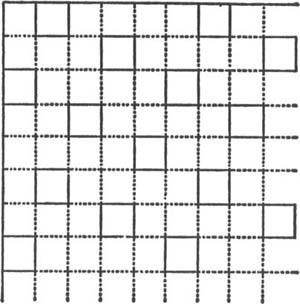

Activity
Extend the exercise from different descriptions to different ways of doing a task. Describing selects features already present; devising a method requires creating an arrangement.
- How would you divide a square into four equal pieces? (For this example it is better that each student tries to draw as many different versions as he can instead of just watching the board and offering a new approach. At the end the papers may be collected if the teacher wants to analyse the results or be left with the students for them to tick off the various versions.)
When to use it
Brainstorming sessions to generate diverse ideas by reframing the problem from multiple angles.
Design thinking workshops to explore different user experiences by describing the same interaction in various contexts.
Educational exercises to teach creativity and flexible thinking, such as having students describe a single object in multiple ways.
Problem-solving when stuck on a single approach, by deliberately listing alternative descriptions or methods for the same task.
FROM THEORY TO EVERYDAY LIFE
In practice
Dividing a Square into Four Equal Parts
There are many ways to divide a square into four equal parts, such as using two diagonal lines, two perpendicular lines through the center, four smaller squares, or even irregular shapes that are equal in area. This exercise illustrates how a simple geometric problem can have multiple valid solutions, encouraging a flexible mindset.
Describing a Triangular Pattern
Consider a pattern of overlapping triangles. One could describe it in terms of individual triangles, groups of triangles forming larger shapes, the empty spaces between them, or the lines that make up the boundaries. Each description reveals a different aspect of the same pattern, useful for analysis or creative reinterpretation.
A MOMENT TO REFLECT
Put it to work.
In what other ways can you describe the pattern of your daily routine? What new insights does each description give?
How can looking at a problem from a different perspective lead to new solutions? Think of a recent challenge and apply at least three different viewpoints.
What are some common patterns in your field that are often seen in only one way? How might varying the description change the approach?
CONTINUE THE CONVERSATION
Source texts
- Lateral Thinking A Textbook of Creativity (Edward de Bono)