Affective Forecasting: The Psychological Immune System in Political Losses
In the election study described here, participants whose candidate lost later evaluated the winner more positively than they had expected. The authors treat this as preliminary support for the idea that people underestimate their emotional adaptation.
THE IDEA
Table 16.3. Affective Forecasts and Experiences of Participants in the Election Study
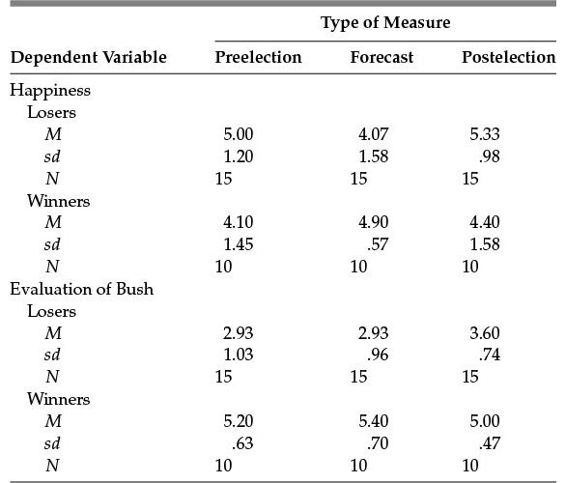
Note: Greater values indicate greater actual or predicted happiness, or more positive actual or predicted evaluation.
Why did Losers overestimate the duration of their affective reactions? Our hypothesis suggests that Losers’ psychological immune systems transformed their negative affect in ways they could not foresee, and the data provide some preliminary support for that suggestion. The data in Table 16.3 show that neither Winners nor Losers expected their evaluations of Bush to change after he won the election. In fact, Winners did evaluate Bush after the election precisely as they had evaluated him before the election. However, Losers changed their minds! That is, Losers evaluated Bush more positively after the election than they had before. In short, Losers underestimated their ability to grow quite quickly fond of a governor with whom they were, quite frankly, stuck. It is worth noting that new governors do not take office 1 month after an election, and thus the governor-elect’s official actions could not have been responsible for any changes in citizens’ evaluations of him.
When to use it
After a job rejection, compare your current feelings with your earlier prediction and notice which changes you did or did not anticipate.
When considering a move, examine how accurately you predicted emotional adjustment to past changes.
After an election, measure changes in voters’ evaluations rather than assuming that all supporters of losing candidates will become more positive.
FROM THEORY TO EVERYDAY LIFE
In practice
Election Study (1992 Label Unverified)
The supplied passage describes an election for governor, not a presidential election. Participants whose candidate lost evaluated Bush more positively after one month than before the election. The authors offer psychological adaptation as a possible explanation, with preliminary support.
Everyday Affective Forecasting
Before a possible rejection, an applicant predicts how they will feel and for how long. Recording those expectations lets them compare the forecast with their later experience, including any adaptation they did not anticipate.
A MOMENT TO REFLECT
Put it to work.
Think of a time you were disappointed by a loss. How did your actual emotional recovery compare with your initial predictions?
Why do we often underestimate our ability to adapt to new circumstances, especially after a negative event?
How might awareness of the psychological immune system change the way you make decisions about major life changes?
CONTINUE THE CONVERSATION
Source texts
- Heuristics and Biases The Psychology of Intuitive Judgment (Thomas Gilovich, Dale Griffin, Daniel Kahneman)