Affective Forecasting (Impact Bias)
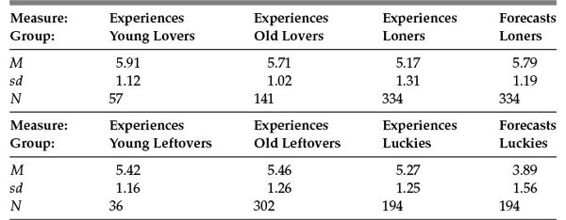
Affective forecasting means predicting how you will feel; impact bias is overestimating the intensity or duration of that response. In the reported breakup study, forecasts of post-breakup happiness were lower than the happiness reported by participants who had experienced breakups.
THE IDEA
Table 16.1. Affective Forecasts and Experiences of Participants in the Breakup Study
Note: Greater values indicate greater actual or predicted happiness.
Consider now the experience of breaking up. As the bottom portion of Table 16.1 shows, Luckies were not happier than Young Leftovers or Old Leftovers, which suggests that experiencing a breakup does not necessarily decrease one’s happiness. Nonetheless, Luckies estimated that 2 months after breaking up, they would be significantly less happy than they currently were. Indeed, Luckies’ estimates of how much less happy they would be 2 months after becoming Leftovers were inaccurate inasmuch as Luckies’ forecasts differed significantly and substantially from the experiences of both Old Leftovers and Young Leftovers. In short, (a) Luckies were not happier than Leftovers; (b) Luckies expected that the dissolution of a romantic relationship would decrease their happiness; and (c) Luckies estimated that if they were to become Leftovers, they would be much less happy than Old Leftovers and Young Leftovers actually turned out to be. It is worth noting that there were no differences between the forecasts of Luckies who were currently in a romantic relationship and Luckies who were not currently in a romantic relationship.
When to use it
Deciding whether to end a relationship, considering the emotional aftermath
Planning for the emotional impact of a career change
Predicting how you'll feel after a loss or failure to make risk assessments
Understanding public reactions to events to design better policies or interventions
FROM THEORY TO EVERYDAY LIFE
In practice
Breakup Study
In the reported study, Luckies predicted lower happiness after a breakup than Young Leftovers and Old Leftovers reported. The excerpt also says forecasts did not differ between Luckies currently in a relationship and those not in one, so the group should not be described simply as people still in relationships.
A MOMENT TO REFLECT
Put it to work.
Think of a time you predicted a future event would make you very unhappy. Did it turn out as expected?
How might affective forecasting influence major life decisions like changing jobs or moving?
Can you identify a situation where you overestimated the duration of emotional impact from a negative event?
CONTINUE THE CONVERSATION
Source texts
- Heuristics and Biases The Psychology of Intuitive Judgment (Thomas Gilovich, Dale Griffin, Daniel Kahneman)